

The Five Warnings of Hebrews
Related MediaPreface
Today we are living in a period of time like the days of Noah when there is no fear of God before men’s eyes (Rom. 3:18). The unsaved know the judgment of God is upon those who do such things as they do today, yet they not only do them but they have pleasure in them that do them (Rom. 1:32). They are treasuring up for themselves wrath against the day of wrath and revelation of the righteous judgments of God (Rom. 2:5).
What is even worse than this, if such could be the case, is that the saved have no fear of God before their eyes. You do not love someone you do not respect. “The fear of the Lord is the beginning of wisdom: and the knowledge of the holy is understanding” (Prov. 9:10; cf. 1:7). “The fear of the Lord is to hate evil” (Prov. 8:13). The early church had a correct godly fear of God, and this is the reason they went out and turned the world ‘right-side-up.’ Notice this in Acts:
Acts 2:42-43 And they were continually devoting themselves to the apostles’ teaching and to fellowship, to the breaking of bread and to prayer. And everyone kept feeling a sense of awe; and many wonders and signs were taking place through the apostles.
Acts 5:5, 11 And as he heard these words, Ananias fell down and breathed his last; and great fear came upon all who heard of it. 6 And the young men arose and covered him up, and after carrying him out, they buried him. 11 And great fear came upon the whole church, and upon all who heard of these things.
Acts 9:31 So the church throughout all Judea and Galilee and Samaria enjoyed peace, being built up; and, going on in the fear of the Lord and in the comfort of the Holy Spirit, it continued to increase. (cf. 19:17).
May God be pleased to use these pages to help stem the tide of fearlessness among believers today. “Let us have grace whereby we may serve God acceptably with reverence and godly fear: for our God is a consuming fire” (Heb. 12:28-29). “Then they that feared the Lord spake often one to another: and the Lord hearkened, and heard it, and a book of remembrance was written before him for them that feared the Lord, and that thought upon his name” (Mal. 3:16).
So Great Salvation— Hebrews: Synthesis
Outline:
I. Christ Alone Qualifies In His Person to Attempt Salvation, (1:1–4:13)
The Son: (Eternal, 1:1-3) …Christ … Prophet
A. Greater than the Prophets (1:1-3)
B. Greater than the Angels (1:4–2:18)
C. Greater than Moses (Ch. 3)
D. Greater than Joshua (4:1-13)
II. Christ Alone Qualifies In His Work to Provide Salvation (4:14–10:18)
The Savior: (Perfect, 7:24-28) … Jesus … Priest
A. The High Priest (4:14–7:28) THE SERVICE: “After the order of Melchisedek”
B. The Tabernacle (8:1–9:11) THE SANCTUARY: “Not made with hands”
C. The Sacrifice (9:12–10:18) THE SACRIFICE: “Once for all”
III. Christ Alone Qualifies In His Position to Effect Salvation (10:19–13:25)
The Shepherd (Great): (13:20) … The Lord … King
Here is the believer’s walk, “by a new and living way” in relation to Christ’s position:
A. Faith (10:19–11:40)
B. Hope (Ch. 12)
C. Love (Ch. 13)
Introduction
Washington, D. C. is one of the few cities in the world that was completely designed before any streets were made or buildings erected. What once was a marshy wilderness now stands one of the most beautiful capitols in the world. Pierre Charles L’Enfant, an engineer in the Continental Army, being recommended by President George Washington for the task, designed the entire city. Capitol Hill was selected as the focal point, and broad avenues were laid out which radiate like spokes of a wheel from centers placed within the rectangular pattern of the streets.
For anyone visiting our nation’s capitol, the first point to visit should be the Washington Monument. From this vantage point of beautiful white marble, forty stories above the city in the tallest masonry structure in the world, may be seen a panoramic view of four of the most picturesque scenes upon which the human eye may gaze.
Looking east at the end of the mall on Capitol Hill stands the Capitol building with its magnificent dome glistening in the sun. At the right and left stand the House and Senate buildings covering a square city block. Behind the Capitol to the right is the massive Library of Congress, and at the left is the white structure of the Supreme Court of the United States. In the foreground may be seen the National Gallery of Art and the Smithsonian Institute.
A diagonal street may be seen running from the Capitol building. As we move north we see that this street is the famous Pennsylvania Avenue which connects the Capitol with the White House. Here we view the President’s home and the Treasury Building to the right.
The western view gives us a picture of the Reflecting Pool and the Lincoln Memorial. Beyond the Potomac River we view Arlington National Cemetery with its Tombs of the Unknown Soldiers and the Marine Memorial.
Looking south the Tidal Basin lined with cherry trees is seen with the Jefferson Memorial on the far side. And across the Potomac, the massive Pentagon building is visible. If time permitted many other important landmarks could be pointed out by our guide.
Now we are ready to descend the Washington Monument on to busy Constitution Avenue and see each building individually. Why? Because now we know the relation of one building to another; we have viewed the design of a planned city. We have seen what no amount of hours spent on the busy and crowded streets could have given us. We have seen the city—our Nation’s Capitol—and we draw back in amazement at what we have just viewed.
God’s Word is identical with this. Each book is a magnificent city designed by the greatest Architect. Avenues of truth run throughout in beautiful symmetry. Monuments are erected by the sterling character of its men. Beautiful scenes catch our vision every direction we look. We see on every hand the grandeur and glory of the Person of our God.
We may wander for days along its streets and through its buildings, and yet never see the relationships of one aspect of truth with another. Our need is first to rise far above the whole picturesque scene, as beautiful as any one spot may be, and receive a panoramic view of the entire landscape. We need to see the design that was in the mind of the Designer, the over-all plan and purpose of this city we are about to view and whose laws are to govern all our lives.
No book in Scripture was written without design: Each was written with specific purpose and aim in mind. This is especially true of the book of Hebrews which we are about to consider. There is a plan and purpose which can never be seen by traveling on its broad avenues or passing through its magnificent structures. It was written that one fact and one fact alone would be in the mind of the Hebrews as they finished reading this letter. This one fact is: Christ alone can qualify to provide perfect salvation. This message is a timeless message. It is just as pertinent today is it was the day this letter was inscribed on parchment and sent by a messenger on to its destination.
There are three areas in which Christ alone qualifies to provide a perfect salvation:
(1) He alone qualifies in His person to attempt salvation (1:1–4:13).
(2) He alone qualifies in His work to provide salvation (4:14–10:18).
(3) He alone qualifies in His position to effect salvation (10:19–13:25).
I. Christ Alone Qualifies in His Person to Attempt Salvation (1:1–4:13)
Fundamental in the mind of the writer of Hebrews is that the person must qualify or else nothing that person does can possibly qualify.
For example, it is the Indianapolis Speedway Classic, and we are seated there on Memorial Day, moments before the five-hundred mile race is to begin. As we anxiously wait for the final flag to be waved to begin the race we undoubtedly realize the hours upon hours of preparation which have gone into making this moment possible. Long before any cars were built regulations were issued giving the specification to which the cars would have to conform. Then came the qualifying run to eliminate those cars not able to maintain a specific speed. Many have labored to be sure that both car and driver would qualify. Yet as we watch the cars going by this day at speeds of 170 mph we fail to see many cars, upon which thousands of dollars were spent, simply because they did not meet the qualifying standard set by the officials. These can never win because they cannot participate.
God says, “I am the qualifying official and whoever runs as the Savior of men must pass the qualifying standards which I have set up.”
The writer of Hebrews spans the whole realm of creation, and the entire span of time to see if there could be found someone who might qualify as the Savior of men. His verdict is that none but Deity Himself can possibly qualify for the standard set by Deity for the salvation of lost mankind. He identifies the only One who can qualify as the Son.
A. The Son—far greater than the Prophets (1:1-3)
The prophets represented God to man, and spoke His message as it was revealed to them. But this One who was the Son, being from a far greater realm, had by this same degree a much greater message. The prophets spoke the message of God; the Son was the message of God.
B. The Son—far greater than the angels (1:4–2:18)
The Son is “so much better than the angels” (1:4). This is proven by quoting seven different Old Testament passages in Chapter 1, and three more in Chapter 2.
In summary, the Son is greater in two ways:
(1) He is the Creator, they are creatures (chapter 1)
(2) He identified Himself completely with humanity (chapter 2).
Angels are always angels so they cannot do what Christ did for man. Angels serve man; but the Son became man in order to serve in a far greater capacity.
C. The Son—far greater than the great deliverer, Moses (ch. 3)
Moses delivered the entire nation from bondage. Christ is even greater. He is the Architect (3:3). Moses was a servant in the house, but Christ is the Son (3:5-6). As the Son is superior to the servant of a house, just to this very proportion was the Messiah superior to Moses.
D. The Son—far greater than General Joshua (ch. 4)
In Hebrews 4:8 the word “Jesus” is the Greek word for “Joshua” and so should be understood. Joshua led the nation into the land, but he could not give then rest. Since a rest was promised, there remained One who is greater than Joshua to come and bring them into a place of rest because He had “ceased from His own works.”
The exhortation is given to the Hebrews to “enter into that rest” (4:11). The throne of grace is the place of rest 44:16). The rest is provided because a greater than Joshua ceased from His own work as God did from His.
The illustration is that of God’s rest of creation. When He finished creation He pronounced everything “very good” and then He experienced a Sabbath rest. Then something happened. Sin came in, and there was no more rest for God. Only after the Lord had a redeemed people, redeemed through blood, did He institute the Sabbath rest for them. Yet there still was no rest for God. This is seen by our Lord saying: “My Father worketh hitherto and I work.” There had been no rest in the Godhead and could not be until there was a completed work. Only after Christ exclaimed: “It is finished” was there rest. Today Christ sits on high because the work is over. We can enter into His rest of a completed work. Have you done this?
II. Christ Alone Qualifies in His Work to Provide Salvation (4:14–10:18)
Previously, the writer’s entire argument had been on the person of the Son; now he turns to His work. He realizes that the worth of the work is dependent upon the worth of the person. Consequently, he now turns from the Son aspects of the person of Christ, to the Savior aspects of the work of Christ.
In the Jewish economy three basic areas of work are involved in providing salvation for sinful man: the high priest, the tabernacle and the sacrifice. If you like them to begin in the same letter, they would be the service, the sanctuary and the sacrifice. These three areas are now taken up in this order.
A. Christ—the Great High Priest (4:14–7:28)
Here Christ is contrasted to the best in the Jewish economy. Aaron, and the Aaronic priesthood. But three times it is said of the Son: “Thou art a priest forever after the order of Melchezedek.”
Christ is not only a greater person than Aaron, but He had a superior priesthood. Because the Son’s priesthood was of a different order, He could be both King and Priest, which was never possible for Aaron. Moreover, He could abide a priest continually because He would not be hindered from continuing by death which affected the Aaronic priesthood. Because of this fact, the Son has an unchangeable priesthood.
The summary conclusion is given in Hebrews 7:25-28. The work of Christ as High Priest is superior to that in Judaism.
B. Christ—the True Tabernacle (8:1–9:11)
There are four words that show the earthly tabernacle in Israel was only an object lesson of the real tabernacle:
- “ Example and shadow of heavenly things,” (8:5).
- “ Pattern of the true tabernacle (8:5).
- “A figure for the time then present” (9:9).
The contrast is between the shadow and the real image that cast the shadow. The earthly tabernacle was then God’s illustration of the work of salvation which was to be accomplished through the body or tabernacle of the Lord Jesus Christ—the true tabernacle “not made with hands.”
This is the reason for God’s specific instruction to Moses in Hebrews 8:5. This true tabernacle is as superior to the earthly copy as (1) the image is to the shadow; (2) the Creator is to the creature, and (3) Infinite is to the finite. Christ, as the true tabernacle, is infinitely superior to that in Judaism.
The transition to the third aspect of the Lord’s work is given in Hebrews 9:11-12 where Christ is specifically stated as the High Priest, the tabernacle and the sacrifice.
C. Christ—the One Sacrifice (9:12–10:18)
Here three words contrast the old sacrifices with the once-for-all sacrifice of the body of the Lord Jesus. (1) “Patterns” (9:23); (2) “Figures” (9:24); and (3) “A shadow of good things to come” (10:1). The outstanding point of contrast is given in Hebrews 10:11, 12 and 14 (Compare Heb. 10:4 with 10:10).
As the true tabernacle was infinitely better than the earthly pattern, so the sacrifice which is to be offered for its purification must be to the same proportion greater (Heb. 9:23, 24, 26b). This is why John the Baptist cried out: “Behold the Lamb of God which taketh away the sin of the world.” This was new. This had never been done in the Old Testament. It was infinitely superior to that in Judaism.
Not only does Christ alone qualify in His person to attempt salvation, He alone qualifies in His work to provide salvation because:
- He is High Priest “after the order of Melchizedek” and not after the order of Aaron.
- He is the true Tabernacle “not made with hands” instead of only a pattern made by men.
- He is the Sacrifice “once for all offered for sin.
Have you ever accepted Him as your sin-bearer and substitute? He died that you might not have to die. He tasted death for every man, Christ died for your sin, but you must personally receive him as your God-appointed Savior before His sacrifice can be credited to your account. He “willed” to be your Sacrifice; you must “will” Him to be your Savior.
III. Christ Alone Qualifies in His Position to Effect Salvation (10:19–13:25)
Up to this point we have been dealing with doctrinal matters in which all you and I can do is sit on the sideline and watch how God provides perfect salvation through His Beloved Son. There was nothing we could do to enter in. Anything we would attempt to do would be only to mar the perfection which characterizes all that God does.
God’s law is fixed—each shall produce after its kind. He has produced a salvation which is entirely His product, and takes after His own nature. It is infinitely perfect. The only way He will allow any of us to enter in is to believe in what He has done. His entire plan for salvation is that “no flesh should glory in his presence.” Anything that we do to help provide this perfect salvation would be only to ruin it. With a perfect salvation provided we now enter into the practical division of the book—First is His person, then His work.
First we have Who He is.
Then we see what He did.
Now the emphasis is on what He can do for you.
First it is Christ’s life.
Then it is His death.
Now it is His new life and position at the Father’s right hand.
Now we are looking at Christ’s outworking of His salvation in our lives. The writer is pressing home one truth: God is taking away the old and establishing the new.
- There is a new object for men’s faith—Christ.
- There is a new will or covenant of which Christ is the Mediator.
- There is also a new walk for the believer because of the person, work and position of Christ,
Now the believer-priest is to enter into the Holy of Holies, i.e., into the very presence of God, by a new and living way through the blood of Jesus (Heb, 10:19), Our new life and walk is to be governed by three new avenues of Christian experience: faith, hope and love.
A. Faith ( 10:19–11:40)
“Without faith it is impossible to please him” (Heb. 11:6). Here is a great list of those in God’s Hall of Fame. God’s testimony of them (Heb. 11:13, 15, 39-40).
Now this better thing is given unto us and is ours for the appropriation: An entrance by faith into the very presence of God. There is nothing greater. Only one Israelite—the high priest—once a year on the day of atonement could enter in, yet we have the privilege of coming and abiding there as often as we wish and staying as long as we desire.
The only way we can grasp the value of this provision is to measure the price that was paid to obtain it. It was the greatest redemptive price ever made: the death of the Son. The rending of the Savior’s side made possible that “whosoever will” may enter in by faith into the very presence of God. The weakest Christian stands here as boldly as the strongest saint, simply because all stand clothed in the righteousness of the Son. Here is the Shekinah Glory by which we are changed into the same image from one glory to another. It is the place of victory.
B. Hope (ch. 12)
We are to run anticipating the approval of the Judge. We are to know that God, even through chastisement, is dealing with us as sons, and our lives are to bear fruit unto righteousness because of this experience.
C. Love (ch. 13)
“Let brotherly love continue” (Heb. 13:1). This is what is to cause all men to know that we are the Lord’s disciples. Love is to permeate and govern every area of our life and our walk with the Lord and with others.
The Closing Benediction (Heb. 13:20-21)
No one else BUT the Son can possibly qualify to effect salvation. It takes a living Savior. “Wherefore he is able also to save them to the uttermost that come unto God by him, seeing he ever liveth to make intercession for them” (Heb. 7:25). He is all that we need.
- He is the eternal Son.
- He is the perfect Savior.
- He is the great Shepherd of the sheep.
There is no need we have but what Jesus Christ is the answer.
My friend, God today has provided perfect salvation. This salvation is in His Son Who alone can qualify. He has accomplished our redemption and now sits at the right hand of the Majesty on High ever living to save all who will come unto God by Him.
Yet though there be a thousand who could qualify to pay the debt for sin, and though they die a thousand deaths to provide salvation, still you would not be saved apart from accepting that salvation provided.
God didn’t need quantities of saviors, nor quantities of sacrifices. He needed One perfect Person to offer one perfect sacrifice that would make perfect forever those who “will” to accept God’s provision for sin, “This man offered one sacrifice for sins for ever … for by one offering he hath perfected for ever them that are sanctified.”
Where once was a marshy wilderness stands one of the most beautiful capitols in the world. Where once there stood a creation ruined by the fall, blighted by sin and under the verdict of death, now has been raised a new creation created in the beauty of holiness and clothed with the perfect righteousness of the Son.
All who “will” may enter in, but there is only one way of approach. This is through the Son. What are you going to do with God’s perfect provision for sin? If you reject God’s way, there is no other way. If you accept God’s provision., you have perfect salvation for He is the Author of eternal salvation to all those who obey Him. And this is God’s will, that we “believe on the name of His Son, Jesus Christ.”
Warning #1:
The Danger of Drifting
(Hebrews 1:1–2:4)
Incorporated within the very framework and message of the book of Hebrews are five danger signals. These are like stop signs on the boulevard of backsliding. They are warning posters placed on the freeway of disobedience.
1. Chapter 2 The danger of drifting.
2. Chapters 3-4 The danger of not entering into rest.
3. Chapters 5-6 The danger of not going on to maturity.
4. Chapter 10 The danger of willful sin.
5. Chapter 12 The danger of indifference to the point of denial.
There is a progression in these warnings. It starts with being careless about salvation and indifferent to spiritual things until finally one comes to be perfectly satisfied with being indifferent.
W. H. Griffith Thomas has stated for these five warnings: “Don’t drift, disbelieve, degenerate, despise, depart.” For our study we will follow the following order.
1. Drifting (2:1-4)
2. Doubtings (3:7–4:13)
3. Deformity (5:11–6:20)
4. Despising (10:26-31)
5. Denying (12:15-29)
Each one of these danger signs is part of the truth of this Epistle. The author stops in each case to apply the truth he has already presented to the lives of his hearers. It is not enough to know. There must be a performance of what is known. Knowledge bears responsibility.
Basic to any understanding of these warnings is to first understand that the Hebrews to whom the writer is speaking in this Epistle are saved. The recipients of this letter were Hebrew believers who had trusted Jesus Christ for their salvation, but were in danger of going back to the Temple in Jerusalem and to the Temple worship in order to escape the persecution that was being brought upon then at this time by the unsaved Hebrews.
The theme of the Epistle is that God has spoken in His Son. We need to consider who this Son is, what He has done, and what the message is to us today. Before, God spoke at sundry times and in divers manners. Some of the ways God used to reveal Himself were:
(1) By His creative acts.
Psalm 19:1-4 For the choir director. A Psalm of David. The heavens are telling of the glory of God; And their expanse is declaring the work of His hands. 2 Day to day pours forth speech, And night to night reveals knowledge. 3 There is no speech, nor are there words; Their voice is not heard. 4 Their line has gone out through all the earth, And their utterances to the end of the world.
Paul at Lystra said:
Acts 14:15-17 and saying, “Men, why are you doing these things? We are also men of the same nature as you, and preach the gospel to you in order that you should turn from these vain things to a living God, who made the heaven and the earth and the sea, and all that is in them. 16 “And in the generations gone by He permitted all the nations to go their own ways; 17 and yet He did not leave Himself without witness, in that He did good and gave you rains from heaven and fruitful seasons, satisfying your hearts with food and gladness.”
Paul at Athens said:
Acts 17:24-30 24 “The God who made the world and all things in it, since He is Lord of heaven and earth, does not dwell in temples made with hands; 25 neither is He served by human hands, as though He needed anything, since He Himself gives to all life and breath and all things; 26 and He made from one, every nation of mankind to live on all the face of the earth, having determined their appointed times, and the boundaries of their habitation, 27 that they should seek God, if perhaps they might grope for Him and find Him, though He is not far from each one of us; 28 for in Him we live and move and exist, as even some of your own poets have said, ‘For we also are His offspring.’ 29 “Being then the offspring of God, we ought not to think that the Divine Nature is like gold or silver or stone, an image formed by the art and thought of man. 30 “Therefore having overlooked the times of ignorance, God is now declaring to men that all everywhere should repent,
Romans 1:20-22 20 For since the creation of the world His invisible attributes, His eternal power and divine nature, have been clearly seen, being understood through what has been made, so that they are without excuse. 21 For even though they knew God, they did not honor Him as God, or give thanks; but they became futile in their speculations, and their foolish heart was darkened. 22 Professing to be wise, they became fools,
Here God tells us that heathens have a revelation of Himself. They were given up by God, not passively but actively, because they changed the truth they knew of God into a lie. They refused to acknowledge God and worship Him.
There was a limitation to the knowledge of God in creation. Man could know only God’s being and His power, but not His person. Thus God began to reveal Himself further.
(2) By the patriarchs (Noah, Job, Abraham).
(3) By the angels (to Abraham and Moses).
(4) By the prophets (who gave us Old Testament revelation).
Still the various methods of revelation were inadequate to reveal God as a person. In order to do this adequately and fully, it would take a person who was himself God as well as man. Such a person was Jesus Christ. The Father sent the Son in order to reveal the Father.
John 1:18 No man has seen God at any time; the only begotten God, who is in the bosom of the Father, He has explained Him.
John 14:8-10 8 Philip said to Him, “Lord, show us the Father, and it is enough for us.” 9 Jesus said to him, “Have I been so long with you, and yet you have not come to know Me, Philip? He who has seen Me has seen the Father; how do you say, ‘Show us the Father’? 10 “Do you not believe that I am in the Father, and the Father is in Me? The words that I say to you I do not speak on My own initiative, but the Father abiding in Me does His works.
All that we know of the person of God is found alone in the Lord Jesus Christ. He came to reveal the Father.
Consider Who the Son is (1:1-3)
1 God, after He spoke long ago to the fathers in the prophets in many portions and in many ways, 2 in these last days has spoken to us in His Son, whom He appointed heir of all things, through whom also He made the world. 3 And He is the radiance of His glory and the exact representation of His nature, and upholds all things by the word of His power. When He had made purification of sins, He sat down at the right hand of the Majesty on high; (Hebrews 1:1-3)
(1) Heir of All. “Whom he hath appointed heir of all things.” He is the focal point of all the universe. Colossians 1:16 tells us: “All things were created … f or him.”
(2) Creator of the Ages. “… by whom also he made the worlds” i.e., “the ages.” He is the beginning point of all the universe. He brought time into being and all things connected with time. Time is His creation and is subject to Him.
(3) Co-essence of Deity. “… who being the brightness of his glory.” The word “brightness” signifies to “flash forth” and thus “to radiate.” The Son is the outshining of Deity to a world in darkness. He is the true Shekinah glory of God.
(4) True Personality of Deity. “… and the express image of his person.” He is the exact reproduction of His essence. All that is in the Father is in the Son. He stands separate from the created universe, and a distinct person of the Godhead.
(5) Sustainer and Governor of the Universe. “… and upholding all things by the word of his power.” He is active today within the universe in order to have all creation accomplish His purpose and program. He is master of ceremonies for all that occurs.
(6) Redeemer of men. “… when he had by himself purged our sins.” This was not done by speaking nor by being, but by dying. He provides complete and perfect redemption for the universe. He alone provided—no one else helped or contributed to it.
(7) Sovereign of Men. “… sat down on the right hand of the Majesty on high.” His work is finished. He is seated above the universe as its sovereign and judge. It is His right to reign and He shall some day put down all opposing rule and authority. His present position reveals His absolute authority. This is the One who is the theme of our study: “Consider Him” (Heb. 12:3).
I. The Superiority of the Person of the Son (1:4–4:13)
A. Superior to the Angels (1:4–2:18)
(1) In His Deity (1:4-14). As Son of God.
4 having become as much better than the angels, as He has inherited a more excellent name than they. 5 For to which of the angels did He ever say, "Thou art My Son, Today I have begotten Thee"? And again, "I will be a Father to Him And He shall be a Son to Me"? 6 And when He again brings the first-born into the world, He says, " And let all the angels of God worship Him." 7 And of the angels He says, "Who makes His angels winds, And His ministers a flame of fire." 8 But of the Son He says, "Thy throne, O God, is forever and ever, And the righteous scepter is the scepter of His kingdom. 9 "Thou hast loved righteousness and hated lawlessness; Therefore God, Thy God, hath anointed Thee With the oil of gladness above Thy companions." 10 And, "Thou, Lord, in the beginning didst lay the foundation of the earth, And the heavens are the works of Thy hands; 11 They will perish, but Thou remainest; And they all will become old as a garment, 12 And as a mantle Thou wilt roll them up; As a garment they will also be changed. But Thou art the same, And Thy years will not come to an end." 13 But to which of the angels has He ever said, "Sit at My right hand, Until I make Thine enemies A footstool for Thy feet "? 14 Are they not all ministering spirits, sent out to render service for the sake of those who will inherit salvation? (Hebrews 1:4-14)
By seven quotations, the Son is shown to be superior to the angels who are referred to in the Old Testament as sons of God.
- He is greater in name (1:4-5). Angels are called sons, but never SON.
- He is greater in authority (1:13-14). He is the Sovereign; they are servants.
Since the Son is superior to angels, His revelation is superior to their revelation. This is important and is the basis of the first warning given in 2:1-4. It is the application of the truth of His person. Notice the connection, marking, or underlining the key words: “God … hath … spoken … by his Son … Therefore we must give the more earnest heed to the things which we have heard … for if the word spoken by angels was steadfast, and every transgression and disobedience received a just recompense of reward; How shall we escape, if we neglect so great salvation …” (Heb. 1:1-2; 2:1-3) from this One who is so much greater than the angels.
There is a double danger involved. The first is physical and represents judgment in time; the second is spiritual—the hearing of these great truths of the gospel and doing nothing about them. It is a danger that is for both saved and unsaved. The revelation of angels to Lot concerning the destruction of Sodom was true, but the same revelation which saved Lot destroyed Lot’s wife because of unbelief. Now look at Hebrews 2.
1 For this reason we must pay much closer attention to what we have heard, lest we drift away from it. 2 For if the word spoken through angels proved unalterable, and every transgression and disobedience received a just recompense, 3 how shall we escape if we neglect so great a salvation? After it was at the first spoken through the Lord, it was confirmed to us by those who heard … (Hebrews 2:1-3).
“On account of this” (2:1) That is the greater person who has come to give revelation to us in these last days.
“We must.” It is a logical necessity.
“Give heed beyond measure.” This is the kind of heed needed by all—myself, you, everyone who has ears to hear. Thus this exhortation and warning is for all.
“To the things that were heard, lest we might drift away (from them).” The truth is represented as being anchored. It will never change because it was given by the changeless Person who changes not. Since the truth will not change, the whole danger is on our side that we change through a careless attitude of indifference, and we drift away from it by the force of an opposing current operative in the world.
The point is this: The greater the revealer, the greater the responsibility to that revealed, and the greater the penalty for not giving heed. Revelation through the Son carries with it, by the very intrinsic nature of the revelation, a far more solemn obligation to its recipients than Old Testament revelation.
2:2 - “For if (as was true) the word that was spoken through angels was secure” (2:2). It never was changed, or failed, or slipped from being grounded in fact. How much could be said on this one point alone from the giving of the Law down to the father of John the Baptist, Zacharias to whom Gabriel said: “And, behold, thou shalt be dumb, and not able to speak, until the day that these things shall be performed, because thou believest not my words, which shall be fulfilled in their season (Luke 1:20). It was in every case exactly fulfilled as revealed of which the revelation by the angel Gabriel to Daniel in Daniel 9 is another example.
The major revelation in the writer’s mind here in Hebrews however is that of the Law—the old covenant—which was given by angels (Duet. 33:2; Acts 7:53).
“And every transgression and disobedience.” “Transgression” refers to a positive offense: someone doing what they were not supposed to do under the law. “Disobedience” refers to a negative offense: someone failing to do what they were supposed to do.
“Received a righteous recompense.” A recompense is a payment of wages. The law gave man exactly what he deserved. It was a system of justice. This revelation of angels in the Old Testament, carried with it its own intrinsic authority. It did not have authority because man sanctioned it, but by its very nature. No one could pass judgment upon it, and yet it did pass judgment upon all.
2:3 - Now the question is given: “How shall we escape if we neglect so great salvation” (2:3)? The neglect was actually then taking place. They had the gospel and in the case of the Hebrew Christians, many of then were no longer meeting with the believers because of the persecution they were suffering, and some were even ready to go back to the Temple and its worship. It was a matter of complete indifference. It was the attitude of Lot’ s wife on a massive scale.
Remember, you cannot neglect something you do not have. The only way you can neglect your child is to have a child. To neglect salvation in the case of the believer is to have it and be completely indifferent concerning church attendance and fellowship with other believers, personal reading and study of the Word and prayer, and so forth. It is that attitude: “I’m saved, so I don’t have to worry. I’m all right.” The truth is just the opposite. You are all wrong. This so great salvation is not a mere ticket to heaven in which you can live just anyway down here on earth.
The writer of Hebrews will point out that it is a life where “the just shall live by faith: but if any man draw back” from going on and living this kind of a life to which he has been called in salvation “my soul shall have no pleasure in him” (Heb. 10:38). God’s wrath is against the unbeliever, but His displeasure is against His sinning child and He personally will discipline and discipline severely. This is why the writer says: “The Lord shall judge his people.” He is speaking about judgment of believers who are His people but who are indifferent to the revelation given. And he adds: “it is a fearful thing to fall into the hands of the living God” (Heb. 10:30-31). This is addressed only to believers.
There is not one of us this day that can escape this warning. It includes me, and it includes you. It includes those who say they are believers and are not here this morning nor are they anywhere even though they are not now sick nor are they in a casket. But they are going to be sick, and if they do not give heed to this sickness, they will be dead.
The question is asked, “How shall we escape?” But the question is not answered, neither in the book of Hebrews nor in all of Scripture. Here is a question no demon in hell, nor even Satan with all of his knowledge, can answer. There is no prophet or wise man; there is no one among us today nor has ever been among us who can answer it. Even the Son Himself or the Holy Spirit or the Father cannot answer it. It is unanswerable, and it is this that gives the solemnity to the warning.
The superiority of this new revelation is threefold:
(1) In its original announcement (2:3b). “… which at the first began to be spoken by (through) the Lord.” This was from the Lord Himself, not from angels. It was from One far superior to the angels.
(2) In its convincing proclamation (2:3c). “… and was confirmed unto us by them that heard him.” The apostles give authentic testimony of what was truth.
(3) In its divine attestation (2:4). “… God also bearing them witness, both with signs and wonders, and with divers miracles, and gifts of the Holy Ghost, according to his own will?” Here was the divine confirmation given to the message of the apostles to confirm the truth of their proclamation.
Now let me ask you who have heard the gospel. You know exactly what it is.
- Christ has died for your sins.
- He was buried.
- He rose again the third day just as He said He would.
- And He has been seen. He is alive today effecting salvation for all who will come unto God by Him.
You know this intellectually, and even perhaps emotionally you have been stirred by it, but you have neglected to respond to it personally yourself. You are not saved because you know the gospel; you are not saved because you even have or have had at some time an emotional response to the Gospel. You are only saved when you act upon what you know because you believe it is true.
As an act of your will you “call upon the name of the Lord” because you know He can save you. As an act of your will you confess with your mouth the Lord Jesus believing in your heart that God has raised Him from the dead. You are willing to come out and confess Him openly regardless of what it means, even if it means the firing squad, or death at the stake by burning.
You can put it off; you can neglect the facts and the truth, spurning the invitation, but let me ask you one question which I dare you to think about: “How shall you escape?” You can’t answer it, can you? In fact, you do not even want to think about it. You want to dismiss it as far as possible from your mind. But you can’t do it.
Oh, how wonderful it is to be able to announce that the invitation is still open. Today is still “‘the day of salvation.” It is still “the accepted time” when you can be saved. There may never be a tomorrow for you. There may never be a tomorrow for this age of grace whereby you can be saved without dying for your faith in Christ or enduring unto the end of the Tribulation period in order to be saved.
Come while it is still called “today” in Scripture. The time will come when the ark of God’s grace will be closed and judgment is for all who have spurned God’s grace,.
“How shall you—put your name there—escape if you neglect so great salvation?”
Warning #2:
The Danger of Doubting
(Hebrews 3-4)
The first danger was the danger of drifting. This is just going along with the crowd and with the currents and pressures of this world’s system which will move you away from the truth. It is possible to wake up some day and find that you are not with God’s people nor with the truth at all. You have drifted from the truth because of an indifference to it. While you came to the truth, it never became something to which you anchored yourself. The truth will never change, but we can change, and this is the danger. It is possible to come to Calvary and be redeemed by the precious blood of Christ and then drift away from this position because of indifference to the things of the Lord. It is the first danger in the Christian life.
Having stated this danger, the writer of Hebrews resumes the truth that Jesus Christ is greater than the angels. Having previously shown the Son to be superior to angels in His Deity as the Son of God (1:4-14), he now shows that He is superior to angels in His humanity as the Son of man (2:5-18). God’s purpose for man is given in 2:5-8. It is to subject the world to man, not angels. This is why the Garden of Eden was given to man to rule. This was God’s will.
Proof that this is still God’s will and program and that this will yet be accomplished, is Jesus’ place today (2:9). “Jesus” is the Lord’s human name. He is the Lord’s “man” to rule the world to come, i.e., the millennium. Provision was made by Christ in His humanity that this might be accomplished (2:10-18). He has defeated Satan already at the cross.
Note the outline:
A. Superiority of the Son to Angels (1:4-2:18).
1. In His Deity as the Son of God (1:4-14).
2. In His Humanity as the Son of man (2:5-18).
B. Superiority of the Son to Moses (3:1-6).
1 Therefore, holy brethren, partakers of a heavenly calling, consider Jesus, the Apostle and High Priest of our confession. 2 He was faithful to Him who appointed Him, as Moses also was in all His house. 3 For He has been counted worthy of more glory than Moses, by just so much as the builder of the house has more honor than the house. 4 For every house is built by someone, but the builder of all things is God. 5 Now Moses was faithful in all His house as a servant, for a testimony of those things which were to be spoken later; 6 but Christ was faithful as a Son over His house whose house we are, if we hold fast our confidence and the boast of our hope firm until the end (Hebrews 3:1-6).
This is the new truth, and from it the writer will draw a new warning. Christ is shown to be superior to Moses in at least four ways.
- Christ was the builder or creator of the House of Israel; Moses was a part of the house or a creature (3:3).
- Christ was over it (3:6); Moses was in it (3:5).
- Christ was as a Son (3:6); Moses was as a servant (3:6).
- Christ was the revealer; Moses testified to a revelation (3:5b).
Not only had One spoken who was greater than angels, but One had spoken who was greater than Moses. Just as God spoke through angels and every word was true; so God spoke through Moses and every word was true. This brings us to the second danger, and the writer of Hebrews stops to give the warning to the Hebrew Christians that they do not fail as their fathers failed.
1. Illustration (3:7-19)
7 Therefore, just as the Holy Spirit says, "Today if you hear His voice, 8 Do not harden your hearts as when they provoked Me, As in the day of trial in the wilderness, 9 Where your fathers tried Me by testing Me, And saw My works for forty years. 10 "Therefore I was angry with this generation, And said, 'They always go astray in their heart; And they did not know My ways'; 11 As I swore in My wrath, 'They shall not enter My rest.'" 12 Take care, brethren, lest there should be in any one of you an evil, unbelieving heart, in falling away from the living God. 13 But encourage one another day after day, as long as it is still called "Today," lest any one of you be hardened by the deceitfulness of sin. 14 For we have become partakers of Christ, if we hold fast the beginning of our assurance firm until the end; 15 while it is said, "Today if you hear His voice, Do not harden your hearts, as when they provoked Me." 16 For who provoked Him when they had heard? Indeed, did not all those who came out of Egypt led by Moses? 17 And with whom was He angry for forty years? Was it not with those who sinned, whose bodies fell in the wilderness? 18 And to whom did He swear that they should not enter His rest, but to those who were disobedient? 19 And so we see that they were not able to enter because of unbelief (Hebrews 3:7-19).
Israel was redeemed out of Egypt from bondage and slavery. They were redeemed by the blood of the Passover lamb, and by the power of God. God brought them out; they did not liberate themselves. This redemption was His work, and He received the glory. It was glorious that Israel was redeemed out of Egypt; the tragedy is that they perished in the wilderness.
a. Explanation: How Israel failed (3:7-11).
Verses 1-6 give the faithfulness of Moses and the Messiah. Now we are shown the unfaithfulness of the children of Israel at the time of Moses, and the danger of unfaithfulness for the church at this present time.
The provocation (3:8) was the rebellion at Meribah given in Numbers 20:13. It was at the end of the wilderness experience. The temptation (3:8) was the rebellion at Massah recorded in Exodus 17:7, and was their experience at the beginning. From the beginning to the end, Israel provoked the Lord.
The result was not entering into rest (Heb. 3:10-11). They never entered into the promised land. Now we must realize that the promised land was never a picture of heaven. It was a picture of rest, and this generation that was saved out of Egypt by God’s grace and power never entered into this life of rest.
The point is this: A redeemed people may lose blessings which depend on continuing faith to enjoy. It is not enough to be saved by faith. “The just shall live by faith.” If God’s people cease to live by faith, they cease to live a life of blessing in time.
Being “saved” gives us rest of conscience, and we have peace with God. “Therefore being justified by faith, we have peace with God through our Lord Jesus Christ” (Rom. 5:1). But then we can go on and enter into the rest of heart and have the peace from God.
“In nothing be anxious, but in everything by prayer and supplication with thanksgiving let your requests be made known unto God. And the peace of God, which passeth all understanding, shall keep your hearts, and minds through Christ Jesus” (Phil. 4:6).
The difference is the difference in rest between Matthew 11:28 and 29: “Come unto me, all ye that labour and are heavy laden, and I will give you rest.” “Take my yoke upon you, and learn of me; for I am meek and lowly in heart: and ye shall find rest unto your souls.”
The first is positional; the second is experiential.
b. Application (3:12-15)
The experience of Israel was not written down for them, for their mistakes being written down never helped then one bit. It is written for us. We are to take heed lest this same thing be in us in departing from the living God. “Departing” signifies a standing off from a former belief. Formerly it was what God said through Moses. Now it is what God says through the Son: we come to Him and we are saved by Him, but then we can “depart” from Him in time.
Verse 13 tells us what we are to do when we discover this in the assembly. We are not to condemn nor condone. We are to exhort one another by love and good works (cf. Heb. 10:24).
The word “hardened” means callused. It comes through the result of repeated irritations. There is callus for the hands and feet, but there is also a callus for the heart. We are never the same when we fail to respond to the Spirit’s wooing. Failing to respond always produces hardening. This is a terrible thing. It is the end product of an evil heart (cf. 3:12). The end result is no longer any sensitivity to the wooing of the Spirit.
c. Interpretation (3:16-19)
Here is the route sin takes. The very people God rescued, provoked Him. There are three questions in verses 16, 17, 18, and these give us the three stages of their sinful attitude.
Unbelief —————> Hardness ——————> Judgment
An attitude of unbelief issued into a manifestation of complaining and this issued into divine discipline upon then from God. The road is always the same. It begins with an attitude, manifests itself in action and culminates in God having to judge.
Then the danger is that we will also defect from the life of faith. Basically we are no different from Israel. The same thing that happened to her can happen to us. First, the children of Israel who were redeemed at Sinai drifted from the truth and made a golden calf and 3,000 died. Then 38 wasted years were experienced in the wilderness while one generation, who accepted His salvation, perished in the wilderness because they refused to continue a life of faith and enter into the promised land. There were 603,550 men of war. Of these 603,548 died in the wilderness.
This meant that every day spent in the wilderness saw nearly 44 military funerals besides all of the civilians who died. These graves are a warning to Christians. It can happen to us too. It can happen here.
2. The Encouragement (4:1-10)
1 Therefore, let us fear lest, while a promise remains of entering His rest, any one of you should seem to have come short of it. 2 For indeed we have had good news preached to us, just as they also; but the word they heard did not profit them, because it was not united by faith in those who heard. 3 For we who have believed enter that rest, just as He has said, "As I swore in My wrath, They shall not enter My rest," although His works were finished from the foundation of the world. 4 For He has thus said somewhere concerning the seventh day, "And God rested on the seventh day from all His works"; 5 and again in this passage, "They shall not enter My rest." 6 Since therefore it remains for some to enter it, and those who formerly had good news preached to them failed to enter because of disobedience, 7 He again fixes a certain day, "Today," saying through David after so long a time just as has been said before, "Today if you hear His voice, Do not harden your hearts." 8 For if Joshua had given them rest, He would not have spoken of another day after that. 9 There remains therefore a Sabbath rest for the people of God. 10 For the one who has entered His rest has himself also rested from his works, as God did from His (Hebrews 4:1-10).
The promise of entering into rest was “left behind to another generation” (4:1). This entering into rest was not the experience of crossing the Red Sea, which experience was salvation by blood and power. This promise was that of crossing the Jordan River. The danger was to perish in the wilderness, rather than that we would not leave Egypt. It was a danger only for those who were saved.
It was 38 years after Israel was redeemed that Moses pleads with the new generation. The record of that plea is the book of Deuteronomy.
It is now 38 years after Pentecost for the church. It is a second generation of believers. They are facing a momentous decision. The Lord Himself is pleading with them not to fail. The record of that pleading is the book of Hebrews.
There was the word of the report given to the nation in the Old Testament by twelve men. The same situation exists today. What are we going to do with the Word of the report (verse 2)?
4:3 The rest of creation is a quality of life enjoyed by God.
4:8 The rest Joshua gave them was only the type. The antitype or fulfillment still remains.
4:9 That life rest: (1) Is provided by God. (2) Is available today. (3) May be entered into by faith.
3. The Exhortation (4:11-13)
11 Let us therefore be diligent to enter that rest, lest anyone fall through following the same example of disobedience. 12 For the word of God is living and active and sharper than any two-edged sword, and piercing as far as the division of soul and spirit, of both joints and marrow, and able to judge the thoughts and intentions of the heart. 13 And there is no creature hidden from His sight, but all things are open and laid bare to the eyes of Him with whom we have to do (Hebrews 4:11-13).
It is not enough to merely know these things. There must be positive action. Disobedience and unbelief will rob us of rest (4:11). God gives us something to search out our hearts. (1) The Word of God (4:12-13). A living, active, sharp, critic. It can cut that callus off where nothing else will. (2) God Himself (4:13; cf. Job 34:21 “For his eyes are upon the ways of man, and he seeth all his goings.”
For all of us who are saved, there is a Jordan River for us to cross. it is an issue between us and the Lord. Will we do His will completely by faith, or will we not? We do one of two things when we come to this point in our lives: we rebel or we surrender. What will it be for you?
“Let us labour therefore to enter into that rest, lest any man fall after the same example of unbelief” (Heb. 4:11).
That fall was physical death.
Warning #3:
The Danger of Deformity
(Hebrews 4:14-6:20)
The writer of Hebrews is concerned about the Christians of his day. He is gravely concerned because of the actions they are committing and the consequences to them for these actions. If they continue on their present course these indifferent Christians will die.
(1) The first danger is the danger of drifting away from the truth spoken by the Son. Those in the nation of Israel that were redeemed by the blood of the Passover lamb and redeemed by the power of God, when they drifted away from the law given by angels, died. Three thousand died at the golden calf incident.
How much greater is the Word spoken to us, and the responsibility to live in light of its truth. We who are believers cannot be indifferent to its message and prosper.
(2) The second danger is the danger of not entering into His rest because of unbelief. It is not enough to be saved by faith. The believer must continue to live by faith. If he lives in unbelief he will receive, not blessings, but discipline from the Lord.
A whole generation perished in the wilderness because of this failure. They were saved out of Egypt and from bondage by the power and to the glory of God, but they perished in the wilderness.
There is more to the Christian life than just being saved. There is a rest for the people of God. There is a crossing of the Jordan River as well as a crossing of the Red Sea. Many believers today die in the wilderness never having entered in by faith into the blessings God has for then. The graves in the wilderness stand as a warning to us that we do not fall after the same manner of unbelief caused by a bitterness against God for His dealings with us.
The exhortation is to every believer to let the word of God do its work in our lives and not to he hardened or callused to its operation. With this the first section of the book of Hebrews is concluded, and leaving the person of the Son, the writer speaks about the work of the Son for us, seeing He is who He is.
Outline:
II. The Superiority of the Word of the Son (4:14-10:16)
A. As the Great High Priest (4:14-7:28)
B. As the True Tabernacle (8:1-9:11)
C. As the Perfect Sacrifice (9:12-10:18)
Under 4:14-7:28 we have:
1. Introduction: Our Great High Priest (4:14-16)
a. Where He is—His Position—“passed into the heavens.”
b. Who He is—His Person—“Jesus, the Son of God.”
c. What He is—His Character—“without sin.”
d. What He does—His Work—“‘touched with the feeling of our infirmities”
He gives mercy and grace to believer-priests.
2. The Son is a True Priest (5:1-10)
a. The nature of a priest (5:1-4)
(1) He must be a man (5:1-2)
(2) He must offer sacrifices (5:3)
(3) He must be God-called (5:4)
b. The Son fulfills these (5:5-10)
Because the Son fulfills these, no other mediator is needed. No other priest officiates. We have one high priest and only one. It is not an earthly man serving in an earthly tabernacle; it is the eternal, perfect Son serving in heaven.
The Third Warning Involves: The Danger of Not Going on to Maturity
Much more is to be said on this subject of the Son being an high priest after the order of Melchizedek and not after the order of Aaron, but the writer stops because of their immaturity. The trouble is with his hearers, not with his subject. They are unable to take this truth in, and there was a reason for this condition.
Before we look into this warning, we need to realize that 5:11–6:20 is one unit of thought. It is one complete paragraph. The chapter break is unfortunate at this place because any interpretation of Hebrews 6 must begin at 5:11.
Let us briefly trace the argument.
1. The Spiritual Problem (5:11-14)
11 Concerning him we have much to say, and it is hard to explain, since you have become dull of hearing. 12 For though by this time you ought to be teachers, you have need again for someone to teach you the elementary principles of the oracles of God, and you have come to need milk and not solid food. 13 For everyone who partakes only of milk is not accustomed to the word of righteousness, for he is a babe. 14 But solid food is for the mature, who because of practice have their senses trained to discern good and evil (Hebrews 5:11-14).
a. Their Present State: Deformity Due to Immaturity (5:11-13)
b. The Ideal State: Normality Due to Maturity (5:14)
5:11 - The problem in his hearers is that they have “become” dull of hearing. They didn’t used to be that way.
5:12 - They had been believers for a long period of time, and when for the time that they had been saved, should have been teaching at the Jerusalem Bible Institute, they still needed the teaching of the beginner course.
5:13 - This explains why they were still in babyhood. They had failed to use the knowledge they had in practical Christian living. The great principle of the Christian life is ‘use or lose.’ These people knew that Christ was the fulfillment of the Old Testament sacrifices and that the temple sacrifices are all fulfilled in His once-for-all sacrifice; yet they cannot understand why it would be wrong for then to go back to the Temple and to the sacrifices. Their problem is not a matter of knowledge, but it is a matter of the use or exercise of that knowledge in life situations to discern right and wrong.
5:14 - The mature ones are able to do more than know facts. They can relate doctrine to experience. Thus maturity in the Christian life is not knowledge as such, but the ability to use that knowledge to solve situations and problems in relation to daily living.
2. The Spiritual Truth (6:1-8)
1 Therefore leaving the elementary teaching about the Christ, let us press on to maturity, not laying again a foundation of repentance from dead works and of faith toward God, 2 of instruction about washings, and laying on of hands, and the resurrection of the dead, and eternal judgment. 3 And this we shall do, if God permits. 4 For in the case of those who have once been enlightened and have tasted of the heavenly gift and have been made partakers of the Holy Spirit, 5 and have tasted the good word of God and the powers of the age to come, 6 and then have fallen away, it is impossible to renew them again to repentance, since they again crucify to themselves the Son of God, and put Him to open shame. 7 For ground that drinks the rain which often falls upon it and brings forth vegetation useful to those for whose sake it is also tilled, receives a blessing from God; 8 but if it yields thorns and thistles, it is worthless and close to being cursed, and it ends up being burned (Hebrews 6:1-8).
a. The Need to Go On (6:1-3)
Notice that this follows in light of what was said in 5:11-14. The chapter begins with “therefore.” Now whenever you see a “wherefore” or “therefore” stop and see what it is there for. It follows something else. In light of certain facts something else is true or some action is to be done. Here it is action to he done.
6:1 - You immature believers need to leave the ABCs of doctrine and go on unto maturity. There is nothing wrong with the ABCs for the early school child, but there is something very wrong if the high schooler still has to go over them because he has not yet learned how to use the dictionary. “Perfection” is the word for maturity. There is nothing wrong with babyhood for babies, but there is something wrong if you continue there year after year requiring others to feed you.
6:1-2 - There are six basic ABCs that they were to leave. There is nothing wrong with these foundational things, for these were things that figured prominently in the first teachings of the apostles after the day of Pentecost. The foundation is fine, but you don’t just continue to build the foundation—you go on.
6:3 - “And this going on to maturity we will do if God wills it.” This is very important. You cannot compel maturity. The Father wants the child to mature; and so this third class condition shows that the fault is with us, not God, if we do not go on to maturity. However, we do not know how much time we have left.
b. The Impossibility of Going Back (6:4-6)
Now we come to the passage that is without exception the most misunderstood passage in Scripture.
The issue to settle first and foremost is the question are the people the writer is addressing saved or not saved? They are either one or the other. There is no third category. These people are believers and are saved for the following reasons:
(1) Because of the message of the whole book of Hebrews. The whole book is addressed to Hebrew Christians. Note the exhortations,
- “Let us fear, lest a promise being left us of entering into that rest…” (4:1)
- “Let us labour to enter into that rest (4:11)
- “Let us hold fast our profession (4:14)
- “Let us therefore come boldly unto the throne of grace (4:16).
(2) Because of the immediate context in Hebrews 5:11–6:3.
- They are babes, and therefore they had life (5:13).
- They did not need knowledge, but needed to use the knowledge they already had (5:13).
- Their lapse into dullness was because of disuse (5:14).
- They were saved else they could not have been expected to be teachers (5:13).
- They are exhorted to go on unto “perfection”(6:1). This does not mean to come to salvation, but to come to maturity in Christ. The writer includes himself along with them in needing to go on (6:1 “us” 6:3 “we”).
- Lastly, they already knew and accepted the basic doctrines
(3) Because of the context following in Hebrews 6:9-12.
- They are addressed as “beloved” (6:9).
- The writer is persuaded of the things that accompany salvation (6:9). You cannot be persuaded of fruit if you do not possess the tree and the life in it.
- They had already produced such fruit (6:10).
- They are exhorted to be imitators (6:12) which is never for the unsaved.
(3) Because of the Hebrews 6:4-6 passage itself. There are five spiritual privileges listed here. Let us look at them carefully. Whenever Scripture uses important terms, the very same book in which they are used will define their meaning and show their significance. This is true here with these statements.
- “Those who were once enlightened.” Notice Hebrews 10:32, “But call to remembrance the former days in which, after ye were illuminated (enlightened), ye endured a great fight of afflictions.” This word refers to the moment when the light of the gospel was apprehended by us for the first time (cf. 2 Cor. 4:4, 6; Eph. 3:9; 2 Tim. 1:10). Moreover, the word “once’ when used in Hebrews marks something that is never repeated (cf. 9:7,26; 10:2;12:26).
- “… and have tasted of the heavenly gift.” Notice Hebrews 2:9, “But we see Jesus … that he by the grace of God should taste death for every man.” Tasting in the Greek signifies holding something in common with someone else. It does not signify, as in our culture, tasting it and then refusing to partake of it. Christ partook of death for us completely so that we might partake of the gift of eternal life. God’s gifts and calling are without repentance so that we have eternal life as our possession. We hold this in common with Jesus Christ. His life became our life because He died our death for us.
- “… and were made partakers of the Holy Ghost.” The word “partakers” is used in 2:14; 3:1 and 14. It signifies in these verses not just participation but rather the personal character that has been gained because of vital relationship. The personal character of the human race was flesh and blood. To be partakers of the Holy Spirit is to have the personal character of the person governed by Him (i.e. to be regenerated).
- “… and have tasted of the good word of God.” This again goes back to the word “taste” and in this case they have experienced a special utterance in which they realized that it was from God.
- “… and the powers of the world to come.” This was the powers of the millennial age. They had not partaken of the age, but of the powers of the age, and they experienced this rebirth in their own lives.
Now the parallel uses and references show that these five things are stated about believers.
a. Only the believer is once enlightened.
b. Only the believer has the gift of eternal life.
c. Only the believer has the Holy Spirit.
d. Only the believer partakes of the New Testament revelation and so governs his life accordingly.
e. Only the believer has experienced the power of the now birth.
Moreover, every one of these statements is an aorist tense signifying that these things are never repeated acts of God’s working. This too shows the writer is speaking to believers in which God Himself has performed operations which will never be repeated. If they had not been saved then they could have experienced these things; but since they were saved these acts could never be repeated.
Furthermore, just what more could someone say about believers than what is stated here? There isn’t anything more that could be said.
Having established without any question that the writer is addressing believers, the question still remains what is he saying to them? Let us consider what this passage cannot teach. It cannot teach that you can be saved, lost, and saved over again. The passage says such is an impossibility. Anyone who teaches such a thing is not only out in left field, he is out of the ball park.
This passage cannot teach that you can come up to a point of enlightenment, etc., and yet not be saved, and reject this enlightenment and experience and never be able to be saved again. This makes an unpardonable sin which Scripture knows nothing about.
What this Passage does teach (and it is just so simple)—something is impossible. It is impossible for those who are saved to fall away and then be saved all over again and so remove all the wasted years of failure and babyhood since this would require Christ to die again and put him to open shame because His first death was not sufficient. Since all of this is impossible, and we cannot remove the record of wasted years as a believer, there is only one thing for us to do—let us go on to maturity.
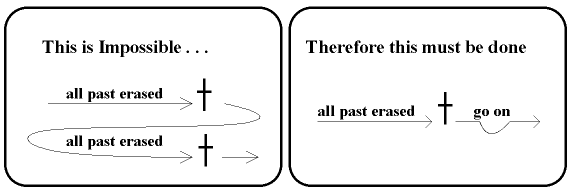
The record of my past stands. I cannot change it. Therefore I must be concerned about today and tomorrow for I cannot do anything about yesterday.
How can we know this is what the writer is speaking about?
(1) Verse 4 begins with “for” and gives an explanation of why we must go on.
(2) This fits the context. The context before is speaking about babyhood and wasted years. The only thing they can do is go on. The context following gives an illustration of wasted years of the land bringing forth thorns and briers (6:7-8). We cannot go back and do anything about these crops. The only thing that can be done is go on and bring forth a good crop this year.
(3) The word used here for “repentance” metanoias and signifies “repentance” to salvation. This is always in the New Testament used of initial repentance to salvation. ( metamellomai is “repentance” which is restoration to fellowship in the New Testament).
(4) The use of the word “again” is significant. It is impossible to renew a saved person “again to initial repentance” unto salvation, simply because he is already saved. The “again” shows a prior experience. In this case a prior experience of salvation.
To paraphrase this we could say: “leaving babyhood, let us go on to maturity for it is impossible by means of a falling away to renew—that is make the whole record new—by means of an initial repentance to salvation seeing this would necessitate Christ dying again and make His first death of no avail, and therefore a mockery to those looking on.”
For this to happen godwardly, it would call for another crucifixion of Christ. Manwardly—to those who watch—they would say that His salvation was not worthwhile as the first crucifixion was not sufficient, and how could we know that even a second crucifixion would be sufficient also?
c. The Illustration of the Principle (6:7-8)
The land is not burned, but the fruit of the land is if it is thorns and briers. So all will be brought out at the judgment seat of Christ (cf. 1 Cor. 3:11-15). It is not the believer who is burned, but his works that are rejected.
We cannot erase the record of last years thorns. Therefore let us go on and by the grace of God this year produce a good crop that will glorify the Lord.
3. The Spiritual Action (6:9-20)
9 But, beloved, we are convinced of better things concerning you, and things that accompany salvation, though we are speaking in this way. 10 For God is not unjust so as to forget your work and the love which you have shown toward His name, in having ministered and in still ministering to the saints. 11 And we desire that each one of you show the same diligence so as to realize the full assurance of hope until the end, 12 that you may not be sluggish, but imitators of those who through faith and patience inherit the promises.
13 For when God made the promise to Abraham, since He could swear by no one greater, He swore by Himself, 14 saying, "I will surely bless you, and I will surely multiply you." 15 And thus, having patiently waited, he obtained the promise. 16 For men swear by one greater than themselves, and with them an oath given as confirmation is an end of every dispute. 17 In the same way God, desiring even more to show to the heirs of the promise the unchangeableness of His purpose, interposed with an oath, 18 in order that by two unchangeable things, in which it is impossible for God to lie, we may have strong encouragement, we who have fled for refuge in laying hold of the hope set before us. 19 This hope we have as an anchor of the soul, a hope both sure and steadfast and one which enters within the veil, 20 where Jesus has entered as a forerunner for us, having become a high priest forever according to the order of Melchizedek (Hebrews 6:9-20).
- Your part: things that accompany salvation (6:9-12)
- God’s part: immutable, steadfast promises (6:13-20)
The exhortation is to us: “Brethren, I count not myself to have apprehended: but this one thing I do, forgetting those things which are behind and reaching forth unto those things which are before, I press toward the mark for the prize of the high calling of God in Christ Jesus” (Phil. 3:13-14).
The prospects are as bright as the promises of God. Not one word has ever failed. Therefore, let us go on…
Warning #4:
The Danger of Despising
(Hebrews 10:26-31)
26 For if we go on sinning willfully after receiving the knowledge of the truth, there no longer remains a sacrifice for sins, 27 but a certain terrifying expectation of judgment, and the fury of a fire which will consume the adversaries. 28 Anyone who has set aside the Law of Moses dies without mercy on the testimony of two or three witnesses. 29 How much severer punishment do you think he will deserve who has trampled under foot the Son of God, and has regarded as unclean the blood of the covenant by which he was sanctified, and has insulted the Spirit of grace? 30 For we know Him who said, "Vengeance is Mine, I will repay." And again, "The Lord will judge His people." 31 It is a terrifying thing to fall into the hands of the living God (Hebrews 10:26-31).
Each warning given in Hebrews is progressively worse. As we’ve seen there is the danger of drifting away from the truth (2:1-4); the danger of not entering into His rest (ch. 3-4); and the danger of not going on to maturity (ch. 5-6).
All of these dangers are only for the child of God, not for the child of the world. The danger of the unsaved is not to be saved and thus go to the lake of fire. The writer of Hebrews is not writing to his people, Israel, who are unbelievers. Matthew has done that. He is writing to those who are believers, who have accepted the Lord Jesus Christ and His sacrifice for their sins. They made a good confession and, even in the midst of suffering, were faithful to the Lord. But persecution has continued and intensified. They had suffered the loss of all their material wealth.
What was their problem? They needed to patiently endure. They needed to hold fast and not give up thinking that it is not worthwhile. One of the key words of the book in Hebrews, therefore, is “patience” or “patient endurance.”
So the author, after reprimanding his hearers for not being teachers of the Word even though they had been saved long enough to be teaching, and still needing to be taught the milk, urges them along with himself to “go on to maturity.” The reason “for” doing this is because it is impossible for “anyone” who is saved if they should defect from the faith to renew them again to an initial repentance. No one can be saved but once. No one can have his past forgiven but once. After coming to Christ, everything we do will come before the judgment seat of Christ and it will be rewarded if it is good, or burnt if it is good-for-nothing.
This is why there is the need to go on and a warning against going back. You can never regain wasted years. Thus the illustration of Hebrews 6:7-8 fits perfectly. All we produce is either for blessing or burning. It is not the believer that will be burned, but what he has produced. Often we take the blessings of the rain and sunshine and yet only produce thorns and briers.
10:9 - The writer stands persuaded of better things from these Hebrew believers than “thorns and briers” and things to be rejected, even though he has been forced to speak in such strong language to them.
10:10 - Moreover, they have produced “good works” and are continuing to do so now. It is not that these things are not appreciated.
10:11 - But there must be the continuing and perseverance. Now he is not saying that they are saved by perseverance, but this is the only way to receive a “full reward” for each years’ harvest. It is not enough to be satisfied with one year, or even a partial crop.
10:12 - “Slothful” goes back to 5:11 and means “dull of hearing” showing this whole section is one unit of truth. Their need was for continued “faith” as believers and “patience” realizing that the promises are for another day.
10:13 - Then he begins to talk about God’s promises.
10:14 - The whole nation of Israel came from this one promise.
10:15 - Abraham had to go through patient endurance in order to obtain the promise. He is an example of the faithful. God’s promises are never immediately rewarded, but this in no way signifies that they are not sure.
10:16 - This is the kind of an affirmation men make, and God also made the same to us. Nothing is higher than God. He is the highest authority and His Word settles and confirms all. There can be no argument against it.
10:17 - God gave His immutable Word and promise, and, as if that were not enough, He gave an oath besides.
10:18 - What is true of Abraham is true for us. The things we have believed are true. Our need is for patient endurance. We have fled for refuge to the Lord Jesus Christ.
A “hope” is set before us. Now remember that hope in Scripture never contains any element doubt as with our English word. Rather it is an anticipated expectation which requires “waiting” for its fulfillment. The waiting for the Lord’s return is waiting for the “the blessed hope” of the believer. Our waiting for the promises God has made to be reality is not faith, but hope. Faith believed them; hope clings to them; love is to characterize our life while we wait.
10:19 - Our hope goes right on into the very presence of God because Jesus Christ is there.
10:20 - And He is the guarantee that we will ultimately be there bodily ourselves. Thus He is our forerunner.
With the mention of Melchizedek, the writer resumes his teaching which he interrupted to give this warning and exhortation.
Note Outline:
II. The Superiority of the Work of the Son (4:14–10:18)
A. As the Great High Priest (4:14–7:28)—“After the order of Melchizedek.”
B. As the True Tabernacle (8:1–9:11)—“Not made with hands.”
C. As the Perfect Sacrifice (9:12–10:18)—“Once for all.”
III. The Superiority of the Outworking of So Great Salvation in the Lives of Believers (10:19–13:25)
It is not enough to know. Knowledge brings responsibility. Because of the superiority of the Son and of His work, we have a superior walk and far superior privileges in this age. But never, never forget that hand in hand with superior privileges come superior responsibilities.
A. Exhortation (10:19-39)
1. In light of superior privileges (10:19-25)
2. In light of greater discipline (10:26-31). THE FOURTH WARNING.
3. In light of former endurance (10:32-39).
Listen to our superior privileges in this dispensation.
10:19 - We can enter into the Holy of Holies. No one in Israel could do could do this but the high priest alone, and tradition holds that he could only do this once in the year and then only according to specific instructions. He entered in “with fear.” Something of that fear is given in the fact that a rope was tied around his ankle. If anything went wrong, he was pulled out. No one else dared go in.
10:20 - The high priest went around the veil; we go through the veil—the sacrifice of His body and by means of his shed blood. Anyone who does not like the blood of Jesus Christ has no access to God.
10:21 - God’s house today is so superior to His house of Israel. They came in by natural birth; we by spiritual birth. They have a high priest who is subject to death; we have one who will never die. Theirs was imperfect and sinful; our High Priest is sinless. And on and on we could go.
10:22 - The exhortation is to come. When a person in Israel was consecrated into the office of the priesthood, the blood of the sacrificial offering was sprinkled upon him, and he was totally bathed in water. Both acts are spiritual works of God’s operations today in which the believer becomes a believer-priest who ministers under the Great High Priest, the Lord Jesus Christ.
Not everyone in the Old Testament could be a priest, but only those related by birth to Aaron. However, every child of God today can be a believer-priest and consecrated to offer spiritual sacrifices to God because he is related by the new birth to the Lord Jesus Christ.
10:23 - We are to stand erect and firm in our profession of the Lord Jesus Christ and not be tottering between two opinions or positions. He is faithful who promised. He has never failed to keep His word. Why do you think He will now?
10:24 - Here is the relation of one who is strong in clinging to the promises, in relation to one who is weak in faith. The fleshly reaction of the sin nature is to criticize them and push them even further down. The Spirit’s operation is just the reverse.
10:25 - Here is an explanation of good works in this crisis period. Negatively, it is not forsaking the assembling of ourselves together as some are doing. Did you realize that missing church attendance is a lack of a good work? Positively it is exhorting one another, and so much the more as you see the day approaching. The day was the day of judgment upon Jerusalem in A.D. 70 which was a prefigure of the final judgment upon Israel before the Second Coming of Christ.
This brings us to the fourth warning (10:26-31)
It seems to me babyish to have to stop at this point and teach you that the writer of Hebrews is talking to saved people. However, I have learned not to take anything for granted.
(1) The writer of Hebrews nowhere in any passage ever says any word about unbelievers except as an illustration. It is a book from beginning to end whose every word is written to Christian believers. Concerning these believers the author says that Jesus Christ is “the author of eternal salvation” (5:9). “He is able also to save them to the uttermost (i.e., to the very end) that come unto God by him, seeing he ever liveth to make intercession for them” (7:25). “For by one offering he hath perfected forever them that are sanctified” (10:14). Thus he is writing to believers who are not only saved, but eternally saved.
(2) The preceding context is dealing only with believers who have access to God through the blood of Christ. Moreover, verse 26 continues with a “for,” a word that gives an explanation of why we are encouraged to exhort one another and not to forsake the assembling of ourselves together. These three exhortations to steadfastness can only be for born again believers, not for unsaved or even professers (10:22-25). The need of the unsaved is to accept Christ.
(3) The context following reveals the same truth (10:32-39). Here we find encouragement to persevere in patience. Unbelievers do not need patient endurance; they need Christ.
(4) Finally, the passage itself shows the writer is addressing believers.
- “We” (10:26). He includes himself along with them.
- “Receive full knowledge of the truth” (10:26). Only a believer can come to full knowledge of the truth for the natural man cannot even know the spiritual things of the Word.
- “There remaineth no more sacrifice for sins” (10-26) shows that they were saved or else the sacrifice of Christ could avail for them.
- The illustration of 10:28 shows they were saved, for those with Moses were blood-redeemed people and under the blood of the covenant of the law.
- “The blood of the covenant by which he was sanctified” shows they are believers (10:29). The blood is applied to believers when they are saved. This is the sprinkling mentioned previously. The application of the blood of God’s Son is that which saves us and sets us apart as believers, We are then under the blood of the covenant, and out from under wrath. No unbeliever is under the blood, nor set apart (sanctified) by the blood. The blood on the houses of Israel set them apart from unbelievers, so the same is true here.
- “The Spirit of grace” shows they are believers (10:29). The Holy Spirit is longsuffering with unbelievers but grace is received through the Holy Spirit only with believers. We are saved by grace through faith. Grace is available to unbelievers, but we who are believers have been recipients of it. Only a believer can, then, “insult” the grace of the Spirit of grace which is the thing involved here. The word has the idea in it of arrogance and willful injury, and it would involve the refusal by the believer to heed the Spirit’s gracious wooings not to commit this specific sin. To go ahead and sin after the gracious operation of the Spirit would be a slap to Him, and He would be grieved.
- Finally, the use of the quotation in Hebrews 10:30, “The Lord shall judge his people,” shows that this is a reference to believers. Judgment here is not on the world, or unbelievers, but on God’s own people who are His children.
The second problem is the nature of the sin. What sin is this that the cross of Christ does not cover in time.
(1) The nature of the sin (10:26). It is a voluntary sin which the believer wills to commit after he has been saved and come to full knowledge of the truth. Now every time a believer sins it is because he “willed” to sin. He did not have to sin. This is the doctrine of Romans 6, 7 and 8. This act here, however, is something different. It is present tense and may be translated “if we keep on sinning willfully after that we have received full knowledge of the truth, there remaineth no more sacrifice for sins.” This sin is, then, a deliberate, premeditated sinning with full knowledge that it is wrong.
(2) The action involved. It is such an act that involves a repudiation of former actions that were good, spiritual, joyful, and for which they were fully aware of future rewards (10:32-35).
(3) The consequences of the act. It would involve a repudiation of their previous confession of Jesus Christ as their Savior (10:23; cf. 3:1; 4:14).
(4) The sin itself. By comparing 10:32-37 with 10:23-25 we may correctly say the sin is (a) a separation of the believer from other believers permanently, and (b) a return of the separated believer to the Temple and all it entails in order to escape the present persecution that was upon them.
(5) The sin involved a denunciation of: (a) The person of Christ (Heb. 1:1–4:13), (b) The work of Christ (Heb. 4:14-10:18), and (c) The ministry of the Holy Spirit of God in the life of the believer (Heb. 10:19–13:25). This is why verse 29 states all three categories.
The final question is what is the nature of the judgment? It just comes down to this. Desiring to escape man’s judgment, they will fall into the judgment of God.
(1) The judgment cannot be loss of eternal salvation or of eternal life (10:39). If it is possible to lose eternal salvation, then it is not eternal salvation.
(2) The judgment does involve loss of spiritual rewards (10:35-36).
(3) The judgment does involve physical death for this is certain to come if they continue and persist in sinning (10:28-29).
(4) The judgment may be that the believer who returns to the Temple and to the City of Jerusalem will be involved in the judgment our Lord prophesied would come upon the city and the Temple (10:25,27). This is why we find in Hebrews 13:13-14 the exhortation to go outside the city bearing His reproach.
Is it possible for a believer today to be guilty of this same sin? It most certainly is. We are saved by the blood of Christ and the eternal guilt of sin is removed forever, but it is possible to neglect this so great salvation and to carelessly drift from it through indifference.
It is possible to stop short of a life of rest and peace which the Lord has planned for us as His child, simply because we never go on living a life of faith and therefore never come to experience the best that God has for us.
It is possible to never mature in the Lord and never grow up, but to be infants in spiritual things all of our lives. Such a person has years of wasted service where all that is produced is “good-for-nothing” but burning.
It is also possible to sin willfully or deliberately with full understanding of the sin and the consequences of our action, and have the hand of God discipline us in time in life even to the point of physical death. We are saved by grace, but grace does not mean that we can do anything we want (Hebrews 10:22-25).
Warning #5:
The Danger of Denying (Part 1)
(Hebrews 12:12-29)
12 Therefore, strengthen the hands that are weak and the knees that are feeble, 13 and make straight paths for your feet, so that the limb which is lame may not be put out of joint, but rather be healed. 14 Pursue peace with all men, and the sanctification without which no one will see the Lord. 15 See to it that no one comes short of the grace of God; that no root of bitterness springing up causes trouble, and by it many be defiled; 16 that there be no immoral or godless person like Esau, who sold his own birthright for a single meal. 17 For you know that even afterwards, when he desired to inherit the blessing, he was rejected, for he found no place for repentance, though he sought for it with tears.
18 For you have not come to a mountain that may be touched and to a blazing fire, and to darkness and gloom and whirlwind, 19 and to the blast of a trumpet and the sound of words which sound was such that those who heard begged that no further word should be spoken to them. 20 For they could not bear the command, "If even a beast touches the mountain, it will be stoned." 21 And so terrible was the sight, that Moses said, "I am full of fear and trembling." 22 But you have come to Mount Zion and to the city of the living God, the heavenly Jerusalem, and to myriads of angels, 23 to the general assembly and church of the first-born who are enrolled in heaven, and to God, the Judge of all, and to the spirits of righteous men made perfect, 24 and to Jesus, the mediator of a new covenant, and to the sprinkled blood, which speaks better than the blood of Abel. 25 See to it that you do not refuse Him who is speaking. For if those did not escape when they refused him who warned them on earth, much less shall we escape who turn away from Him who warns from heaven. 26 And His voice shook the earth then, but now He has promised, saying," Yet once more I will shake not only the earth, but also the heaven." 27 And this expression, "Yet once more," denotes the removing of those things which can be shaken, as of created things, in order that those things which cannot be shaken may remain. 28 Therefore, since we receive a kingdom which cannot be shaken, let us show gratitude, by which we may offer to God an acceptable service with reverence and awe; 29 for our God is a consuming fire (Hebrews 12:15-29).
Next we are considering the fifth and final warning in the book of Hebrews. These warnings are an integral part of the message of the Epistle. They take the truth, expounded and relate it to life and action.
The book of Hebrews may be looked upon as in three parts—all concerning the Son and His superior salvation.
I. His Person (1:1–4:13)
II. His Work (4:14–10:18)
III. His Outwork (10:19–13:25)
His life—what He was from all eternity past.
His Death—what He did once in a point of time
His Resurrection Life—what He will be for all eternity to come.
Who He is.
What He did.
What He can do for you.
The Son—eternal.
The Savior—perfect.
The Shepherd—great.
He is Prophet—the Revealer. As such lie represents God to man.
As Prophet, He was crowned with thorns (John 19:2).
He is Priest—the Sacrificer. As such He represents man to God.
As Priest., He is crowned with glory and honor (Heb. 2:9).
He is King—the Sovereign. As such He represents man to man.
As King, He will be crowned with many crowns (Rev. 19:12).
Beginning at 10:19 we commence the last section of the book. This is the application of the doctrine. It is our work in light of His work.
We have superior privileges (Heb. 10:19-21), but with these come also greater responsibilities (10:22-25). We are exhorted to enter into these greater privileges (10:22) to hold fast to our profession of Christ as Savior because God’s promises will come to pass (10:23), and to encourage one another, not forsaking the assembling of ourselves together (10.24-25).
The reason we must do these things is because if we willfully sin having full knowledge of the sin and its consequences, God is forced to chasten us (10:26-29) because of His very nature (10:33-31). He cannot and will not let His children get by with this any more than we could let our children get by with this.
The Hebrews are thus encouraged to persevere in patience (10:32-39). They have previously endured (10:32-34) so they should continue (10:35-36) because the Word of the Lord stands sure (10:37) and all who please God must patiently endure, living by faith (10:38-39).
In fact, real faith produces patient endurance (11:1-3), and this is seen in every era of the Old Testament (11:4-40). The implication is, to go back to the Temple of Jerusalem is not to be joined to the faithful company of the Old Testament at all, but is to depart from them.
All of the Old Testament saints are a witness to us that the race can be run (12:1), and the only way to have rest is through patient endurance even as was true of the Lord Jesus Christ (12:2) . When we consider Christ and His sufferings, our sufferings and struggles are mild (12:3-4). But God has a purpose in the believer receiving discipline with patient endurance, and that is the maturity of His child (12:5-11).
So the believer has an obligation to weaker ones in the assembly (12:12-13) and to himself (12:14). He must know the three dangers that are before him (12:15-16) which may be illustrated by Esau’s decision which was irrevocable even though he regretted it later. Esau had neither faith nor patient endurance, and he was cut off by one act from the place of blessing (12:17).
By application, if the Hebrews returned to the old system of the Temple, they go to that of utter “terror” (12:18-22), and they leave in contrast the place of privilege and grace, and the heavenly city which is the reward of those who faithfully endure (12:22-24).
Therefore, there must be a final warning. Abel’s blood spoke continually on earth; Christ’s blood is greater and speaks continually from heaven that He shall come, judge, and bring in the new age with its new covenant (12:25-27). So patiently endure, offering spiritual worship as a believer-priest, knowing God purifies dross (12:28-29).
This carries us through the fifth warning. Now let us look at the context to this final warning in detail.
Our Responsibility in light of all of the Facts Presented (12:12-29)
1. The Exhortation (12:12-17)
12:12 - “Wherefore,” in light of all of these facts presented this conclusion goes back all the way to the willful sin in 10:26. In light of it and the truth presented from 10:26 to 12:11 the exhortation is given. “Lift up the hands which hang down, and the feeble knees.” Here is our relationship to others in the body.
(1) Hands—we are to lift then up in prayer even as Moses did (Ex. 17:11-12) in order to win the victory for others. We are not to be defeated and discouraged. We are not to criticize someone else; we are to pray for them.
(2) Knees—feeble knees will not hold you up in the day of battle (Ezek. 7:17). We are to be strong in battle and not terrified by the adversary.
12:13 - “And make straight paths for your feet, lest that which is lame be turned out of the way; but let it rather be healed.”
(3) Feet—The Children of Israel wandered around in circles for 38 years without ever going anywhere. We are to make straight paths for our feet. We are to go on. We are to look unto Jesus, and setting our eyes on Him, not wander from the course set before us.
“Lame” here is “to be put out of joint” and it speaks of the shuffle of the paralytic, Some in the body were paralyzed, and they were traveling along with greatest of difficulty. The figure of the body is used to represent the church and its spiritual condition and it shows that the lame person is spiritually lame. This person is to be spiritually healed so that the whole body may move out and move on together, without some being left behind.
12:14 - “Follow peace with all men, and holiness, without which no man shall see the Lord.” Here is the injunction to each person individually rather than collectively as in the preceding verses. “Peace” indicates there is to be no quarrel, no animosity between ourselves and anyone else. “Holiness” signifies we are to be set apart for the Lord. The one is our personal relationship with others; and the other is our personal relationship with the Lord Himself.
12:15 - “Looking diligently lest any man fail of the grace of God.” This word “looking diligently” signifies searching out carefully or minutely just like the Israelites searched their homes before the Passover to rid them of all leaven. It is constant spiritual oversight by each one of us of our own lives. The reason is three-fold, brought out by the three occurrences of the word “lest.” Here are three dangers that every believer may face and for which he must be constantly on guard.
(1) “… lest any man fail of the grace of God.” This is failure on the part of the child of God to appropriate grace. Whenever I fail to appropriate grace for the needs of the day, I will fail when testing and temptation come. God has provided grace to meet it, but I have failed to appropriate it. I will then react according to my sin nature.
If God brings something into our lives, He will also give us grace to overcome it and gain the victory (2 Cor. 12:9), rather than to be overcome by it. “As our days, so shall our strength be.” These Hebrew Christians were going through trials and testings, but they had failed to appropriate God’s grace so as to stand up under the testings. Thus they were living defeated lives. They had failed of the grace of God.
(2) “… lest any root of bitterness springing up trouble you., and thereby many be defiled.” This is open infidelity. Bitterness in the heart leads to murmuring with the tongue. And murmuring is one of the most dangerous sins because it always affects others and leavens the whole camp. It starts with one., but it ends defiling many. This is what happened in Israel over and over again.
So it is always, when I fail to appropriate grace, there will be a root of bitterness in my heart against God who has allowed this “trouble” to come, and it will ultimately come out in my speech.
(3) “… lest there be any fornicator, or profane person, as Esau, who for one morsel of meat sold his birthright.” This final step and condition is open contempt of what is our responsibility or our privilege. The entire passage hinges on this one illustration. It is very significant.
There are two obstacles to holiness that are presented here: fornication and profane person. Esau represents the latter and this is also the danger of the Hebrews. “A little bit of material food” emphasizes for how little Esau sold his birthright.
Now the birthright and its significance to Esau can only be understood as one understands that this was not merely being heir of flocks and herds, and Esau rejected this. This is not the issue. God had made a covenant with Abraham, and that covenant promise was going to be fulfilled through Isaac’s heirs. Esau was the one in direct line, and being the elder son of Isaac would have received the elder son portion, i.e., two-thirds. But he surrendered for himself and his descendants the covenant promises of God for one meal. That is what he thought of God’s promises, and that is how much he wanted to wait, or patiently endure for them.
What was Esau’s problem? He failed to appropriate the grace of God (12:15a). Consequently, there was in Esau a root of bitterness against God. Esau was in trouble and hungry. He was angry with God because God could have prevented him from being hungry. This bitterness of heart expressed itself and he became materialistic. He recognized nothing but the here and now. He focused his whole attention on material things, not on invisible and eternal things. He thought more of one meal now than receiving the fulfillment of all the promises God had made at a later date. God calls this being profane. This is cursing God in the heart, and God looks upon the heart.
12:17 “For ye know how that afterward, when he would have inherited the blessing, he was rejected: for he found no place of repentance, though he sought it carefully with tears.”
Esau represents here a covenant son. This is essential for one to realize or they will miss the point of the illustration. The Hebrews are also saved and in a covenant position in relation to God. Yet Esau was rejected on the basis of one decision, for this decision was irrevocable, even though he later sought to change the decision with tears.
This is the warning to the Hebrews lest they also make an irrevocable decision that would cut them off from blessing. Salvation is not in view here as it has not been in view anywhere beyond the first warning, but eligibility for blessing is in view.
In Hebrews 10:26 we found that the willful sin will bring temporal judgments upon the person who commits it. Now the added truth is here stated that this decision of sinning willfully is an irrevocable decision. If the Hebrews commit this, they will never be able to go back and change it later on regardless of tears or anything else. They will have turned from God’s blessings not found in Judaism, and will never be able to come back to the place of blessing now enjoyed. They will settle for a blasted life, and they will have disqualified themselves from any place of leadership ever again in the assembly. The sin can be forgiven, but the effects will continue on and on. Esau, for one sin, was cut off from God’s blessing. Take heed!
It all starts with a little thing of failing to appropriate the grace of God. But there are no little things in the Christian life. Let us look diligently lest any of us fail of the grace of God; lest any root of bitterness springing up trouble us, and thereby many be defiled.
We are not immune to failure.
Warning #5:
The Danger of Denying (Part 2)
How long has it been since you heard a message on hell? It has been quite a while hasn’t it? Perhaps many of you have never heard a message on the lake of fire. While I have read sermons on the subject, I have never heard one myself. This is not a very popular subject, and is neglected by default of those who do believe in it.
But., beloved, if there is not a hell to be saved from, then there is absolutely no need for a Savior to rescue us from it. A Savior is meaningless without a certain death. While I am not going to speak on hell, I do want to relate its truth to unbelievers.
We who are believers have experienced the Lord’s so great salvation. We have come to know that He saved us from an eternal death. We are saved and that salvation is eternal (Heb. 5:8-9). This eternal salvation has saved us from eternal judgment (Heb. 6:2). This is why it is so great salvation because He bore our eternal judgment in a point of time.
The believer’s problem, then, can never be eternal salvation or eternal judgment. That issue stands settled. “We are not of them who draw back unto perdition; but of them that believe to the saving of the soul” (Heb. 10:39).
Our problem as believers is not a matter with sin that would cause us to lose our eternal salvation, but it is with sin that would cause us to lose the Lord’s blessings in our lives, and may even cause us to lose our lives in death. Our problem is with time—not eternity. Our problem is with our physical life—not our eternal soul. Our problem is with physical death—not eternal death.
This is the issue before the Hebrew Christians, and it is the issue with us also.
Some sins are small, but others are not. Some things we do are relatively unimportant, while other things are very important. This is why I John 5 speaks about sin not unto death., and about sin unto death. We are to stop and. take heed to ourselves and our actions “for our God is a consuming fire” (Heb. 12:29).
I want you to notice that this is never spoken in reference to unbelievers. God is not, and never will be, a consuming fire in reference to unbelievers. For unbelievers He will be an eternal fire that will consume nothing. However, in reference to the believer He is a consuming fire that will consume all that is wood, hay and stubble, and all that is thorns and briers. He will even take away our lives if we are completely displeasing to Him.
Never say, “that couldn’t happen here; it couldn’t ever happen to me.” This was the attitude at the time of Christ when they said: “If we had been in the days of our fathers, we would not have been partakers with them in the blood of the prophets. Wherefore ye be witnesses unto yourselves; that ye are the children of them which killed the prophets” (Matt. 23:30-31).
There is not any sin that we as believers are not capable of committing. This is why we are to take heed to ourselves lest we fall (1 Cor. 10:11-12; 1 Tim. 4:16; Heb. 4:11).
We saw in the last lesson that the route of any failure is a progression involving three stages.
(1) It begins with failing to appropriate grace. “… lest any man fail of the grace of God” (12:15a).
(2) The next step is having bitterness in the heart. “… lest any root of bitterness springing up trouble you, and thereby many be defiled” (12:15b). Bitterness in the heart leads to murmuring with the mouth, and this leads others to sin also.
(3) The final step is open contempt of what is our responsibility or our privilege. “… lest there be any fornicator, or profane person, as Esau, who for one morsel of meat sold his birthright.” Either one of these two sins permanently disqualifies one from service and from blessings therein.
Concerning these three things we are to search out ourselves and our hearts carefully, to give inspection, to oversee continually lest these things come into our lives unexpectedly and undetected. No one sins any other route. We fail to appropriate God’s grace for the situation or trial. This leads us to have bitterness in our hearts to God for allowing this hardship or difficulty to come upon us. What is in our hearts ultimately comes out and it defiles others. All this in turn causes a final state in which we settle for the temporal rather than the eternal; for the here-and-now rather than the hereafter; and for the material rather than the spiritual. We fail to patiently endure. This is what Esau did, and his decision was irrevocable. We are capable of doing the same thing.
Here is a young man or a young woman. The Lord has called them to the mission field. The way to Bolivia, or India, or Morocco is long and hard. They fail to appropriate the grace necessary for the way and for the testings along the journey. Then everything caves in. “God is not really concerned about me. He really does not love me. If He loved me He would have provided for me, and given me a life partner.” Then the person falls in love with someone not called to the field and they are married. They made a decision that is irrevocable. They have missed the perfect will of God and must settle the remainder of their lives for that which is His second best, His 20th best, or His 200th best.
Having given the exhortation not to fail (Heb. 12:12-17), we come to our next point …
(2) The Believer’s Privileges and Position (12:18-24)
18 For you have not come to a mountain that may be touched and to a blazing fire, and to darkness and gloom and whirlwind, 19 and to the blast of a trumpet and the sound of words which sound was such that those who heard begged that no further word should be spoken to them. 20 For they could not bear the command, "If even a beast touches the mountain, it will be stoned." 21 And so terrible was the sight, that Moses said, "I am full of fear and trembling." 22 But you have come to Mount Zion and to the city of the living God, the heavenly Jerusalem, and to myriads of angels, 23 to the general assembly and church of the first-born who are enrolled in heaven, and to God, the Judge of all, and to the spirits of righteous men made perfect, 24 and to Jesus, the mediator of a new covenant, and to the sprinkled blood, which speaks better than the blood of Abel (Hebrews 12:18-24)
The believer must understand his privileges and his position today or he cannot understand why the Lord will judge him so severely for disobedience. The author of this book states this truth both negatively and positively.
Negatively (12:18-21)
To go back to the law and the Temple is to go back to a system of terror. The law was a system of terror. “Do you not hear the law,” the writer is saying. The contrast here is between the Old Testament revelation and its responsibilities with the New Testament and its responsibilities and privileges.
Positively (12:22-24)
The one was “terror”; the other is “grace” and far superior privileges. The emphasis is not on the city, but on the One living in the city. Look at the occupants of the city.
(1) Angels, i.e., the holy angels.
(2) Church of the Lord Jesus Christ (which began at Pentecost and will end at the rapture).
(3) God, the Judge of all.
(4) Spirits of just men made perfect (the Old Testament saints who are not a part of the church nor ever will
be).
(5) Jesus., the mediator of the New Covenant.
(6) Blood of Sprinkling, i.e., the mercy seat, or the throne of grace as it is called in Hebrews.
This is the city we are looking for, not some earthly city. Abel was the very first person to offer blood sacrifice. It was a testimony from then on, even though he was dead, that this is God’s only method of acceptance and only way of approach (Cf. 11:4).
But now there is a greater witness than that of Abel, because there is greater blood in a greater place that is continually speaking to men. The blood of Jesus Christ is God’s only means of acceptance and only way of approach.
(3) The Final Warning (12:25-29)
In light of the better blood in a better place, and all the superior privileges we possess, there is a far greater obligation and responsibility that is ours.
12:25 - “See that ye refuse not Him that speaketh.” Literally it is “He who is right now speaking” (present tense). This ties the Epistle of Hebrews and its message into one unit. “God, who at sundry times and in divers manners spake in time past unto the fathers by the prophets, hath in these last days spoken unto us by his son” (Heb. 1:1-2) “Therefore … how shall we escape …” (Heb. 2:1,3).
These Hebrew believers in grace who reject the present voice of the Lord are guilty of a far greater sin than their fathers. Their fathers did not escape; so much more will they not escape. “How much more sorer punishment” (Heb. 10:29). “The Lord will judge His people” (Heb. 10:30).
It is not salvation, but temporal punishment that is in view here (cf. 1 Cor. 11:31-32).
12:26 - The One who spoke on Sinai is now the One who speaks from heaven in grace and bids us come. He is yet to speak one more time, and the last time He comes and speaks it will be in judgment.
You had better be right with Him. It is one thing to be out of step with an earthly monarch. It is something else to be out of step with the Sovereign of the universe.
The prophecy quoted here is from Haggai 2:6 and refers to the second coming of Christ. It pictures judgment which precedes the coming of a new age. The shaking of the earth will be the purifying judgment and the removal of all things not in conformity to the holiness of the Lord and not subject to the King.
God will yet do this for Israel. You had better be found on the right side in that day. The judgment in A. D. 70 was just a preview of the final judgment that will occur.
12:27 - Those things that can be shaken show they are temporary. What is unshakable manifests it is eternal. The Temple and the old covenant as prophesied are shakable and therefore temporary. The New Jerusalem and the new covenant are unshakable and eternal. The Temple will be completely destroyed. The old covenant will pass away, but both the New Jerusalem of the new covenant with the house of Israel will last forever. The shaking is viewed as already in process.
12:28 - The final appeal is given to “believers.” Believers are looked upon as in a process of receiving a kingdom. At the present time the Mediator is still in heaven. The establishment of this kingdom on earth with the New Jerusalem over the earth is definite and sure, yet it is still unseen. We must abide faithful, and obtain grace so as to patiently endure for our reward until He comes or until He calls home. In the meantime we are to serve the Lord acceptably with reverence and godly fear.
You do not love someone you do not respect. You cannot love the Lord unless you respect Him. The Lord will judge His children. You had better take heed and reverence Him. No child will deliberately sin without paying the full price in discipline from the Lord.
Acceptable service to God is in the called out assembly, not in returning back to the Temple and offering animal sacrifices.
12:29 - The exhortation closes and the warnings are over. But the discipline awaits all who will not heed. Hebrews begins with the Son speaking, and it ends with the blood of the Son continuing to speak from heaven as an eternal witness.
We have considered the five warnings of Hebrews. Here are five flashing red lights on the road of disobedience. They are five stop signs on the freeway of backsliding. Each one of these warnings may be illustrated by the nation of Israel in covenant relationship with the Lord. Just as these things happened to the nation of Israel under the blood of the first covenant, so these things may happen of the church under the blood of the new covenant.
(1) The Danger of Drifting (Heb. 2). The children of Israel w ho were redeemed by blood and by power, drifted from the truth at Mount Sinai, and they made a golden calf. It cost the physical life of 5,000 saved Israelites. So the question is asked us: “How shall we escape if we drift from so great salvation?”
(2) The Danger of Not Entering into Rest (Heb. 3-4). After leaving Mount Sinai, the nation of Israel wandered for 40 years in the wilderness. The nation and generation that accepted His salvation perished in the wilderness because they refused to continue a life of faith. Over a million perished. We are not only saved “by faith,” but “the just shall live by faith.” Here is the danger for us of doubting, of not walking by faith as a believer, and of missing His rest and His best.
(3) The Danger of Not Going on to Maturity (Heb. 5-6). This was the state of the nation after entering into Canaan under the judges, the kings and the prophets. They never grew up as a nation. They were never able to use the Word of God in their lives. They never applied it to life’s situations. The result was that thousands upon thousands perished in the sieges and conflicts of the Assyrian and Babylonian Captivities.
(4) The Danger of the Willful Sin (Heb. 10). Here is a picture of the nation at the time of the first coming of Christ. They kept on sinning willfully. Christ even spoke a parable against those of His generation (Luke 20:9-16,19; cf. Matt. 21:43). Consequently the Lord Himself said: “The blood of all the prophets, which was shed from the foundation of the world (shall) be required of this generation” (Luke 11:50). Josephus tells us that millions of Jews perished in A.D. 70 under the Roman, General Titus. The nation had committed the willful sin.
(5) The Danger of Indifference.(Heb 12). This will yet be the sin of the nation of Israel during the coming tribulation. The Lord speaks in Matthew 25:1-13 of the five wise and five foolish virgins, and shows the indifference on part of even those who profess. Many will not patiently endure. The Old Testament prophets have prophesied that two-thirds of the nation of Israel will perish in the tribulation period because they are indifferent to spiritual realities.
You may have noticed that each of these warnings is greater than the previous one, and that failure to heed them brought in each case more severe discipline. This same progression of sinning that is possible in the life experience of these second generation believers, and that which may be illustrated in the history of the children of Israel, may also be illustrated in the history of the church as seen in Revelation 2 and 3.
(1) The Danger of Drifting. While this is a danger to any generation of believers, it was an actuality in the time of the church of Pergamos, which is a picture of the exalted church from the time of Constantine to Gregory the Great. They drifted from the truth, and had those in the church with different doctrine—doctrines of Balaam and the doctrine of the Nicolaitans.
The message was “repent; or else I will come unto thee quickly, and will fight against them with the sword of my mouth.” They did not repent and the Lord himself destroyed those in the church with the sword of His mouth even as the Levites had destroyed 3,000 at the time of the golden calf incident.
(2) The Danger of Not Entering into Rest. The church at Thyatira went into open rebellion against the Lord even as Israel openly rebelled against the Lord and against Moses. For Israel it was a very dark period of her history where a generation perished in the wilderness. For the church it is the dark ages where a millennium of souls perished without light.
(3) The Danger of Not Going on to Maturity. The church at Sardis had the truth, but not the life. They had a name that they lived, but they were dead. They failed to use the Word in daily practice, and so failed to go on to maturity even though they had come to salvation. Their works were not perfect before God, for they produced only things destined for the bonfire.
(4) The Danger of the Willful Sin. The church at Philadelphia faced a crisis in which they had to decide whether they would keep true to the Lord’s word and not deny His name, or whether they would give up both. This church did not fail this crisis. But the implication is that there were others who did. It was only a very small church, a remnant, that remained true to the Lord. This is a picture of the modernism fundamentalism controversy that took place in the last half of the 19th century and the first half of the 20th century. At this time most of the church committed the willful sin, denying the person of Christ, the blood work of Christ and did despite unto the Spirit of grace.
(5) The Danger of Indifference. Here is the Laodicean period of the church, or the modern ecumenical church. The Lord is seen standing outside the door of His own church, and the church itself is totally indifferent to His knock and His voice. Therefore His call is to any individual who will hear and let Him come into them. This church, along with the church of Thyatira, will go into the Great Tribulation. God will give them just as they have given Him. He will spew them out of His mouth.
“He that hath an ear, let him hear what the Spirit saith unto the churches.”
As a believer I cannot live just any way and get by with it. I am not going to get by; I am going to get it. But “if we would judge ourselves we should not be judged” (1 Cor. 11:31). But when we will not judge ourselves then “God will judge His people.”
Write this on your heart, and live accordingly. You cannot love One that you do not respect. Disobedience brings discipline; obedience brings blessing: it is just as we will it.
The Church and the New Covenant
One of the great programs of God is His covenant program. No understanding of Scripture is possible without understanding God’s covenant program. What took place on Calvary was a part of that program, for it was there that the blood of the New Covenant was shed. This is why the communion cup is said to be “the new testament” (or new covenant) “in my blood” (1 Cor. 11:25).
But just how does the church relate to this New Covenant. We read a caption at the beginning of the last 27 books of Scripture: “The New Testament.” The word testament and covenant are identical. Thus these are the New Covenant books. But just what is the church’s relationship to this New Covenant? Does Scripture say? Yes, it does; and the truth is very important to us.
Background
A. Definition. What is a covenant?
A covenant is a binding agreement between two parties which prescribes a course of action that will be followed. It is a contract that is binding. I agree to pay so much money and you agree to deliver to me such and such in return. This is a covenant.
B. Two Types of Covenants in Scripture.
1. Conditional Covenant.
Here a certain course of action will occur after something else occurs. “If you do this, then I will do that.” This covenant is always identifiable by “if … then …” In this type of agreement, there are conditions attached. One or both parties must meet the conditions before the covenant agreement will be met.
God entered into a conditional covenant with Israel at Mount Sinai, and they entered in with Him. “All that the Lord says we will do.” They bound themselves to this covenant. God promised blessing if the people obeyed His laws and He promised judgment if they disobeyed.
By the way, this is the only conditional covenant God ever entered into with man. All the rest are unconditional. Some people teach that God entered into a covenant of works with Adam in the Garden. This is totally wrong. God told Adam what would happen for disobedience. There was no agreement whatever between them. For there to be a conditional covenant, Adam would have had to agree to the conditions. You can have an unconditional covenant with one person agreeing to act and the other person saying nothing (this is what happened in the case of Abraham when God put him to sleep, and the Lord alone entered into the covenant), but you cannot have a conditional covenant without both parties covenanting together. This never happened in the Garden of Eden.
2. Unconditional Covenant
This is a covenant agreement in which no conditions are attached on which fulfillment depends. An unconditional covenant states what one party will do regardless of human action, merit, failure, or any other conditions. When an unconditional covenant is entered into in Scripture by God, the key words are, “I will.”
God entered into an unconditional covenant with David that He would establish David’s house and throne forever (2 Sam. 7:12-16). God would chasten his descendants if they sinned, but he would never remove the promised agreement regardless of anything (cf. Ps. 89:34-37).
There is one more thing that should be carefully noted. There may be a condition or conditions attached as to whether a covenant may be enacted with a certain party or not, while once it is enacted the covenant itself is unconditional. This was the case with the Abrahamic covenant where Abraham had to leave his father and land before the covenant applied to him; but once he had met the conditions, the covenant itself is unconditional.
C. The Various Relationships of Covenants in Scripture
All kinds of covenant agreements are given in Scripture for the express purpose of teaching us just exactly what a covenant is, and how it operated. We will mention just a few of each type.
1. Covenants of Men
a. Covenants between individuals and individuals.
- Abraham and Abimelech (Gen. 21:32).
- Jacob and Laban (Gen. 31:44).
- Jonathan and David (1 Sam. 18:3).
- The marriage bond is a form of a covenant agreement (Prov. 2:17; Mal. 2:14).
b. Covenants between an individual and a group.
- Isaac and Abimelech with the nation (Gen. 26:28).
- Jabash-Gilead and Nahash, the Ammonite (1 Sam. 11:1-2).
c. Covenants between nation and nation.
- Israel and the Gibeonites (Joshua 9:15-21).
This shows us something of the binding nature of a covenant. Once a covenant is entered into, it is irrevocable even though obtained by false pretenses. If this is true with man—and it is—how much more is this true with God.
Numbers 23:19 “God is not a man, that he should lie; neither the son of man, that he should repent: hath he said, and shall he not do it? or hath he spoken, and shall he not make it good?”
Romans 11:29 “For the gifts and calling of God are without repentance.”
2. Covenants of God.
a. Covenants between God and the world generally.
- No flood to destroy all mankind (Gen. 9:8-17).
- Covenant of day and night (Jer. 33:20,25; Gen. 8:22).
b. Covenants between God and Israel.
- Covenant of the Law (Ex. 19:5-8).
- Covenant of Restoration (Deut. 30:1-9).
c. Covenants between God and Individuals.
- With Abraham (Gen. 12ff).
- With David (2 Sam. 7:12-16).
From all of these various types, it can be seen that a covenant may be in the physical, social, political or spiritual realm.
D. The Ratifying of Covenants
While a covenant is a promise, an agreement, or a contract -which may be only verbal (Josh. 9:15-21)., yet it may also be ratified by some means. Three such means are used in Scripture.
1. A Shoe Covenant.
Here was something valuable to one person only, and something quite individualistic, yet it would be given as a symbol of ratifying the covenant. If both shoes had been given, then this might have been valuable to another, but this cannot be the case with the giving of but one shoe (Deut. 25:9; Ruth 4:7).
2. The Salt Covenant.
Salt was very valuable in this country and it was used as a means of ratifying an agreement (Lev. 2:13. Num. 18:19. 2 Chron. 13:5).
3. A Sacrifice or Blood Covenant.
This was the most binding of all means of ratifying a covenant. God ratified His covenant promise to Abraham with a blood sacrifice (Gen. 15:9-15). Abraham realized what was going on and what it meant. In a blood covenant, the two parties would join hands and walk between the divided pieces. The Hebrew expression for making a covenant is literally, “to cut a covenant,” and comes from cutting the animal into two pieces. A blood covenant was dissolved only by death. So binding was this covenant that to break it meant I will give my blood as even this innocent animal. You actually need only one animal sacrifice for a blood covenant.
E. Symbols or Signs Employed to Show a Covenant had been Established
Many and various symbols or signs were used to show that a covenant had been established. Do not confuse the ratifying of a covenant with the sign of the covenant, for these are two entirely separate things. The sign might be anything:
- Rainbow (Gen. 9). Sign of covenant with the whole of creation.
- Circumcision (Gen. 17:10-12). Sign of Abrahamic covenant.
- Animals (Gen. 21:30). Sign of covenant between Abraham and Abimeleck.
- Sabbath (Ex. 31:16-17). The sign of the Mosaic covenant.
- Clothes (1 Sam. 18:4). The sign of the covenant between David and Jonathan.
- Bread and Cup (1 Cor. 11:23-25). The sign that the blood sacrifice has been made for the new covenant.
F. The Covenant People
While God has entered into agreements with all mankind and even with the animal creation as in Genesis 9, He has only entered into covenant relationships with one people or nation. That nation is Israel. God never entered into a covenant with any other people, nor with any Gentile nation: neither Moab, nor Ishmaelites, nor Edom, nor the American Indian as Mormonism contends.
The truth stated positively: “Who are Israelites; to whom pertaineth the adoption, and the glory, and the covenants …” (Rom. 9:4).
The truth stated negatively. Speaking of Gentiles, “That at that time, ye were without Christ, being aliens from the commonwealth of Israel, and strangers from the covenants of promise … (Eph. 2:12).
Oh, I wish people knew what Paul taught about the covenants. Men who know so well what he teaches about justification by faith, know so little what he teaches about the covenants.
This is extremely important. A covenant made by Joshua with the Gibeonites had to be kept with them and could not be transferred to the Edomites. Likewise when God entered into a covenant with Israel and gave the physical descendants an unconditional covenant promise ratified by blood, it is legally binding upon God to that nation. This covenant cannot either legally, morally or spiritually be transferred to another people. If you can do this, then who can say that God might not transfer His covenant promise of salvation made to us, and transfer it to the fallen angels. What then happens to eternal salvation and justification? If an unconditional covenant can be transferred in one case, who can say it cannot be transferred in another?
It is time we let God be true and every man a liar. God must fulfill His word made to Israel with Israel and not with the descendants of Ishmael, or with the church, or with any other people. Paul says in Romans 11 that God will do this very thing.
G. God’s Method of Fulfilling the Covenants
God only has one method of fulfilling Scripture whether it is prophecy, type, parable or covenants. God fulfills His Word literally in exact and specific detail. No proof has ever been shown for any other method of fulfillment.
God’s Covenant Program with Israel
No understanding of Scripture is possible apart from an understanding of God’s covenant program with His covenant people. There are three main covenants:
- The Abrahamic Covenant that commenced the nation.
- The Mosaic Covenant that bound the nation.
- The New Covenant that will free the nation.
Besides these three are two minor covenants.
- The Palestinian Covenant.
- The Davidic Covenant.
Both of these covenants, however, only enlarge upon the provisions of the Abrahamic Covenant.
Let us look at the three major covenants.
(1) The Abrahamic Covenant (Gen. 12-22). This is an eternal, unconditional, blood covenant. The covenant promise was made in Genesis 12; the covenant was ratified by blood in Genesis 15; the sign of the covenant was given in Genesis 17. This covenant was stated over again to both Isaac and Jacob and so by-passed Ishmael and Esau. God over and over again refers to Himself as the God of Abraham, Isaac and Jacob. He does this because He is referring to His covenant with these men.
There are three key words in the Abrahamic Covenant. These three are “land,” “seed,” and “blessing.” This covenant is the basis for all the rest of God’s dealings with Israel, and through Israel with the world.
(2)The Mosaic Covenant (Ex. 20:1–31:18). This was a temporary, conditional, blood covenant. The blood made it binding, but it is nowhere spoken of as an eternal covenant. In fact., the moment God announced through His prophet that there was to be a New Covenant (Jer. 31; etc.,) which would replace this Mosaic Covenant, at that moment this covenant was shown to be temporary. This is the whole argument of the writer of Hebrews.
(3) The New Covenant. This is an eternal, unconditional, blood covenant (Jer. 31:31-34; Ezek. 37:26; Rom. 11:25-27; Heb. 8:6-13; 10:16-17). The new covenant enlarges and fulfills all that was promised in the Abrahamic Covenant, but it also supersedes the Mosaic Covenant. It does what the Mosaic Covenant never could do, not because there was anything wrong with the Mosaic Covenant as such, but because there was something wrong with the people (cf. Heb. 8:8, “for finding fault with them,” i.e., the people under the covenant, “he said …”).
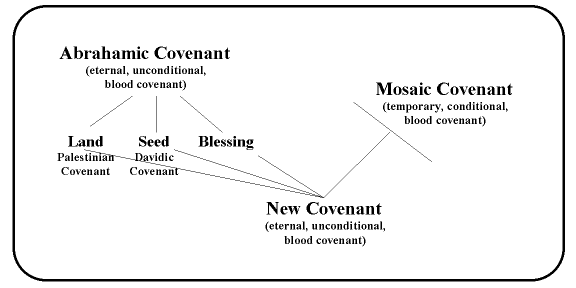
This New Covenant is prophesied as being made with the nation of Israel in the last days. It will make old the first covenant (Mosaic Covenant was the first covenant made with the nation), and will thus supercede it. The Mosaic Covenant was never spoken of as an eternal covenant, yet all of the other covenants made with Israel were somewhere in Scripture called eternal covenants.
As we have said, the problem with the Old Covenant of the law was not in the law itself because it was holy, righteous and good (Rom. 7:12). The problem was with the heart of man. The New Covenant solves this problem by changing the heart (Jer. 31:33). This will involve a complete understanding of the Lord (Jer. 31:34a). Teachers of the Lord will be out of a job in that day. Man will be back in the place of fellowship with God which was lost in the Garden of Eden. Moreover, God will do a complete work in reference to sin (Jer. 31:34b). This is just a few of the things Scripture tells us concerning this glorious covenant.
The Church’s Relation to the New Covenant
What does Scripture tell us? Is the New Covenant already in existence? Has it already been made with the church? I would answer as Paul answers: Me Genoito (translated: “God forbid”).
(1) Paul says the covenants pertain to Israel, and the church is not Israel, for God will yet deal with Israel (Rom. 11:26-29) in covenant relationship. Now if the church is Israel, then who in the world is Israel?
(2) The New Covenant is specifically said to be made “with the house of Israel, and with the house of Judah” (Jer. 31:31). The Lord makes no mistakes in His wording. He says what He means and means what He says. He doesn’t say “Israel” and mean “The Church.” The writer of Hebrews confirms this truth. By stating both houses, it has to refer to the nation of Israel (Heb. 8:8). Verse 9 shows them to be the same people God led out of Egypt. This also has to refer to Israel.
Now just which house is the church? It is neither “house.” God never entered into a covenant with my father, did He with yours? The church is not composed of just those of Israel, but it is composed of Jew and Gentile. The church is one new man.
(3) The Covenant will be enacted at the second coming of Christ (Rom. 11:26) with the coming of a Deliverer that will do a complete job in reference to sin in Israel. This was never done when Christ came the first time. In fact, at the first coming of Christ, the sins from Abel to Zecharias were required of that generation; they were not removed.
This period when the Covenant will be made is spoken of as “the last days.” The first coming of Christ is never called the last days. Moreover, when this New Covenant is made, Israel will be the Lord’s people and they will have the Lord as their God. They will teach no one to know the Lord for all will know Him. The Lord will forgive their sins and remember them no more. None of these things have yet been fulfilled, so therefore, the New Covenant has not been made as yet.
In summary then:
- The Great Deliverer has not come and turned away ungodliness from Jacob.
- The last days have not been fulfilled.
- The teaching of the Person of the Lord today is very necessary for all men do not know Him.
- The forgiveness of sins has not occurred in reference to Israel.
- Consequently, the New Covenant has not been made with the house of Israel and with the house of Judah, and this exactly what the writer of Hebrews states.
No Scripture anywhere says the New Covenant has been made with the Church. What Christ said at the last supper was: “This is my blood of the new covenant” (Matt. 26:28 and Mark 14:24), and “This is the new covenant in my blood” (Luke 22:20 and 1 Cor. 11:25). The blood of the New Covenant is not the New Covenant. The New Covenant in blood is still not the New Covenant itself.
What is involved? When Christ returns to the nation of Israel and appears the second time., He will appear without sin (Heb. 9:28). At His second appearing there will be no sacrifice for sin and no blood ratifying of the New Covenant that will be made. The blood sacrifice will have been made years before at the Lord’s first coming. This sacrifice of blood at the first coming will ratify the New Covenant with the nation of Israel at the second coming. The one sacrifice of Christ is the basis of everything, and of every provision.
Here then is the picture. Just as Moses went up on the mountain to receive the Old Covenant and was thus the mediator of the covenant between God and the people, so Christ has ascended to heaven itself and is the mediator of a better covenant. “But now hath he obtained a more excellent ministry, by how much also he is the mediator of a better covenant, which was established upon better promises” (Heb. 8:6).
Hebrews 12:24 says in reference to the city to which we are to come and to its inhabitants: “… and to Jesus the mediator of the new covenant.” He is the mediator of the New Covenant but has never returned to enact that New Covenant with the people to whom the covenant belongs. Just as the covenant was not enacted with the nation until Moses came down from the mountain, so the New Covenant of which Christ is the Mediator today will not be enacted with the nation until Christ returns “without sin unto salvation”
8 For finding fault with them, He says, "Behold, days are coming, says the Lord, When I will effect a new covenant With the house of Israel and with the house of Judah; 9 Not like the covenant which I made with their fathers On the day when I took them by the hand To lead them out of the land of Egypt; For they did not continue in My covenant, And I did not care for them, says the Lord. 10 "For this is the covenant that I will make with the house of Israel After those days, says the Lord : I will put My laws into their minds , And I will write them upon their hearts . And I will be their God , And they shall be My people. 11 "And they shall not teach everyone his fellow citizen, And everyone his brother, saying, 'Know the Lord,' For all shall know Me, From the least to the greatest of them. 12 "For I will be merciful to their iniquities, And I will remember their sins no more." 13 When He said, "A new covenant," He has made the first obsolete. But whatever is becoming obsolete and growing old is ready to disappear (Hebrews 8:8-13).
… so Christ also, having been offered once to bear the sins of many, shall appear a second time for salvation without reference to sin, to those who eagerly await Him (Hebrews 9:28).
You will remember that while Moses was on the mountain mediating the Covenant that the nation was in unbelief. God desired to cast them off from His sight. Moses interceded and the covenant was made ultimately with the nation after a second attempt.
This is what is taking place today. The nation of Israel is in unbelief (Rom. 11:20; etc.). During this time when the nation is in unbelief, anyone (Jew or Gentile) may be saved by faith, by believing in the One who is greater than Moses who has ascended to the Mount of God and is today mediating the New Covenant.
“By so much was Jesus made a surety” (literally “guarantee”) “of a better testament” (Heb. 7:22). Why is Jesus the guarantee of a better testament or covenant? Simply because the better covenant has not been enacted yet. If it had been enacted you would not have needed the guarantee that it will be. Because of the shed blood, we who are believers today believe that the New Covenant will be enacted. We are saved by the blood of the New Covenant, which is called in Hebrews 13:20 “the blood of the everlasting covenant,” because this covenant once made will never give place to another throughout all eternity.
The New Testament believer today comes under the blessings of the blood of the covenant, and is “by faith” appropriating from the Mountain of God’s throne the mediatorship of the Lord Jesus Christ. Israel, in unbelief, never approaches this Mountain; we by faith and by blood approach it as a throne of grace, not judgment.
You should never confuse the blessings which the believer enjoys today because the New Covenant promise has been ratified by the blood sacrifice of the Lord Jesus Christ, and the fulfillment or enactment of the New Covenant with Israel at the second coming of Christ. These are two completely distinct and separate entities. The ratification has only made it doubly sure. It has made the oath (or promise God previously made) an absolute surety of fulfillment. It has not fulfilled the promise; it has only guaranteed its fulfillment. Jesus today in the Father’s presence is the guarantee of its future fulfillment.
Thus the believer has two immutable things upon which to stand by faith in which both are impossible for God to lie (Heb. 6:18). The one is God’s promise or oath. The other is His ratification of the New Covenant promise with the very blood of His own Son. Just as the Abrahamic covenant had blessings that extended to the whole world so does the Hew Covenant and we by faith today through blood may experience those blessings.
The Lord has given temporary tokens to believers today as symbols that the New Covenant will be enacted. These temporary tokens which we are to do until He returns are the bread and the cup. They tell the story of the sacrifice that ratifies the covenant until the covenant itself will be enacted with Israel at the time of the Lord’s return. This is why they are only temporary: “till he come” (1 Cor. 11:26). This is why the believer must wait and patiently endure. In the meantime “we have an altar, whereof they have no right to eat which serve the tabernacle” (Heb. 13:10).
When we accept Christ as our personal Savior, we are exercising personal faith in what Christ did for us in dying for our sins. This is our part. God’s part is to unconditionally save us and all who believe in His Son—His person and His work.
And, as Moses lifted up the serpent in the wilderness, even so must the Son of man be lifted up, That whosoever believeth in him should not perish, but have eternal life. For God so loved the world, that he gave his only begotten Son, that whosoever believeth in him should not perish, but have everlasting life (John 3:14-16).
Related Topics: Soteriology (Salvation), Introductions, Arguments, Outlines