

Revisiting the Colwell Construction in Light of Mass/Count Nouns
Related MediaIntroduction1
Increasingly Colwell is cited as evidence of a determinate semantic reading of John 1:1c.2 Both orthodox and otherwise utilize Colwell’s rule to promote not only different but contradictory interpretations of this passage—obviously contradictory interpretations cannot at the same time and in the same way be true. Adding to this problem, otherwise careful scholars misstate and misunderstand Colwell’s rule. Worse yet, nothing innovating or revolutionary has come to bear regarding Colwell’s rule or construction in over twenty years.3 The time is ripe, therefore, for not only understanding Colwell’s rule, but for setting forth an entirely new paradigm from which to understand the construction per se.
The purpose of this article, then, is first to clearly articulate what has become known as Colwell’s rule, including its abuse, then to enunciate a revolutionary method by which to better understand the Colwell construction. This latter will be accomplished by the utilizing of the mass/count noun distinction.4 Finally we wish to apply these results to the New Testament as a whole, then to the Gospel of John in particular as a case study.5 It is hoped that this method can aid in a more scientific approach to this grammatical construction and assist in making a more surer semantic determination of the phrase καὶ θεὸς ἦν ὁ λόγος and other significant passages appearing in this construction.
Colwell’s Contribution to Anarthrous PNs
In 1933 Ernest Cadmen Colwell wrote his celebrated article on “A Definite Rule for the Use of the Article in the Greek New Testament” in which he claimed, “Definite predicate nouns which precede the verb usually lack the article.”6 This brief assertion, spawning as the exception to regular articular definite nouns, respected the predictability of anarthrous but definite PNs that precedes the copulative verb—it is better known as Colwell’s rule. Since this monumental article is the basis for what follows, and is the object of much abuse, it is therefore incumbent to allow Colwell to speak for himself and then follow this by pointing out both the legitimacy of Colwell’s rule, as well as the methodological assumptions and/or flaws that pre-determined its outcome. The consensus that followed his article will be briefly noted along with the misunderstandings that have come to be associated with it. This historical evaluation will then prepare the way for an entirely different methodological approach from which to better treat the construction itself.
Colwell’s Rule
Colwell’s study began, according to his article, in response to Torrey who claimed that certain nouns, three of which were precopulative PNs, were anarthrous in John due to Semitic influence (1:49; 5:27; 9:5).7 So in part, Colwell wanted to dispel this notion in favor of a view that understood this phenomenon as part of NT usage rather than Semitic influence. It was the result of studying these passages that Colwell arrived at his rule(s) regarding the usual omission of the article in the pre-copulative PN construction.
He began with John 1:49 where both a post-copulative articular construction and a pre-copulative anarthrous construction were used with apparent semantic equivalence, i.e., with definiteness. Contextually the verse is the affirmation of Nathaniel to Jesus in response to the latter’s ability to supernaturally see him under a fig tree. Nathaniel exclaims, ῥαββί, σὺ εἶ ὁ υἱὸς θεοῦ, σὺ βασιλεὺς εἶ τοῦ ᾿Ισραήλ (1:49b). Colwell asked himself, “What reason is there for this difference” [i.e., semantical, grammatical or syntactical between the two PN constructions in σὺ εἶ ὁ υἱὸς θεοῦ and σὺ βασιλεὺς εἶ τοῦ ᾿Ισραήλ]? When the passage is scrutinized, it appears at once that the variable quantum is not definiteness but word-order.”8 Therefore, according to Colwell, “It seems probable that the article is used with ‘Son of God’ because it follows the verb, and it is not used with ‘King of Israel’ because it precedes the verb.”9 Confining himself to instances where the copula was expressed he states a rule: “A definite predicate nominative has the article when it follows the verb; it does not have the article when it precedes the verb.”10
From this initial observation he then follows with several points of validation and ends with his classic statement of his rule, “Definite predicate nouns which precede the verb usually lack the article.”11 Thus by assuming semantic equivalence (definiteness), Colwell shifted the focus on structure as determinate of the syntactic and grammatical difference—i.e., why in a post-copulative construction it is articular, and why in a pre-copulative construct it is anarthrous. The grammatical shift regards articularity or lack thereof, while syntactic refers to pre or post copulative occurrence.
Argument. First, Colwell felt that important to his argument, in demonstrating the validity of this rule, were verses which had the article and then did not have it.12 What he appears to mean by this is that words such as “king” or “Son of God” used in contexts referring to Jesus which did not have the article, and then in other contexts referring to Jesus using the article, were vital in confirming the hypothesis underlying his rule—that definite PNs which preceded the copulative verb were usually anarthrous. Therefore, he argued the occurrence of like nouns validated the proposition of his rule, i.e., if the anarthrous construct appeared in one instance antecedent to the copulative verb while the articular construct appeared in another instance subsequent to the copulative verb with the identical semantic nuance, then the rule was legitimate. Therefore from the start Colwell begins with a semantic category of definiteness, a definiteness established by its post-copulative articular occurrences elsewhere, and proceeds to investigate for instances of its anarthrous occurrence in a pre-copulative construction.
He focused on several specific phrases which allegedly demonstrate this phenomena including “King of the Jews,” “King of Israel,” “Son of God,” “Son of Man,” “light of the world,” and the phrase “my mother,” where both syntactic and grammatical conditions were met. Of special interest was Matthew 13:37-39 where “in a series of seven clauses the predicate nouns follow the verb and take the article five times; while in the last two clauses equally definite predicate nouns precede the verb and do not have the article.”13 Again it must be stressed, semantic equivalence was assumed on the basis of this observation.
Second, Colwell offered proof of this phenomenon of word order as “easily obtained from the very grammarians who are unaware of its existence.”14 He notes Robertson’s admission that out of 41 occurrences of articular PNs, 38 follow the verb rather than the reverse.15 After then citing Blass-Debrunner,16 who incidentally list articular constructions following the verb, he states, “it is significant that they found them after the verb.”17 This second argument is really a confirming of the first but here the mere numerical preponderance of post-copulative articular PNs, as a rule, brings out the disproportion of the same in the pre-copulative occurrence. Again, his point is that the article in not needed because this variation (pre-copulative) impugned the lexeme with definiteness without need of recourse to the article.
A third argument came from an observation within the manuscript evidence in the nature of variants regarding the article. Here he argues the following:
Such a simple omission or addition [of the article] would of itself prove little for the theory advocated here, but when the omission or addition of the article is accompanied by a change of word-order, we have evidence of high value. Such evidence would seem to indicate that the relation between word-order and the use of the article was as real to the scribes who copied the MSS as it was to the original authors.
In the course of this study I noted three passages [John 1:49; Matt 23:10; Jas 2:19] in which the article issued by one group of MSS and omitted by another group with a change in word-order. In each of these passages Westcott and Hort’s Heavenly Twins (Codex Vaticanus and Codex Sinaiticus) disagree; yet both of them support the rule stated in this paper. That is to say, their variation is from one to the other of the alternatives described in this rule . . . . It is interesting that B each time has the predicate before the verb without the article, while a each time has the predicate after the verb with the article . . . These are enough to indicate that the scribes felt that a definite predicate noun did not need the article before the verb and did need it after the verb.18
In all he tallied 254 occurrences of articular PNs noting 239 as post-copulative and only 15 pre-copulative.19 He also tallied the anarthrous occurrences totaling 139 of which 99 were pre-copulative and 40 were post-copulative (this included relative clauses).20 Subtracting relative clauses he arrived at two different ways of examining these figures. 21
When a document is going to be converted to htm format for viewing on the web we can’t use any tabs, extra paragraph returns, or more than one space. Everything extra is eliminated when the file is converted so formatting has to be done via styles or tables. Here I put an equal symbol to separate the numbers, but you can change this however you want it.
I. Definite Predicate Nouns with Article . . . . . . . . . 244
A. After Verb . . . . . . . . . . . . . . . . . . . . . . . . .229 = 94%
B. Before Verb . . . . . . . . . . . . . . . . . . . . . . . . . 15 = 6%
II. Definite Predicate Nouns without the Article . . . . . .123
A. After Verb . . . . . . . . . . . . . . . . . . . . . . . . . . .26 = 21%
B. Before Verb . . . . . . . . . . . . . . . . . . . . . . . . . .97 = 79%
I. Definite Predicates after the Verb . . . . . . . . . . . . . . 255
A. With the Article . . . . . . . . . . . . . . . . . . . . . .299 = 90%
B. Without the Article . . . . . . . . . . . . . . . . . . . . 26 = 10%
II. Definite Predicates before the Verb . . . . . . . . . . . . .112
A. With the Article . . . . . . . . . . . . . . . . . . . . . . 15 = 13%
B. Without the Article . . . . . . . . . . . . . . . . . . . . 97 = 87%
Colwell noted that in his tabulations he had omitted qualitative nouns “since all such nouns (and their total in the New Testament is small) are not definite.”22 Thus Colwell has started with a semantic category of definiteness and proceeded to figure out the ratio of this to syntactic factors (pre or post-copulative) and grammatical features (articular and anarthrous). He notes two exceptions to his rule: (1) He found fifteen nouns which do precede the copulative verb and are articular,23 and (2) He recorded 26 occurrences where the omission of the article after the verb which he nevertheless viewed as definite.24 He also goes outside the NT including the LXX and the Didache with somewhat the same statistical ratio.
Conclusions. All this he concludes has implications for grammar, the text and translation or interpretation. In relation to grammar, predicate nominatives with the verb should not be regarded as regularly omitting the article, for two-thirds of definite predicate nouns have it. In regards to the article he gives two broad rules the second of which amounts to exceptions to his first:
(1) Definite Predicate nouns here regularly take the article. (2) The exceptions are for the most part due to a change in word order: (a) Definite predicate nouns which follow the verb (this is the usual order) usually take the article; (b) Definite predicate nouns which precede the verb usually lack the article; (c) Proper names regularly lack the article in the predicate; (d) Predicate nominatives in relative clauses regularly follow the verb whether or not they have the article.25
For textual criticism the issue involves predicting deliberate scribal tendencies to amend the text. When the case involves finding a pre-copulative articular construction (a rarity) with other variants which, in their individual cases, have either the articular post-copulative rendering, or the pre-copulative anarthrous one, then separate rules apply. In the first, where a pre-copulative articular is found, it is to be preferred over the post-copulative articular one (cf. 2 Pet 1:17). That is, it is more likely that the former gave rise to the latter than the reverse since it is a rarer rendering. The second regards when articular PNs are found in a pre-copulative occurrence and other readings have the anarthrous pre-copulative PN rendering. In this case the latter anarthrous reading, with the understanding that the noun is clearly (or assumed) definite, is to be preferred as more than likely the original—i.e., more likely to give subsequent rise to the former rather than the reverse.26
However it is the last area, translation and interpretation, that Colwell regards his rules as having the most value. He states in negative terms that
A predicate nominative which precedes the verb cannot be translated as an indefinite or a “qualitative” noun solely because of the absence of the article; if the context suggests that the predicate is definite, it should be translated as a definite noun in spite of the absence of the article. In the case of a predicate noun which follows the verb the reverse is true; the absence of the article in this position is a much more reliable indication that the noun is indefinite. Loosely speaking, this study may be said to have increased the definiteness of a predicate noun before the verb without the article, and to have decreased the definiteness of a predicate noun after the verb without the article.27
With this in mind, therefore, he tackles John 1:1c regarding it as a definite noun arguing that its anarthrous occurrence does not argue necessarily for qualitativeness or indefiniteness. He supports this by referencing to the confession of Thomas, ὁ κύριός μου καὶ ὁ θεός μου (20:28).
Evaluating Colwell’s Rule
There are several problems with Colwell’s method of tabulation as well as statement of rules. To Colwell’s credit, however, he chose a wide base of samples, in fact he apparently included the entire NT.28 Furthermore, we have found that the rule with which Colwell is most acclimated with (2b above) is actually a verifiable (and falsifiable) one. The method he used to gather this information is somewhat suspect, but the rule itself is valid.
But this leads us to consider some of the problems with Colwell’s method of investigation. First, he begins with a semantic category (definiteness) which is apparently established prior to the investigation of pre-copulative anarthrous constructs themselves, and proceeds to make an observation in regards to its articularity or lack thereof. Thus he omits obviously “qualitative” nouns up front. But presumably he acknowledges such do exist in the construction under discussion, for he mentions the clause ὁ θεὸς ἀγάπη ἐστιν (1 John 4:8).29 So obviously he does not view all pre-copulative PNs as definite. But the criticism here, is his limitation to a specific semantic category rather than to the construction itself as the starting point.
Second, he determines definiteness of a pre-copulative anarthrous PN based on its articular occurrence in a post-copulative construction. Calculating to this semantic determination, however, assumes that the noun is fixed to a semantic nuance simply because it occurs in another construction (post-copulative) with articularity that is clearly (for the sake of argument) definite. That the same noun which occurs in a post-copulative articular construction, can be found in a pre-copulative anarthrous occurrence, on the one hand, does not rule out the identical semantic nuance being present, but on the other hand, the demonstration of semantic equivalence by Colwell is more presumed than demonstrated. His assumption has become prescriptive and is not based on the construction (pre-copulative anarthrous PNs) itself, but on a noun’s semantic occurrence elsewhere. By showing that the noun can be definite in a post copulative articular construction by no means demonstrates its semantic nuance in a pre-copulative anarthrous construction. In short, Colwell commits a grammatical as well as a syntactical category mistake.30
Third, Colwell appears to be responsible, because of his application to John 1:1, for laying the groundwork of a logical blunder.31 Colwell’s rule “Definite predicate nominatives that precede the verb usually lack the article” came to be seen as “Anarthrous predicate nominatives that precede the verb are usually definite.” We have affirmed, based on our study, that Colwell’s original rule is valid but the converse of his rule is inductively falsifiable. In fact our study confirms that within the NT as a whole, this semantic category (definiteness) is certainly not the expected nuance of the construction, and not the predominant sense when it comes to singular count nouns as well. Thus this converse is neither true of the whole nor of its parts. So although definiteness is a possible semantic category, it is certainly not the probable one regarding anarthrous constructions. In addition, although the converse of Colwell’s rule is not formally illogical, it is inductively falsifiable.32
Fourth, Colwell seems to have misunderstood what a definite semantic to the noun entailed linguistically.33 His improper method of prescription, based on his analysis, led him to commit a category mistake by foisting a semantic upon a certain group of nouns (pre-copulative PNs) that he failed to appreciate on their own terms. Because of this, and apparently without considering the ramifications of what the semantic suggested, he applied it to John 1:1c and argued against the indefinite or qualitative sense. But this was an improper use of his own rule, for his rule was only to be applied post hoc to nouns clearly understood to be definite from context. But here is where the problem of his method shows up starkly. Because John 20:28 has the articular θεός, he assumes that its pre-copulative anarthrous occurrence bears the same semantic. But this is simply an example of pigeonholing a noun into a semantic box based completely on the semantics born out in a separate construction. Count nouns can bear different nuances without the article than it can with the article—Colwell has not properly understood this principle.34 In short he begged the question by making his rule prescriptive rather than descriptive of the majority of cases involving definite nouns preceding the copulative verb.
Fifth, his initial conclusion of definiteness, in regards to John 1:49, did not take into consideration other factors which make the noun definite independent of word order, like the presence of genitive adjuncts.35 Therefore, many of what he considers definite PNs in the pre-copulative construction can be attributed to other factors besides the transferal leap he makes, requiring semantic congruity based on its articular occurrence in post-copulative constructs. It is here that another methodological fallacy emerges. Grammatical analysis must carefully identify, within the batch of samples, any factors that would tend to slant the conclusions towards a predicted outcome independent of the actual focus of study. Thus Colwell should have omitted PNs which had genitive adjuncts, proper names, or monadic nouns—for these factors tend to definitize the head noun. Conversely, factors influencing the opposite semantic category should be omitted as well. Thus qualitative nouns should be identified and omitted from contaminating the statistical pool towards that semantic nuance.36 It is the construction that we wish to understand, and its affect upon the semantics of the noun, a noun which has the possibility of multiple semantic options, that can bring out the semantic predilection of the construction itself. In short, the samples must be free of semantic bias. Colwell’s study fell short in this area.
Where he regarded his rule most important, in the area of translation and interpretation, is exactly where it is in fact most irrelevant yet ironically most dangerous, especially the latter. When his rule is applied prescriptively in the fashion he and others since him have, it is most damaging to the semantics of the pre-copulative anarthrous construction as a whole. For when it is determined that most pre-copulative anarthrous PNs are in fact not definite, then one has to ask what use the rule serves at all in determining such. It is one grand question begging venture, therefore, to cite his rule for ascertaining any semantic preponderance anywhere, not to mention disputable passages like John 1:1c.37
Illegitimate Usage of Colwell
Thereafter Colwell’s conclusions were accepted nearly unanimously in the scholarly world.38 Many evangelicals, because of the implications to John 1:1, unwittingly assumed, as Metzger did, the converse of Colwell’s rule which led to its abuse.39 His actual rule states, “Definite predicate nouns which precede the verb usually lack the article.”40 This statement, however, was taken to imply that anarthrous predicate nominatives that precede the verb are usually definite.41 This type of abuse bled into the commentaries on John as well. Later research seriously questioned this consensus of opinion by attempting to demonstrate that pre-copulative anarthrous PNs were predominately qualitative in nature,42 a fact not considered seriously enough within the semantic range of some, including Colwell.43
The first ground breaking work subsequent to Colwell was done by Philip Harner.44 He suggested that “anarthrous predicate nouns preceding the verb may function primarily to express the nature or character of the subject, and this qualitative significance may be more important than the question whether the predicate noun itself should be regarded as definite or indefinite.”45 What was unusual about Harner’s thesis was the assertion of quality for the pre-copulative PN within a consensus of opinion that had assigned the construction to an either-or semantic situation, i.e., either indefinite or definite.46 He found that Mark, for example, was a careful author who used various constructions deliberately to indicate specific semantic nuances. Mark uses the formula V + PN, for example, nineteen times to indicate an indefinite sense and the formula V + T + PN twenty times to indicate a definite sense. However, he uses the formula PN + V eight times with apparent intentional variation on word order for qualitative emphasis.
Looking at these eight passages47 individually Harner reasoned that although the nouns could be either indefinite or definite, they could also simultaneously have a qualitative force due to the construction.48 His conclusions, based on Mark’s Gospel, showed a preponderance of the construction away from that affirmed by Colwell and almost unanimously qualitative in force as the primary meaning. Evidently he included the possibility of quality independent of either the definite or indefinite nuances too, as his treatment of John 1:1 seems to indicate. In other words, he appears to include, open up or establish the proposition for distinct semantic alternatives to encompass both Q or I-Q and D-Q as viable qualitative semantic domains.
He next turned his attention to John’s Gospel where he found fifty three occurrences of the construction PN + V. He limited his focus to a handful of examples including John 1:1 καὶ θεὸς ἦν ὁ λόγος. He first showed, as earlier with Mark, that John was familiar with other ways of structurally expressing the qualitative sense indicated in the formula V + PN. He uses this construction eighteen times with only one exception to the rule. Harner also indicates that John is equally familiar as Mark to the structural options possible for expressing definiteness indicated in the formula V + PN. He uses this particular construction some sixty times. Out of these, Harner viewed forty to be predominantly qualitative, over both indefinite and definite, as the primary or exclusive meaning. After examining a few passages (1:14; 8:31; 9:24) he concludes that “John used this type of syntactical construction in essentially the same way as Mark.”49 However, it should be recognized that Harner did not make any distinction between mass and count nouns as seen in his treatment of John 1:14. Again, the fact that “flesh” is mass makes it qualitative irregardless of the construction, thus it is lexically qualitative irrespective to syntax.
Harner goes on to illustrate the semantic possibilities as syntactically available at the time to rule out some of the interpretive options to John 1:1. He lists five options in all. (1) ὁ θεός ἦν ὁ λόγος, represents a convertible proposition—leads to Sabellianism. (2) θεὸς ἦν ὁ λόγος, represents a subset proposition—the word has the nature of deity rather than something else. (3) ὁ λόγος θεὸς ἦν, represents a subset proposition—the word, rather than something else, has the nature of deity.50 (4) ὁ λόγος ἦν θεὸς, represents a subset proposition—a god distinct but belonging to the same category of deity (Mormonism/Arianism). (5) ὁ λόγος ἦν θεῖος, represents a subset proposition—either a god or God having the attributes of deity (could support monotheism or polytheism). Regarding John 1:1 he concludes, “I think that the qualitative force of the predicate is so prominent that the noun cannot be regarded as definite.”51
The important contribution of Harner’s study was the recognition that the lexeme, whether viewed ultimately as definite or indefinite, did not necessarily rule out qualitative aspects, and if a noun was viewed as qualitative this did not necessarily rule out indefiniteness or definiteness. What he categorically did not affirm was that qualitativenss always includes indefiniteness—although this might be assumed with some warrant.52 Thus he got past Colwell and others’ disjunctive fallacy and furthered the range of semantic possibilities.53 What his contribution lacks, however, is the identification of lexically qualitative nouns. In other words, he includes within his tabulation nouns which are lexically already qualitative despite syntax. His study, therefore, opens up the avenue to search for nouns which cannot be indefinitized and which are exclusively qualitative. We hold that mass nouns fulfills the requirements for this search.
Qualitative Nouns
What is a Qualitative Noun?54
A recent book has clouded the point of Harner’s article over the issue of the semantics of qualitative nouns.55 It is true that Harner opened up the possibility that a qualitative noun could include within it a semantic addition of indefiniteness, but this in no way made qualitativeness intrinsically or necessarily bound to this semantic tag. Thus Harner showed that theoretically a noun could be, among other things, indefinite-qualitative (I-Q or Q-I) or simply qualitative (Q). However, to demonstrate the absurdity that a noun must be of the semantic category I-Q (Q-I) if affirmed as being of a qualitative nature (Q), one simply has to encounter the semantics of a mass noun. A mass noun, as we shall see below, is a noun that by definition cannot be semantically indefinitized or pluralized. Semantically, therefore, this noun is always qualitative and qualitativeness always implies a subset type proposition. If this can be acquiesced to, in lieu of the attempt to lay out the criteria for the determination of such below, then the idea that qualitativeness must entail indefiniteness falls to the ground.
Following successively this necessary progression in our argument, it opens up the treatment of count nouns, which can include indefiniteness (I), with the concurrent possibility of semantic qualitativeness (I-Q [or Q-I]) or without indefiniteness necessarily being involved at all (Q). Thus count nouns by definition are nouns which can be semantically indefinitized and semantically pluralized. Therefore, in contrast to mass nouns, which cannot be indefinite in any sense, count nouns proffer the possibility of being purely qualitative like mass nouns. That is, although retaining the lexical feature of possible semantic indefiniteness and/or plurality, the count noun also retains the potentiality of exhibiting neither but rather mimicking the semantic of the mass noun—it is thus a semantically versatile noun.56
Thus, the establishment of mass nouns as exclusively qualitative provides the basis for the semantic idea of qualitativeness as distinct from indefiniteness without ruling out the fact that it is perfectly viable to have a noun that is both indefinite and qualitative at the same time (although the latter is impossible for a mass noun in either purely I or the blended I-Q). The contribution to understanding the semantics of mass nouns, then, regards the fact that there are nouns which exhibit purely/exclusively qualitative features without the possibility of indefiniteness within its semantic. Demonstrating this opens up the feasibility of the transferal of that semantic category to other nouns (count) which do have the prospect of indefiniteness without necessarily latching the latter semantic tag with it. Therefore, the study of mass nouns prior to count nouns is a logical one—Q is possible without inferring I-Q (Q-I). We want to preserve rather than blur, for the purposes of greater semantic clarity, this distinction.
Linguistic Analysis of Qualitative Nouns
What kind of a proposition does a qualitative noun in a PN construction imply? Usually the discussion revolves around convertibility verses non-convertibility. Convertibility refers to the interchangeability of subject and PN without a necessity in the change of referent. Non-convertibility, or a subset type of proposition, refers to a subject being a part of the larger category represented in the PN. An example of the former is “All bachelors are unmarried men.” An example of the latter is “All dogs are animals.” The former is convertible whereas the latter is not. In regards to subset type propositions, moreover, there is a difference between an indefinite and qualitative PN. In the statement “He is a man” where “man” indicates the class to which “he” belongs is different than “He is human” where “human” is the qualities that mark the “he” under discussion. Both are subset propositions, neither of which are mutually exclusive, but neither are they necessarily united.57
Beyond this, however, something needs to be noted in regards to inferred subjects in relation to the explicit subject within subset type propositions. This will impact how one views John 1:1c and minimize the equivocation of the PN in relation to multiple (actual, implicit or possible) subjects. Moisés Silva has provided a sense-relation paradigm for nouns from which to view qualitative propositions as distinct from purely referential statements.58 He has relations based on similarity including overlapping relations (proper synonymy), contiguous relations (improper synonymy), inclusive relations (hyponymy) and those based on oppositeness including binary relations (antonymy) and multiple relations (incompatibility).59 For our purposes we will focus on relations based on similarity.60
Type of proposition. In determining sense relations we want to focus on two questions. The first question pertains to what type of relationship exists between the S and the PN. Using John 1:1 as a guide the question is, What relation does the S, ὁ λόγος occupy in relation to the PN θεός in John 1:1c? If it is an overlapping relation or proper synonymy then the S = PN and PN = S, thus it is a convertible proposition. But if the referent to θεός has been contextually determined to be the Father (1:1a, 1b) then the referent to which the convertible sense inevitably points to is the Father only. Thus the λόγος = θεός (the Father) which amounts to Sabellianism. In other words, although the sense does not necessarily mean that the Word = the Father, the context determines that θεός has been used (twice) to refer to the Father. And if the proposition is determined to be convertible, there is no other contextual (extralingual) referent to infer otherwise as to who θεός would be but the Father.
The second alternative would be to propose a contiguous relation or improper synonymy where S ≠ PN. In other words, these terms never occupy a sense in which they are interchangeable but instead relate at a higher level. Therefore the ὁ λόγος is not θεός in any sense as identified by context that θεός has been. This contiguous relation is to be rejected outright because it denies a relationship to which the text clearly affirms there to be, namely that the Word is God. In other words, the S ὁ λόγος is clearly in some sense related to θεός. To affirm that the Word is not God is as silly as saying that walking is not traveling because flying has been used of traveling in context twice before. In short, the copulative verb excludes this sense relation entirely.
A better alternative is to propose an inclusive relationship or hyponymy where ὁ λόγος occupies the subset to the overarching PN θεός (superordinate). In this sense θεός could be stressing either the class (generic)—therefore ὁ λογός would be a member of that God-class, or understood as purely qualitative stressing the character of the subject but without diminishing either the nature of the PN or eliminating other members to which the PN in its qualitative sense can refer to. In regards to its previous occurrences (1:1a, 1b) θεός referred to the Father indirectly in distinction to the Word thus avoiding convertibility, whereas the latter it refers to an already explicit subject (ὁ λόγος) where it could not be taken as a convertible proposition (1:1c). To propose that θεός, as an overarching category, is other than the same characteristics assumed in its previous occurrences (apart from personal referentiality), is to foist unwarranted equivocation on the text.61
Relation of hyponyms. The second question we want to focus on is this: What relation does ὁ λόγος in John 1:1 occupy in relation to the Father if the PN θεός is the overarching category (superordinate) to which each hyponym (Word and Father) belong? In other words, if we assume that θεός in 1:1 always denotes, whether it is referring to the Father or the Word, the same characteristics, then we must assume they are within the same superordinate, and thus must ask what relationship they exercise in regards to each other. Do they exhibit an overlapping, contiguous, or inclusive relationship? In other words, if we assume that the proposition καὶ θεὸς ἦν ὁ λόγος is a subset type proposition where θεός occupies the paradigmatic slot of superordinate, while ὁ λόγος occupies the paradigmatic slot of hyponym, then the question focuses on the relationship between the Father (assumed from context) and ὁ λόγος (1:1c) to θεός (1:1c).
Again, if the relationship is overlapping then in some way the Word = the Father—a contextually difficult position to sustain in light of the distinction maintained by the phrase καὶ ὁ λόγος ἦν πρὸς τὸν θεόν. If the relationship is inclusive then somehow the Word is a subset of the Father or visa versa. This option is perhaps better left for the psychologist to deal with rather than the grammarian. But if the relationship is contiguitous, then a personal distinction can be maintained between the two (or perhaps more) hyponyms yet still affirm one superordinate to which each equally belongs. In other words, if both walking and running are part of the larger category of traveling then walking is not running, but neither does this rule out a third alternative such as jogging is traveling. This understanding leads one neither to equate the hyponyms (walking = running), or hyponym with superordinate (walking = traveling) nor to equivocate on the superordinate (traveling ≠ traveling). It is according to these types of sense relations that we believe John 1:1c exhibits linguistically.
With these two issues in mind, therefore, we shall lay out briefly the criteria for determining mass nouns, what this entails semantically and then proceed to tackle the issue of identifying count nouns. It is the latter that furnishes us with exegetically disputed passages. In the process semantic tags will be assigned to certain types of nouns quite independent of context but based solely on lexemic factors. In other words the reader will encounter a possibility of six semantic tags, which we deem to both clarify the issues more accurately and establish greater clarity in regards to the denotative idea of qualitativeness. The six semantic tags are Q-d (qualitative-definite), D-q (definite-qualitative), D (definite), Q (qualitative), I (indefinite) and I-Q (indefinite-qualitative or Q-I).62 After we examine mass nouns and establish a clear idea of what qualitativeness means, then we shall understand better why this apparent redundancy of semantic tags is necessary in the discussion. Finally, the NT as a whole and John’s Gospel in particular will be examined according to this scheme in order to consider what semantic preponderance is established for count nouns. The statistical results will be applied to the semantically disputed PN in John 1:1c—καὶ θεὸς ἦν ὁ λόγος.
Mass and Count Nouns
The purpose of this section regards the identifying of mass nouns linguistically and applying that criteria to the Greek of the New Testament with the goal of understanding them in the Colwell construction. The intention then is fourfold: (1) to identify mass nouns, (2) to demonstrate that pre and post-copulative mass nouns are semantically equivalent, (3) to partially account for mass nouns in the pre-copulative construct or at least have a working hypothesis, and (4) to isolate count nouns for detailed study.
The post-copulative anarthrous construct has been used as a “control group” to determine both the semantic weight of pre-copulative constructs and the exegetical weight afforded that construct by the New Testament authors. In order to clearly identify the Greek mass noun, it is necessary to understand the linguistic characteristics of it in general as outlined by various linguists and philosophers.63 The following amounts to the justification for the classification of mass terms which are found in this paper.
The discussion below develops along three areas of focus: grammatical characterizations, philosophic characterizations and semantic interpretations based upon interactions among linguistic constructions.64 The grammatical involves specifying the factors that identify mass nouns as opposed to count nouns. The philosophic involves understanding nouns from a sortal/nonsortal distinction, while the semantic deals with their behavior in a variety of constructs—including (for our purposes) pre and post-copulative occurrences with various adjuncts.
Criteria of Mass Nouns
Grammatically, Givon and Otto Jespersen each attempt to describe the phenomenon of mass verses count nouns. Givon states,
Mass nouns tend to take the form characteristic of singulars, as in the English words ‘water’, ‘blood’, ‘love’, ‘sand’ etc. In such cases if pluralization can be applied, it usually denotes different instances/batches of the mass.65
To this Jespersen adds,
There are a great many words which do not call up the idea of some definite thing with a certain shape or precise limits. I call these “mass-words”; they may be either material [concrete], in which case they denote some substance in itself independent of form, such as silver, quick-silver, water, butter, gas, air, etc., or else immaterial [abstract], such as leisure, music, traffic, success, tact, common sense, and especially many “nexus-substances” like satisfaction, admiration, refinement, from verbs, or like restlessness, justice, safety, constancy, from adjectives.66
Jespersen attempts a syntactic categorization of mass nouns in terms of English determiners used as opposed to those used with count terms.67 Basically the syntactic criteria include the following: (1) Mass nouns are identified by the type of quantifiers they take as opposed to count nouns. Their quantifiers are called ammassives such as much, an amount of, a little, some (unstressed[sm]), while count nouns are marked by their quantifiers called enumeratives by words such as each, every, some (stressed [s^m]), few many, one, a(n).68 (2) Mass nouns do not take the grammatical plural form, whereas count nouns do. (3) Mass nouns do not take cardinal modifiers whereas count nouns can.
After mentioning the specific quantifiers that mark mass/count nouns, Jespersen elaborates some exceptions: (1) Nouns that are grammatically plural but are treated as mass, such as victuals, dregs, lees, proceeds, belongings etc. (2) Nouns that in the singular are mass but in the plural are count, occasionally involving words that have several meanings. His examples include cheese, iron, cork, paper, talent, experience. (3) Count words becoming mass such as words made into names for countables including oak and fish. (4) Mass nouns becoming count: (a) mass nouns in English that become countable in other languages such as tin and bread;69 (b) immaterial mass words that stand for a single act or instance of the quality like stupidity, follies, and kindnesses; (c) “when a nexus-substantive like beauty comes to stand for a thing (or a person) possessing the quality indicated.”70 (d) When a mass word is meant to specify a kind of the mass from the other as in This tea is better than the one we had last week.71 These exceptions, therefore, have caused some tension among linguists about the legitimacy of syntactic characterization.
Muelen states that a purely syntactic characterization of what constitutes a mass noun is insufficient, based on the above exceptions. According to her, in the end Jespersen’s criteria doesn’t distinguish mass nouns from count nouns, but only demonstrates that count nouns can become mass nouns.
Most attempts at syntactic characterization of mass terms, describing their lack of plural form or their typical determiners ‘little’ and ‘much’, not only recognize that these criteria are not necessary and sufficient conditions for mass terms, but point out that almost any noun can be used as a mass noun. This indicates that the mass/count distinction is rather a matter of the interpretation of the language, and not so much reflected at the syntactic level of analysis.72
Grammatical/Semantic Characterizations
It might be noted that in our classifications of mass and count nouns no dependence on the type of quantifiers used in a syntactic schema was deemed necessary.73 Muelen is correct, in our view, in affirming that a reliance solely on syntactic characterizations is not a sufficient guide. However, grammatical features remain valid. For example, one of the continuously cited features of mass nouns includes grammatical singularity. Although this is not a sufficient proof of mass/count distinction it does mark some nouns as clearly mass. Examples of this in Greek include what we have labeled class A nouns, i.e., nouns that are mass which never appear in the grammatical plural.
We have identified 62 such nouns within a predicate construction.74 A few examples illustrate this phenomenon. 1 Corinthians 1:30 reads, ἐξ αὐτοῦ δὲ ὑμεῖς ἐστε ἐν Χριστῷ ᾿Ιησοῦ, ὃς ἐγενήθη σοφία ἡμῖν ἀπό θεοῦ, δικαιοσύνη τε καὶ ἁγιασμὸς καὶ ἀπολύτρωσις. “Of whom [the Father] you are in Christ Jesus, who became for us wisdom from God, righteousness and sanctification and redemption.” John 17:17 ἁγίασον αὐτοὺς ἐν τῇ ἀληθείᾳ· ὁ λόγος ὁ σὸς ἀλήθειά ἐστιν. “Sanctify them with your truth; your word is truth.”
However, we have also identified a strand of count nouns that never appear in the grammatical plural that no doubt are count in regards to their semantic function. In other words they have the ability, under the right circumstances, to be semantically (and grammatically) pluralized as well as have the ability to be indefinitized. We have labeled these nouns under class D. We have identified 42 occurrences of this type of noun.
A few examples illustrate the category. John 8:44 reads, ὑμεῖς ἐκ τοῦ πατρὸς τοῦ διαβόλου ἐστὲ . . . ἐκεῖνος ἀνθρωποκτόνος ἦν ἀπ ᾿ ἀρχῆς. “You are of your father the devil . . . he was a murderer from the beginning.” Hebrews 8:6 reads, νυνὶ δὲ διαφορωτέρας τέτυχεν λειτουργίας, ὅσῳ καὶ κρείττονός ἐστιν διαθήκης μεσίτης, ἥτις ἐπὶ κρείττοσιν ἐπαγγελίαις. “But now having obtained a more valuable ministry, and to the degree which he is a mediator of a better covenant, which has been enacted upon better promises.” It is clear that these terms are count and could easily be both grammatically and semantically pluralized. For example, it is not hard to imagine “murderers” or “mediators.”
The purely syntactic way of describing the count/mass distinction has other short comings as well. For example, mass nouns are typically distinguished from count nouns by their inability to take numerals as determiners, for this supposedly encroaches upon singular-plural distinctions of count nouns. Yet examples of mass nouns with numeral determiners are recognized as referring, both in English and Greek, to mass terms. In English the word “oatmeal” appears to be a mass term, yet one can ask, How many oatmeals do you have in your kitchen? and get a response, Three oatmeals! without much confusion.75 Likewise in Greek the cardinal adjective is used in the expression “one flesh” without confusion that what is under discussion is a mass term.76 Another problem, alluded to earlier, relates to the inability of mass terms towards grammatical pluralization. Pluralization reportedly applies only to count terms whereas mass terms have an aversion to it. Yet, according to Pelletier, “there are mass terms that without change of sense admit of apparent (syntactical) pluralization: e.g., ‘beans’ and ‘potatoes’ (‘Pass the (mashed) potatoes’, etc.).”77
Likewise, there are Greek terms that appear in a grammatically plural form but are deemed as semantically mass. For example, we have divided plural mass nouns into class B and C according to their semantic relations in regards to their grammatical (but not semantic) plurality. Class B nouns are nouns that appear in the grammatical plural but remain semantically singular. The Greek nouns ἄρτος and σάρξ are examples of this class of noun. According to our study ἄρτος appears in 8 verses, 2 anarthrous and 6 articular PN constructions, whereas σάρξ occurs in 4 verses, 3 anarthrous and 1 articular PN construction.78 An illustration occurs in Matthew 4:3 where the Devil states, Εἰ υἱὸς εἶ τοῦ θεοῦ, εἰπὲ ἵνα οἱ λίθοι οὗτοι ἄρτοι γένωνται. “If you are the Son of God, command that these stones become bread.” The plural form is used but the sense is not “breads” or even the more acceptable “loaves” but simply “bread.”79 In all we have identified 25 nouns of this mass type.
Class C nouns are mass nouns that are mass in their singular but become either semantically different in the plural or a substantive. This type of noun includes only 7 of which ἀγαπή is a representative.80 Examples include John 4:8 where it states, ὁ θεὸς ἀγάπη ἐστίν. “God is love.” Or another passage, 1 Timothy 1:5 states, τὸ δὲ τέλος τῆς παραγγελίας ἐστὶν ἀγάπη, “But the end of the commandment is love.” The plural form of ἀγαπή carries with it the substantive usage of “beloved ones” elsewhere in the NT. Further, δόξα in the singular refers to “glory” whereas in the plural it usually takes on the substantized usage meaning “glorious ones” or, as class B nouns, it retains it’s semantic singularity. In all PN constructions, however, the singular referred to the mass usage.
The final category of nouns is the largest and refer to count nouns that appear in either singular-plural, or plural only. We have labeled these class E nouns.
|
CLASS OF NOUN |
GRAMMATICAL DESCRIPTION |
|
|
Mass
|
A B
|
Never plural form Singular and plural forms—semantically equivalent Appear in singular and plural forms—only mass in singular |
|
Count |
D E |
Never in plural form Appears in singular and plural or just plural forms |
There are certain nouns that do not fit within the category of either count or mass nouns including proper names. However, although this is somewhat true in both English and Greek, certain names appear to come under the rubric of count, or despite their unique referential identity, retain qualitative features. For example, if someone was called “Judas” or “Benedict Arnold” the terms themselves would take on a pejorative-qualitative connotation. This can also be true of Greek only in a different sense. In our study of pre and post-copulative anarthrous constructions involving proper names, all 21 appear with the verb εἰμί, 3 are pre-copulative and 18 are post-copulative. We make the case that significance lies in the pre-copulative construct of proper names there (all in John).81
Philosophic Distinction
Before focusing on count nouns a discussion involving the difference between mass/count verses sortal/nonsortal should be briefly noted. This latter nomenclature roughly corresponds to the grammatical distinction of mass/count. However, the emphasis in this categorization scheme differs in that mass/count is strictly a grammatical appraisal whereas sortal/non-sortal is a philosophic assessment. This latter system distinguishes between those nouns which can be counted (sortal) verses those nouns which cannot be counted (non-sortal). Pelletier explains:
This distinction is supposed to divide predicates that “provide a criterion for counting” from predicates that do not provide such a criterion. In a space appropriate to the sortal ‘S’, we can count how many S’s there are in that space; but in a space appropriate to a non-sortal ‘M’ we cannot straightforwardly ask how many M’s there are. Thus we can ask how many men in a room, but not how many waters (without change of sense of ‘water’). Non-sortal terms are collective —if ‘M’ is a non-sortal term, them ‘M’ is true of any sum of things of which ‘M’ is true (down to a certain lower limit, the setting of which is generally an empirical matter).82
Pelletier then goes on to explain the differences between mass/count (grammatical) and sortal/non-sortal (philosophical) with four distinctive elements: (1) Grammatical applies to nouns, whereas the philosophical applies to all monadic predicates; (2) Grammatical applies only to simple nouns, whereas the philosophical to complex terms; (3) Certain count nouns are classified as non-sortals (‘thing’, ‘object’, ‘entity’), although grammatically they are count; and (4) Grammatical takes abstract nouns and, depending upon their ability to be indefinitized, puts them into either mass or count categories, whereas, the philosophical distinction is vague on this point. Overall the distinction is one of starting point and focus.
The grammatical distinction is supposed to describe the syntax of our language—it tries, without theory, to show us how to tell the one kind of word from another. It is supposed to be a starting point for a theory—that is, it is supposed merely to describe some phenomenon that any general account (i.e., theory) of language must face up to. For this reason, in order to succeed, the distinction must not appeal to any theory, but only to surface structure and other pre-theoretic information.83
What Pelletier is saying in effect, is that the starting point must be with the grammatical aspects rather than from metaphysics. The purpose of delving into this sortal/non-sortal distinction is simply to press the issue that it is grammatical characterization rather than metaphysical distinction that we have sought to follow.84 Therefore, despite the shortcomings and exceptions to purely syntactic marks of identification for mass/count distinctions, we still regard the grammatical features legitimate and part and parcel of proper linguistic order.
Beyond this something must be said about the relation of mass nouns to abstract/concrete nouns. It would be a mistake to think that all abstract nouns are mass or that all concrete nouns are count. What is true, however, is that concrete mass nouns like “flesh” connote powerful abstract-qualitative ideas, so much so that Nigel Turner has called σάρξ “virtually an abstract noun.”85 On the other hand, it is not difficult to imagine abstract count nouns either (thoughts, ideas, feelings, reasons etc.). Mass nouns, therefore, can cover either concrete or abstract nouns that share the characteristic of qualitativeness. Therefore mass nouns have an intrinsic qualitative feature combined with the inability to be indefinitized, hence qualitative-definite or Q-d. Thus the semantic designation of qualitative-definite (Q-d) appears most congenial to describe the semantics of the mass noun.
Count Nouns
Contrary to mass nouns, count nouns are open to all six possible semantic tags: definite, definite-qualitative, qualitative-definite, qualitative, indefinite and indefinite-qualitative (qualitative-definite).86 These semantic categories are possible because count nouns, by definition, can be indefinitized—so the indefinite category is a viable option. Even (Q-d) is included but restricted to nouns in the plural form. The reason for this is due to the nature of count plurals. They tend to partly mimic the semantics of the mass noun in that they speak of a class and qualities along with the inability to be indefinitized (you can’t say “a brothers” for example). Therefore they have a generic-qualitative semantic about them rather than purely qualitative like the mass noun. They differ from mass nouns in that they are generic as opposed to purely qualitative.
Only singular count nouns are subject to the indefinitizing process and conversely cannot take the semantic label Q-d. This is due to the fact that singular count nouns themselves can be indefinitized. However, the category Q, which is semantically equivalent to Q-d, can be applied to the singular count noun. Mass nouns establish Q as a semantic category without indefiniteness being present, while singular count nouns offer the possibility of having that tag applied to it among other semantic options.
Semantic Tagging
As noted above we have listed six semantic tags as possible designations for mass and count nouns. Below we now describe more fully these semantic tags as in regards to their definition and limitations to certain types of nouns. Based on this we will then look at the NT as a whole and the Gospel of John in particular and ferret out mass nouns and plural count nouns for reasons enumerated above.
Categories
Indefinite-Qualitative (I-Q). This category indicates an indefinite noun that also retains the semantics of a qualitative noun. The member as well as the characteristics of that member are equally stressed. A key to identifying this type of noun is that it applies only to count nouns in cases where either only quality or only an indefinite sense would appear to omit an important semantic feature. Since it is equivalent to what we could label qualitative-indefinite (Q-I) the latter is forgone in the following discussion. Two types of nouns are excluded: mass nouns, because they cannot be indefinitized, along with plural count nouns for the same reasons. The first is excluded on lexemic grounds, while the latter on grammatical. This semantic presupposes a subset type of proposition.
Indefinite (I). This is the unmarked referent whose semantic associates the subject within a larger group, i.e., it lacks referential identity. The characteristics can be implied based upon the membership within this group but the qualities are not important and not stressed. Only count nouns occur with this semantic category. Furthermore, excluded from this category along with category I-Q, are plural count nouns due to their inability to be indefinitized. This semantic presupposes a subset type of proposition.
Qualitative-Definite (Q-d). Here quality, nature or essence is emphasized. However, the noun that occurs cannot be indefinitized and thus is labeled definite. Nearly all mass nouns fall within this category. We also tentatively put most plural count nouns here. The reason for the “-d” in this category is due to the fact that the noun cannot be indefinitized, a grammatical feature of mass nouns. Therefore, only two types of nouns will occur here, mass and plural count. This category is semantically identical with “Q” below when the former applies to a mass noun (the plural count is slightly different but retains the same Q-d tag). This semantic presupposes a subset type of proposition.
Qualitative (Q). The qualities, nature or essence of concepts, beings or things are stressed. It is usually associated with one member and usually without reference to class. Only singular count nouns that are qualitative will fall within this category. By definition count nouns can be indefinitized (only in their singular), thus they cannot be tagged as Q-d. This semantic presupposes a subset type of proposition.
Definite-Qualitative (D-Q). The identity of the individual is stressed where the proposition becomes convertible. However, the noun (PN) itself has qualitative features and will retain them within the construction. This can occur with mass nouns but oftentimes with count nouns that have additional qualitative features implicit within either the lexeme or brought out through contextual considerations. This proposition presupposes a convertible type of proposition.
Definite (D). This clearly marks an individual or thing apart from the others. It has unique referential identity without reference to quality or nature. This tag will occur with count nouns and proper names (usually). The test of this is whether the proposition can be inverted without change of referent, i.e., one necessarily implies the other—convertibility.87 The fact that a statement is about identity does not necessarily demand convertibility.88 This proposition presupposes, therefore, a convertible type of proposition.
Procedure89
When making determination as to whether a noun is count or mass we must submit that noun to several queries. (1) Can it be grammatically pluralized? Answering in the affirmative does not necessarily determine for sure that it is a count noun. Thus, grammatical number must be narrowed to a semantical question. (2) Can it be semantically pluralized? If it can then it is a count noun, if it cannot then it is a mass noun. To confirm this a third question can be asked. (3) Can it be indefinitized? If so it is a count noun, if not it is a mass noun. Some nouns change from their singular occurrence to the plural form. Therefore, a final question involves asking, (4) Does the noun change when it is pluralized? If so you are probably dealing with a mass noun in the singular but a substantized form in the plural, hence it is only mass in the singular.
For any occasion of a singular count noun the semantic options are (D-Q, D, Q, I, or I-Q). However, if the count noun is plural then only two options are available (Q-d or D-Q). For a mass noun there remains only two possible semantic tags that are appropriate (Q-d or D-Q), the latter being rare. Thus to a certain extent, the lexemic criteria have served to limit the semantic options available. The disputable examples all come from singular count nouns. And the only way to determine if syntax plays a role in its semantic determination is to first examine both pre and post-copulative anarthrous constructions, next to establish a grouping of clear semantic preponderance based on clear passages in either construction, and then determine from this a distinctive statistical probability between the two. From this one can not only compare the syntactic semantical differences but leave disputed texts aside to be determined separately.
Statistical Distribution
Although PNs occur with several verbs, we have limited our analysis to three particular ones, εἰμί, γίνομαι, and ὑπάρχω. The most important and frequent is the first, while the second follows and finally the third. While εἰμί and ὑπάρχω are semantically identical, γίνομαι offers a distinct subset type of meaning. That is, the former verbs allow for both convertible and subset type of propositions, while the latter affords only the latter type. Before we consider John in particular, we have laid out the statistics for these verbs below in regards to the entire NT.
The Overall Picture
The Verb εἰμί. Of the 664 constructions involving this verb there are a total of 479 (72%) anarthrous PN constructions and 185 (28%) articular constructions. Of the articular constructions alone, 22 (12%) are pre-copulative90 and 163 (88%) are post-copulative. Of the pre-copulative 3 were mass (14%) and 19 count (85%). Of the post-copulative 33 were mass (20%) and 130 were count (80%). Of the anarthrous constructions alone 224 (47%) are pre-copulative and 255 (53%) are post-copulative. Breaking this down, a look at pre-copulative anarthrous constructs alone indicate that 33 (15%) are mass and 191 (85%) are count while the post-copulative reveal 63 (24%) mass and 192 (76%) count.91
These structural statistics, from an overall point of view, reveal that a mass noun will most likely occur in a post-copulative anarthrous construct by nearly a 2-1 (66%) margin while the normal position of a count noun can be said to be equally distributed (if only anarthrous constructs are considered). However, given a pre-copulative anarthrous construction verses a post-copulative construct the percentage of count nouns appearing in a pre-copulative construct are 10% more likely to occur, (per number of occurrences of the total pre-copulative anarthrous PNs), than a count term appearing in a post-copulative anarthrous PN construction. The opposite can be said for mass terms, i.e., given the two constructions one is 10% less likely to find a mass term in a pre-copulative anarthrous construct than in a post-copulative construct.92
The Verb γίνομαι. Considering the verb γίνομαι a few differences between this verb and εἰμί should be noted before moving to the former. First, the latter has the possibility of convertibility whereas the former does not.93 Therefore, even relative clauses in the former do not render the phrase definite, nor do genitive adjuncts even though the PN in fact is definite. The nature of the verb militates against it. Second, if a subset proposition occurs the latter connects the subject constitutionally to the PN in such a way that they are indivisible whereas the former may or may not.
For example, A dog is an animal indicates that while the dog is an animal it does not cease to be a dog, only that all animals are not dogs. However, The stones became bread indicates a subset proposition where the constitutionality of one is subsumed by the other. When stones become bread they are no longer stones. However, The Word became flesh shows that although the same grammatical construction occurs (as in the latter) a totally different interpretation results. The Word has flesh added to it while remaining in identity the Word also. In one type a constitutional transference occurs, in the latter an addition takes place. These observations affect more the level of interpretation than grammar, for both are in the possible semantic range of the verb. However, a failure to distinguish between the two has given at least one cult a reason to deny the hypostatic union of Christ (World-wide Church of God).94
Of the 97 PN constructions involving the verb γίνομαι there are a total of 92 (96%) anarthrous PN constructions and 4 (4%) articular constructions. Of the articular constructions alone, 1 (25%) is pre-copulative and 3 (75%) are post-copulative.95 Of the anarthrous constructions alone, 46 (49%) are pre-copulative and 47 (51%) are post-copulative. Breaking this down, a look at pre-copulative anarthrous constructs alone indicate that 11 (26%) are mass and 34 (74%) are count while the post-copulative reveal 16 (34%) as mass and 31 (66%) as count.
For all practical purposes the distribution of mass and count nouns are roughly the same. The numbers reveal that it is only slightly less likely to find a pre-copulative mass noun than a post-copulative and slightly less likely to find a post-copulative count noun than a pre-copulative.
The Verb ὑπάρχω. The verb ὑπάρχω occurs a total of 13 times in the NT where they are convertible propositions (including subset). Of these only one is post-copulative and it is a count noun (Acts 17:24). The rest are pre-copulative. Of the 12 that are, 7 (58%) are count and 5 (42%) are mass. Because this verb is semantically equivalent to εἰμί when a PN is determined to be definite the proposition becomes convertible, or reciprocal.
Conclusions on εἰμί
First we will list the total semantic picture of an anarthrous PN with the verb εἰμί, then divert to consider both pre-copulative and then post copulative conclusions. Definitizing factors will be ruled out eventually and then an overall semantic situation will be presented. At first the conclusions will include all nouns in both constructs, then a breakdown into mass and count and finally to singular counts. All these are based on clear passages. In total 23 passages (16 in pre-cop count, 7 in post-cop count) were deemed either exegetically significant or disputed and are thus excluded in the following charts.
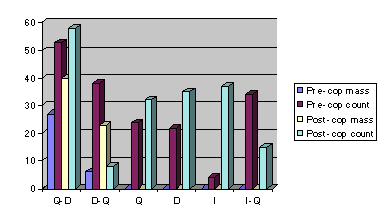
Chart 1: Semantic Situation for EIMI
Universal statistics. Considering both pre and post-copulative anarthrous constructions in combination the following chart reveals what one should expect having asked the question, “What semantic domain should an anarthrous PN construction with εἰμί lean towards?” That is given any anarthrous PN whether pre or post-copulative concerning the verb εἰμί, what general semantic domain predominates?
|
SEMANTICS |
Q-d |
D-Q |
Q |
D |
I |
I-Q |
TOTAL |
|
Pre-cop Mass |
27 |
6 |
0 |
0 |
0 |
0 |
33 |
|
Pre-cop Count |
53 |
38 |
24 |
22 |
4 |
34 |
175 |
|
Post-cop Mass |
40 |
23 |
0 |
0 |
0 |
0 |
63 |
|
Post-cop Count |
58 |
8 |
32 |
35 |
37 |
15 |
185 |
|
TOTAL |
178 |
75 |
56 |
57 |
41 |
49 |
456 |
|
PERCENT |
39% |
16% |
12% |
13% |
9% |
11% |
100% |
According to our scheme of six possible semantic domains, the answer to the question is the following according to frequency: 39% Q-d, 16% D-Q, 13% D, 12% Q, 11% I-Q and 9% I. If one uses the previous semantic system of definite, qualitative and indefinite (D, Q, I) the semantic situation for the question asked would be the following: 29% definite, 9% indefinite and 62% qualitative. This is based upon those works cited earlier which put our category of I-Q into the category of Q thus making that category statistically high.96 This is an overall category and no further subdivisions shall be drawn off this (no factoring out of mass nouns, plural counts, proper names, genitive modifiers or relative clauses). Below is a statistical breakdown of both the pre and post-copulative constructs individually.
Individuated statistics. For each individual construction the statistics are drawn from the overall statistics above but separated into the pre-copulative anarthrous construction involving εἰμί and then the post-copulative. This first chart answers the question, “What semantic situation should one find with εἰμί in a pre-copulative anarthrous PN barring any other considerations?”
|
SEMANTICS |
Q-d |
D-Q |
Q |
D |
I |
I-Q |
TOTAL |
|
Pre-cop Mass |
27 |
6 |
0 |
0 |
0 |
0 |
33 |
|
Pre-cop Count |
53 |
38 |
24 |
22 |
4 |
34 |
175 |
|
TOTAL |
80 |
44 |
24 |
22 |
4 |
34 |
208 |
|
PERCENT |
38% |
21% |
12% |
11% |
2% |
16% |
100% |
The highest semantic for a pre-copulative anarthrous PN with εἰμί is the Q-d semantic. The order is as follows: 38% Q-d, 21% D-Q, 16% I-Q, 12% Q, 11% D and 2% I. The reason for the high Q-d factor is apparent when one deletes from this mass and plural count nouns which will be factored out shortly. The picture according to the old semantic scheme would be 32% definite, 2% indefinite and 66% qualitative. The next chart reveals the post-copulative situation.
|
SEMANTICS |
Q-d |
D-Q |
Q |
D |
I |
I-Q |
TOTAL |
|
Post-cop Mass |
40 |
23 |
0 |
0 |
0 |
0 |
63 |
|
Post-cop Count |
58 |
8 |
32 |
35 |
37 |
15 |
185 |
|
TOTAL |
98 |
31 |
32 |
35 |
37 |
15 |
248 |
|
PERCENT |
40% |
13% |
13% |
14% |
15% |
6% |
100% |
Here the statistics are still a majority of Q-d. The breakdown is as follows: 40% Q-d, 15% I, 14% D, 13% for both D-Q and Q and 6% for I-Q. Comparing this with the pre-copulative statistics reveals that mass and plural count nouns are roughly equally distributed the two constructs (Q-d). However, the pre-copulative has a high rate of I-Q compared with the post-copulative, and the post-copulative has a high I (indefinite) compared to the former. The statistics according to the old semantic scheme are, 27% definite, 15% indefinite and 59% qualitative. What the statistics are beginning to show also is the slightly higher ratio of definites in the pre-copulative construct and the higher ratio of indefinites in the post-copulative construction.
The next step in getting down to an ontological meaning to the pre-copulative and post-copulative anarthrous construct is to omit all mass nouns from both.97 This would take out many if not most of the Q-d category, but leave the plural counts intact. What is left is a semantic situation for all count nouns in both constructions. The following chart answers the question, “If we consider only count nouns, what should the semantic situation be like for εἰμί in a pre or post-copulative construct?” The first chart answers that for the pre-copulative construct.
|
SEMANTICS |
Q-d |
D-Q |
Q |
D |
I |
I-Q |
TOTAL |
|
Pre-cop Count |
53 |
38 |
24 |
22 |
4 |
34 |
175 |
|
PERCENT |
30% |
22% |
14% |
13% |
2% |
19% |
100% |
Even with the omission of mass nouns, the prevalent semantic remains Q-d, no doubt due to the plural counts. The statistics in their order of priority would be as follows: 30% Q-d, 22% D-Q, 19% I-Q, 14% Q, 13% D and 2% I. The semantic situation according to the old scheme would be as follows: 35% definite, 2% indefinite, and 63% qualitative. The following chart represents the post-copulative situation.
|
SEMANTICS |
Q-d |
D-Q |
Q |
D |
I |
I-Q |
TOTAL |
|
Post-cop Count |
58 |
8 |
32 |
35 |
37 |
15 |
185 |
|
PERCENT |
31% |
4% |
17% |
20% |
20% |
8% |
100% |
The semantic scheme in order of frequency would be as follows: 31% Q-d, 20% for both D and I, 17% Q, 8% I-Q and 4% D-Q. %. The statistics from the old scheme would be as follows: 24% definite, 20% indefinite and 56% qualitative. The picture compared with the pre-copulative marks significantly in the D-Q category (down 18%) but slightly higher in the D category (up 7%). Most significant is the post-copulative’s high statistics over the pre-copulative in the indefinite (I) category (up 18%) but lower in the I-Q category (down 11%). When comparing the old schemes, the indefinite category appears statistically minute for the pre-copulative construct. However, when one factors in the 6 category semantic scheme, the picture becomes different. The old scheme, therefore, can be deceptive.
The next step was to omit all plural count nouns from the statistics for εἰμί. This chart answers the question, “If we consider only singular count nouns, what should the semantic situation be like for εἰμί in a pre or post-copulative construct?” This first chart answers the question for the pre-copulative singular count nouns with εἰμί.
|
SEMANTICS |
Q-d |
D-Q |
Q |
D |
I |
I-Q |
TOTAL |
|
Pre-cop Count |
0 |
38 |
24 |
17 |
4 |
34 |
117 |
|
PERCENT |
0% |
32% |
21% |
15% |
3% |
29% |
100% |
These statistics show a rise in the statistics in just about every category. The least statistical significance lies with the Indefinite category rising only 1% from the former chart. The definite category, although statistically higher than the previous chart has nevertheless dropped in it’s statistical increase compared with the other categories. The statistical phenomenon would be as follows: 32% D-Q, 29% I-Q, 21% Q, 15% D and 3% I. The old semantic scheme would be as follows: 47% definite, 3% indefinite and 50% qualitative. The following chart represents the post-copulative construct.
|
SEMANTICS |
Q-d |
D-Q |
Q |
D |
I |
I-Q |
TOTAL |
|
Post-cop Count |
0 |
8 |
32 |
35 |
37 |
15 |
127 |
|
PERCENT |
0% |
6% |
25% |
28% |
29% |
12% |
100% |
Basically the ratio among post-copulatives has remained the same due to the fact that no plural counts were omitted from any category except the Q-d. The statistical phenomenon would be as follows: 29% I, 28% D, 25% Q, 12% I-Q and 6% D-Q. The old scheme would be as follows: 34% definite, 29% indefinite and 37% qualitative. The picture compared with the pre-copulative still shows significance in the D-Q category, 6% compared to the pre-copulative 32%, and significance is also to be seen in the Indefinite category, 29% compared to the pre-copulative 3%. The purely qualitative category appears basically the same while the I-Q category shows 29% for the pre-copulative and only 12% for the post-copulative. So while there is an increase of indefinites for the post-copulative construction by a 26% margin, there is simultaneously an increase of I-Q category for the pre-copulative construction by a 17% margin.
The next step is to omit from the singular count nouns any definitizing factors such as genitive adjuncts, proper names and (with regard to post-copulative constructs) relative clauses. Not all genitive adjuncts were omitted (nor all relative clauses) but only those which were proved to be clearly definite. The question the following charts attempt to answer is, “If all definitizing factors are omitted from singular count nouns, what semantic predominates?” This first chart represents the answer to that question for the pre-copulative construction.
|
SEMANTICS |
Q-d |
D-Q |
Q |
D |
I |
I-Q |
TOTAL |
|
Pre-cop Count |
0 |
2 |
24 |
2 |
4 |
34 |
66 |
|
PERCENT |
0% |
3% |
36% |
3% |
6% |
52% |
100% |
The most significant decreases evidence themselves in both the D-Q and D categories as should be expected. With this decrease the particular semantic situation for εἰμί emerges. The predominant semantic lies with the I-Q category (52%) followed by the Q category (36%), the indefinite category (6%) and finally the D-Q category (3%). The old semantic scheme would be the following: 6% definite, 6% indefinite and 88% qualitative.98 However, this later scheme does not reveal the I-Q category and is a bit deceptive. Before we jump ahead and apply this to John 1:1, however, a look at the post-copulative construction is necessary to conclude the study for the NT.
|
SEMANTICS |
Q-d |
D-Q |
Q |
D |
I |
I-Q |
TOTAL |
|
Post-cop Count |
0 |
0 |
32 |
2 |
37 |
15 |
86 |
|
PERCENT |
0% |
0% |
37% |
2% |
43% |
17% |
100% |
Statistically, the most predominant semantic category is overwhelmingly the Indefinite (I) category at 43%, followed by the Q (37%), then the I-Q (17%) and finally the D category (2%). According to the old scheme it would be, 2% definite, 43% indefinite and 54% qualitative.99 Comparing this with the pre-copulative construction reveals that a singular count noun (minus all definitizing factors), if definite (D-Q, or D), is 75% more likely to appear in a pre-copulative construct than the latter. The purely qualitative category (Q) is equally distributed (about 50/50) but the I-Q category is heavily tilted towards the pre-copulative construct, and is 69% more likely to appear in a pre-copulative construct than the latter. Of the indefinite category (I) the chances that it appears in a pre-copulative construct is only 9% with a 91% probability for a post-copulative occurrence.
The problem with these statistics is when exegetically significant passages are determined from them. For example, John 1:1 uses εἰμί with a singular count noun. Using the above statistics alone would mean the text would support the Jehovah Witnesses and their interpretation of that passage. However, below we demonstrate a contextually closer concentric circle to John 1:1 that is more determinative in it’s interpretation than this statistical phenomenon regarding the entire NT. Therefore, it is wise to reserve a semantic judgment until the book from which the verse arises has been statistically tallied. So although it is true that the predominant semantic for a singular count noun minus all definitizing factors in a pre-copulative anarthrous PN construct with εἰμί is statistically higher for the I-Q category, this is not the entire case for each book or author of the NT.
Conclusions on γίνομαι
The same procedure will be followed as with the verb εἰμί but a much shorter discussion. This is due to the fact that virtually no definites occur with this verb therefore no definitizing factors need ruled out.100 Therefore a total semantic situation for γίνομαι will be presented below followed by a breakdown into pre and post-copulative counts, then lastly singular counts to indicate the semantic situation for that construction.
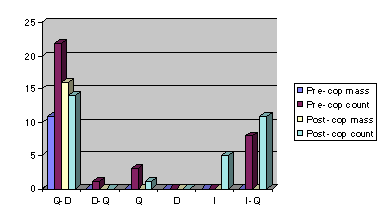
Chart 2: Semantic Situation for GINOMAI
Universal statistics. Considering both pre and post-copulative anarthrous constructions in combination the following chart reveals what one should expect having asked the question, “What semantic domain should an anarthrous PN construction with γίνομαι lean towards?” That is given any anarthrous PN whether pre or post-copulative concerning the verb γίνομαι, what general semantic domain predominates?
|
SEMANTICS |
Q-d |
D-Q |
Q |
D |
I |
I-Q |
TOTAL |
|
Pre-cop Mass |
11 |
0 |
0 |
0 |
0 |
0 |
11 |
|
Pre-cop Count |
22 |
1 |
3 |
0 |
0 |
8 |
34 |
|
Post-cop Mass |
16 |
0 |
0 |
0 |
0 |
0 |
16 |
|
Post-cop Count |
14 |
0 |
1 |
0 |
5 |
11 |
31 |
|
TOTAL |
63 |
1 |
4 |
0 |
5 |
19 |
92 |
|
PERCENT |
68% |
1% |
4% |
0% |
5% |
20% |
100% |
According to our six scheme semantic system, the answer to the question is the following according to frequency: 68% Q-d, 20% I-Q, 5% I, 4% Q and 1% D-Q. If the previous semantic system is used the semantic situation for the asked question would be the following: 93% Q, 5% I and 1% D. What follows is a further breakdown into both pre and post-copulative constructs individually.
Individuated statistics. The next two charts represent separately the pre-copulative anarthrous construct and the post-copulative anarthrous construct with γίνομαι. They answer the question, “What semantic situation should one find with γίνομαι in a pre-copulative [then “post-copulative”] anarthrous PN construction barring any other considerations?”
|
SEMANTICS |
Q-d |
D-Q |
Q |
D |
I |
I-Q |
TOTAL |
|
Pre-cop Mass |
11 |
0 |
0 |
0 |
0 |
0 |
11 |
|
Pre-cop Count |
22 |
1 |
3 |
0 |
0 |
8 |
34 |
|
TOTAL |
33 |
1 |
3 |
0 |
0 |
8 |
44 |
|
PERCENT |
75% |
2% |
6% |
0% |
0% |
18% |
100% |
The highest semantic for the pre-copulative anarthrous PN with γίνομαι is the Q-d category. The order is as follows: 75% Q-d, 18% I-Q, 6% Q and 2% D-Q. Several factors account for the high statistics of the Q-d category: (1) Eleven of the Q-d are mass nouns and (2) twenty-two are plural count nouns. The mass nouns will be factored out of the next charts, and the plural counts out of the second set. The semantic picture according to the old semantic scheme would be 98% Q and 2% D. The next chart reveals the post-copulative construction.
|
SEMANTICS |
Q-d |
D-Q |
Q |
D |
I |
I-Q |
TOTAL |
|
Post-cop Mass |
16 |
0 |
0 |
0 |
0 |
0 |
16 |
|
Post-cop Count |
14 |
0 |
1 |
0 |
5 |
11 |
31 |
|
TOTAL |
30 |
0 |
1 |
0 |
5 |
11 |
47 |
|
PERCENT |
64% |
0% |
2% |
0% |
10% |
23% |
100% |
Here the statistics are still a majority of Q-d. However, the difference between this and the pre-copulative is the number of count nouns in this category. There are more mass nouns in the post-copulative construct than the pre-copulative construct (16 to 11) but more plural counts in the Q-d category for the pre-copulative than the post-copulative (22 to 14). The semantic breakdown is as follows: 64% Q-d, 23% I-Q, 10% I and 2% Q. Comparing this with the pre-copulative construction reveals an increase in the indefinite category (10% to 0%) and a slight increase in the I-Q category (23% to 18%). According to the old semantic scheme the statistics would be as follows: 90% Q and 10% I.
The next step is to omit all mass nouns and simply consider count nouns. The following charts answer the question, “If we consider only count nouns, what should the semantic situation be like for γίνομαι in a pre or post copulative anarthrous PN construct?” The first chart answers that question for the pre-copulative construct.
|
SEMANTICS |
Q-d |
D-Q |
Q |
D |
I |
I-Q |
TOTAL |
|
Pre-cop Count |
22 |
1 |
3 |
0 |
0 |
8 |
34 |
|
PERCENT |
65% |
3% |
9% |
0% |
0% |
23% |
100% |
Even with the omission of mass nouns, the prevalent semantic remains Q-d, no doubt due to plural counts. The statistics in their order of priority would be as follows: 65% Q-d, 23% I-Q, 9% Q and 3% D-Q. The semantic situation according to the old scheme would be as follows: 3% D, 0% I and 97% Q. The following chart represents the post-copulative situation.
|
SEMANTICS |
Q-d |
D-Q |
Q |
D |
I |
I-Q |
TOTAL |
|
Post-cop Count |
14 |
0 |
1 |
0 |
5 |
11 |
31 |
|
PERCENT |
45% |
0% |
3% |
0% |
16% |
35% |
100% |
Here the semantic scheme in order of frequency would be as follows: 45% Q-d, 35% I-Q, 16% I and 3% Q. The statistics from the old scheme would be as follows: 0% D, 16% I, and 84% Q. Comparing the post-copulative with the pre-copulative shows up most apparently in the I category. There are no examples of an indefinite in the pre-copulative construct at all and the I-Q category is only slightly higher in the post-copulative construct (35% to 23%). The Q category is only slightly higher in the pre-copulative (9% to 3%) and the Q-d category is quite a bit higher in the pre-copulative (65% to 45%). This latter merely indicates that pre-copulative count plurals out number the post-copulative counterpart.
Since there are no definitizing factors needed to be factored out from this verb the next chart simply gives the singular count noun it’s semantic situation with the γίνομαι verb. This chart answers the question, “If we consider only singular count nouns, what should the semantic situation be like for γίνομαι in a pre or post copulative construct?” The first chart answers the question for the pre-copulative singular count noun with γίνομαι.
|
SEMANTICS |
Q-d |
D-Q |
Q |
D |
I |
I-Q |
TOTAL |
|
Pre-cop Count |
0 |
1 |
3 |
0 |
0 |
8 |
12 |
|
PERCENT |
0% |
8% |
25% |
0% |
0% |
67% |
100% |
The semantic situation, as with the εἰμί verb above, is predominantly leans towards the I-Q category—only here to a much greater extent. The semantic scheme would be as follows: 67% I-Q, 25% Q and 8% D. According to the old scheme it would be as follows: 8% D, 0% I and 92% Q.101 It seems apparent that the predominant pre-copulative semantic ontological significance to be attributed to this structure is the I-Q category. This has been completely overlooked by the previous studies. Below is the chart representing the post-copulative construct.
|
SEMANTICS |
Q-d |
D-Q |
Q |
D |
I |
I-Q |
TOTAL |
|
Post-cop Count |
0 |
0 |
1 |
0 |
5 |
11 |
17 |
|
PERCENT |
0% |
0% |
5% |
0% |
30% |
65% |
100% |
The semantic situation for this construction indicates a heavy tilt towards the I-Q category (65%) followed by the I category (30%) and then by the Q category (5%). According to the old scheme the semantic situation would be as follows: 0% D, 30% I and 70% Q. The difference with this construction compared with the pre-copulative lies in the I category. The pre-copulative construct offered no examples of an indefinite sense. But if viewed from the old scheme this could be deceptive, for the predominant scheme in both constructions is the I-Q category (67% and 65%). So merely indicating that the pre-copulative construct does not have any indefinites doesn’t mean that the qualitative feature does not include an indefinite sense (hence the I-Q category).
We have not found any disputed texts with this verb. The point of showing the semantic situation was to help in confirming the ontology of the anarthrous PN construction in both pre and post-anarthrous constructs.
Conclusions on ὑπάρχω
The same procedure will be followed as with the previous verbs, but a shorter discussion. This is due to the fact that there are so few examples of this verb with convertible (subset) propositions (13 all together). Further, the post-copulative construction has only one example and it is a count noun. This makes it difficult to base any conclusions upon this verb and usage in the PN construction. It’s statistics are included because it semantically parallels the verb εἰμί and serves to conclude the study. Therefore a total semantic situation for ὑπάρχω will be presented below followed by a breakdown into pre and post-copulative counts then lastly singular counts to indicate the semantic situation for that construction. No disputed texts were identified with this construction.
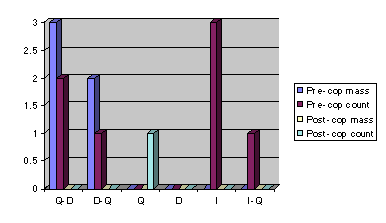
Chart 3: Semantic Situation for UPARCW
Universal Statistics. Considering both pre and post-copulative anarthrous constructions in combination the following chart reveals what one should expect having asked the question, “What semantic domain should an anarthrous PN construction with ὑπάρχω lean towards?” That is, given any anarthrous PN whether pre or post-copulative concerning the verb ὑπάρχω, what general semantic domain predominates?
|
SEMANTICS |
Q-d |
D-Q |
Q |
D |
I |
I-Q |
TOTAL |
|
Pre-cop Mass |
3 |
2 |
0 |
0 |
0 |
0 |
5 |
|
Pre-cop Count |
2 |
1 |
0 |
0 |
3 |
1 |
7 |
|
Post-cop Mass |
0 |
0 |
0 |
0 |
0 |
0 |
0 |
|
Post-cop Count |
0 |
0 |
1 |
0 |
0 |
0 |
1 |
|
TOTAL |
5 |
3 |
1 |
0 |
3 |
1 |
13 |
|
PERCENT |
38% |
23% |
8% |
0% |
23% |
8% |
100% |
According to our six scheme semantic system, the answer to the question is the following according to frequency: 38% Q-d, 23% for both the D-Q and the I category and 8% for both the Q and I-Q categories. If the previous system is used the semantic situation for the asked question would be the following: 23% D, 23% I and 54% Q. What follows is a further breakdown into both pre and post-copulative constructs individually.
Individuated statistics. The next two charts represent separately the pre-copulative anarthrous construct and the post-copulative anarthrous construct with ὑπάρχω. They answer the question, “What semantic situation should one find with ὑπάρχω in a pre-copulative [then “post-copulative”] anarthrous PN construction barring any other considerations?”
|
SEMANTICS |
Q-d |
D-Q |
Q |
D |
I |
I-Q |
TOTAL |
|
Pre-cop Mass |
3 |
2 |
0 |
0 |
0 |
0 |
5 |
|
Pre-cop Count |
2 |
1 |
0 |
0 |
3 |
1 |
7 |
|
TOTAL |
5 |
3 |
0 |
0 |
3 |
1 |
12 |
|
PERCENT |
42% |
25% |
0% |
0% |
25% |
8% |
100% |
The highest semantic for the pre-copulative anarthrous PN with ὑπάρχω is the Q-d category. The order is as follows: 42% Q-d, 25% for both D-Q and I, and 8% for I-Q. According to the old scheme it would be 25% D, 25% I and 50% Q. What is significant is that when compared with εἰμί, this verb has a much higher percentage of pre-copulative indefinites (25% to 2%) than would be expected. Also, no D category occurs (compared to εἰμί 11%) although the D-Q category is about the same as εἰμί (25% to 21%). The I-Q category is twice as low percentage wise (8% to 16%) and the Q category has none compared to 12% with εἰμί.102 The next chart reveals the post-copulative construction.
|
SEMANTICS |
Q-d |
D-Q |
Q |
D |
I |
I-Q |
TOTAL |
|
Post-cop Mass |
0 |
0 |
0 |
0 |
0 |
0 |
0 |
|
Post-cop Count |
0 |
0 |
1 |
0 |
0 |
0 |
1 |
|
TOTAL |
0 |
0 |
1 |
0 |
0 |
0 |
1 |
|
PERCENT |
0% |
0% |
100% |
0% |
0% |
0% |
100% |
It is fairly evident that the only category that this construction bears is the Q category due to the infrequency of the post-copulative construct. Since it involves a count noun it is not necessary to produce any further charts on this post-copulative construction. Below, therefore, attention is focused solely on the pre-copulative construct.
The next step is to omit all mass nouns from the pre-copulative construct and focus entirely on count nouns. The following chart answers the question, “If we consider only count nouns, what should the semantic situation be like for ὑπάρχω in a pre-copulative anarthrous PN construct?”
|
SEMANTICS |
Q-d |
D-Q |
Q |
D |
I |
I-Q |
TOTAL |
|
Pre-cop Count |
2 |
1 |
0 |
0 |
3 |
1 |
7 |
|
PERCENT |
29% |
14% |
0% |
0% |
43% |
14% |
100% |
With the omission of mass nouns the predominant semantic switches to the I category. The statistics in their order of priority would be as follows: 43% I, 29% Q-d and 14% for both D-Q and I-Q. The semantic situation according to the old scheme would be as follows: 14% D, 43% I and 43% Q. Compared with the εἰμί verb the statistics for the I category are inordinately high (43% to 2%). The Q-d category is virtually the same (29% to 30%), the D-Q category is much less (14% to 22%), the I-Q is only slightly less (14% to 19%) but the Q and D category are empty compared with 14% and 13% for eijmiv respectively.
The next chart represents only the singular count nouns with this verb. It seeks to answer the question, “If we consider only singular count nouns, what should the semantic situation be like for ὑπάρχω in a pre-copulative construct?” The following chart attempts to answer that question.
|
SEMANTICS |
Q-d |
D-Q |
Q |
D |
I |
I-Q |
TOTAL |
|
Pre-cop Count |
0 |
1 |
0 |
0 |
3 |
1 |
5 |
|
PERCENT |
0% |
20% |
0% |
0% |
60% |
20% |
100% |
Here the semantic situation gains a higher frequency towards the I category. The semantic scheme would be as follows: 60% I and 20% for both D-Q and I-Q. According to the old scheme the semantic situation would be as follows: 20% D, 60% I and 20% Q. Below is the final chart taking out all definitizing factors (only 1 verse) and thus presents the semantic situation for the singular count noun minus all definitizing factors.
|
SEMANTICS |
Q-d |
D-Q |
Q |
D |
I |
I-Q |
TOTAL |
|
Pre-cop Count |
0 |
0 |
0 |
0 |
3 |
1 |
4 |
|
PERCENT |
0% |
0% |
0% |
0% |
75% |
25% |
100% |
The highest semantic has increased to 75% for the I category, followed by the I-Q category (25%). According to the old scheme the semantic situation would be as follows: 75% I and 25% Q.
The Fourth Gospel—A Test Case
We will confine our study of John to two verbs, εἰμί and γίνομαι. With respect to the former, we intend to focus on the semantics of John 1:1c. Therefore, we wish to lay out the total semantic picture and then proceed according to the set process as enunciated above, i.e., ferreting out mass nouns, plural counts, definitizing factors to end with a semantic situation regarding singular count nouns. It is hoped that this will provide a statistical predilection by which to categorize disputed texts.
The Overall Picture
The verb εἰμί. We start with the Gospel and its use of the verb ∏∞. Since John 1:1c uses this verb, we will confine ourselves to looking at the statistical picture both pre and post copulative in regards to count/mass nouns. According to our calculations, the verb appears 121 times in convertible propositions. Of these 52 (43%) are articular constructions and 69 (57%) are anarthrous. Of the articular constructions 7 (13%) are pre-copulative of which 1 (17%) is mass and 6 (83%) are count.103 The 45 (87%) remaining are post-copulative of which 11 (24%) are mass and 34 (76%) are count.104 Of the 69 anarthrous constructions, 50 (72%) are pre-copulative and 19 (28%) are post-copulative occurrences. In respect to the pre-copulative anarthrous occurrences, 42 (84%) are count and 8 (16%) are mass.105 The post-copulative reveals 17 (89%) count and 2 (11%) mass nouns.106 Up front, however, we mark as exegetically disputed texts 1:1c, 49b, 4:19, 9:17 and 10:33, 36. Each of these are in the Colwell construction and are singular count nouns.
The verb γίνομαι. John’s use of this verb is less pervasive than the former. In total there are 9 instances of the anarthrous usage in this Gospel, 7 (77%) pre-copulative and two post-copulative (23%). Of the former 3 (43%) are count and 4 (57%) are mass.107 Of the post-copulative both are count nouns.108 The usage of this verb is triply emphatic. First, the verb itself implies a subset type of proposition. Second, this is compounded semantically by the use of mass terms, and finally, its placement in a pre-copulative anarthrous construct begs questions. Thus it appears to present, in some contexts, a triple confirmation of qualitativeness. It is unquestionable that both a pre-copulative or post-copulative rendering with the first two criteria fulfilled would amount to an identical semantic. The question involves why the word order change to a pre-copulative anarthrous occurrence at all. We suspect it is in these instances that discourse reasons should account for its pre-copulative anarthrous occurrence.
Conclusions on εἰμί
First we want to list the total semantic picture of an anarthrous PN with the verb εἰμί, then divert to consider both pre-copulative and post-copulative occurrences. Mass, plural counts as well as definitizing factors will be ruled out eventually and then an overall semantic situation will be presented regarding singular count nouns. As noted above, disputed passages have been kept out of the statistical tabulations below, i.e., 6 passages were kept out of these statistics (1:1c, 49b; 4:19; 9:17; 10:33, 36).
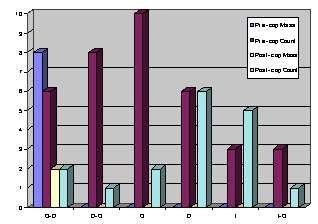
Chart 4: Semantic Situation in John for EIMI
Universal statistics. Considering both pre and post-copulative anarthrous constructions in combination the following chart reveals what one should expect having asked the question, “What semantic domain should an anarthrous PN construction with εἰμί lean towards?” That is, given any anarthrous PN whether pre or post-copulative concerning this verb in John’s Gospel, which general semantic domain predominates?
|
SEMANTICS |
Q-d |
D-Q |
Q |
D |
I |
I-Q |
TOTAL |
|
Pre-cop Mass |
8 |
0 |
0 |
0 |
0 |
0 |
8 |
|
Pre-cop Count |
6 |
8 |
10 |
6 |
3 |
3 |
36 |
|
Post-cop Mass |
2 |
0 |
0 |
0 |
0 |
0 |
2 |
|
Post-cop Count |
2 |
1 |
2 |
6 |
5 |
1 |
17 |
|
TOTAL |
18 |
9 |
12 |
12 |
8 |
4 |
63 |
|
PERCENT |
29% |
14% |
19% |
19% |
13% |
6% |
100% |
According to our scheme of six possible semantic domains, the answer to the question is the following according to frequency: 29% Q-d, 19% D, 19% Q, 14% D-Q, 13% I and 6% for I-Q. If one utilizes the previous semantic system of definite, qualitative and indefinite (D, Q, I) the semantic situation for the question asked would be the following: 54% qualitative, 33% definite, and 13% indefinite. This is the overall picture without regard to factoring out mass nouns, plural counts or definitizing factors. Below the ferreting process is laid out.
If we compare these overall statistics with the NT as a whole, several distinctions are already apparent. First in regards to individual semantic tags the following is to be noted: It is depreciably lower in John for the Q-d category (29% to 39%). It is slightly lower in D-Q (14% to 16%). The Q category is markedly higher in John than the NT as a whole (19% to 12%). Also, the D category is higher than the NT (19% to 13%). Interestingly, the I category is higher in John than the NT (13% to 9%). The I-Q category, however, is less in John than the NT as a whole (6% to 11%). Second, in respects to the old semantic scheme (D, Q, I), the following is to be noted: The Q category is highest in both but considerably higher in the NT than John (54% to 62%). The D category is second in both, but higher in John than the NT (33% to 29%). The I category is lowest in both but is slightly higher in John than the NT (13% to 9%).
It appears that the reason for the high Q and I in John, as compared to the NT, is the prevalence of singular count nouns in John, on the one hand, and a higher statistical occurrence of either mass and/or plural count nouns in the NT as a whole, on the other. Further individuated statistics below should account for this marked difference.109
Individuated statistics. For each individual construction the statistics are drawn from the overall statistics above, but separated into the pre-copulative anarthrous construction involving εἰμί and then post-copulative. The first chart answers the question, “What semantic situation should one find with εἰμί in a pre-copulative anarthrous PN in John barring any other considerations?”
|
SEMANTICS |
Q-d |
D-Q |
Q |
D |
I |
I-Q |
TOTAL |
|
Pre-cop Mass |
8 |
0 |
0 |
0 |
0 |
0 |
8 |
|
Pre-cop Count |
6 |
8 |
10 |
6 |
3 |
3 |
36 |
|
TOTAL |
14 |
8 |
10 |
6 |
3 |
3 |
44 |
|
PERCENT |
32% |
18% |
23% |
14% |
7% |
7% |
100% |
The highest semantic for a pre-copulative anarthrous PN with εἰμί is the Q-d semantic. The order is as follows: 32% Q-d, 23% Q, 18% D-Q, 14% D, 7% I and 7% I-Q. According to the old semantic scheme the following results occur: 62% Q, 32% D, and 7% I. The next chart reveals the post-copulative situation.
|
SEMANTICS |
Q-d |
D-Q |
Q |
D |
I |
I-Q |
TOTAL |
|
Post-cop Mass |
2 |
0 |
0 |
0 |
0 |
0 |
2 |
|
Post-cop Count |
2 |
1 |
2 |
6 |
5 |
1 |
17 |
|
TOTAL |
4 |
1 |
2 |
6 |
5 |
1 |
19 |
|
PERCENT |
21% |
5% |
10% |
32% |
26% |
5% |
100% |
The highest semantic for a post-copulative anarthrous PN with εἰμί is the D category. The order is as follows: 32% D, 26% I, 21% Q-d, 10% Q, 5% D-Q and 5% I-Q. According to the old scheme the following results occur: 37% D, 36% Q, and 26% I.
If we compare these two charts there is evidence of a semantic difference between the two constructions. It is quite plain that in every category where qualitativeness is a factor, the pre-copulative has the higher statistical number. For example, given a definite nuance (D-Q or D), the pre-copulative puts statistically more in the former category than the latter as compared with the post-copulative occurrence. In this same regards is the issue of qualitative nuances (Q-d, Q and I-Q). In every case the pre-copulative is a higher statistical occurrence whereas the post-copulative is especially noteworthy in the I category (26% to 7%) and its slight statistical semantic Q (10% to 23%).
This is an important observation because at this juncture, given a disputable text involving a PN with εἰμί, we would combine Q-d with Q (because Q-d = Q) and leave the rest to survive in their distinct semantic categories. For example, if we were to judge John 1:1c based on the pure semantic preponderance of all pre-copulative PNs in John (w/o respect to whether a noun is plural count or mass), we would come up with a 55% probability of Q, 18% D-Q, 14% D, 7% I, and 7% I-Q. Thus if one were to forego the following process of elimination, the Q semantic would be fully established for John 1:1c. It is noteworthy, too, that both I and I-Q are least probable.
From this point on we are in the process of elimination. We will begin by factoring out mass nouns, then plural count nouns, and finally from singular count nouns any definitizing factors. Arguably, this process will inevitably push towards either the Q, I, or I-Q category for either pre or post-copulative constructions. The first chart below answers the question, “If we consider only count nouns, what should the semantic situation be like for εἰμί in John for a pre or post-copulative construct?” The first chart represents the pre-copulative situation.
|
SEMANTICS |
Q-d |
D-Q |
Q |
D |
I |
I-Q |
TOTAL |
|
Pre-cop Count |
6 |
8 |
10 |
6 |
3 |
3 |
36 |
|
PERCENT |
17% |
22% |
28% |
17% |
8% |
8% |
100% |
With the omission of mass nouns, the prevalent semantic shifts to Q, despite the prevalence of plural counts. The statistics in their order of priority would be as follows: 28% Q, 22% D-Q, 17% Q-d, 17% D, 8% I and 8% I-Q. According to the old scheme it would be as follows: 53% qualitative, 39% definite, and 8% indefinite. The following chart represents the post-copulative situation.
|
SEMANTICS |
Q-d |
D-Q |
Q |
D |
I |
I-Q |
TOTAL |
|
Post-cop Count |
2 |
1 |
2 |
6 |
5 |
1 |
17 |
|
PERCENT |
12% |
6% |
12% |
35% |
29% |
6% |
100% |
With the omission of mass nouns, the prevalent semantic basically remains the same. The statistics in their order of priority would be as follows: 35% D, 29% I, 12% Q-d, 6% D-Q and 6% I-Q. According to the old scheme it would be 41% definite, 30% qualitative and 29% indefinite.
These statistics are still quite significant. In regards to the comparison to the pre-copulative occurrences, the post-copulative is higher in categories lacking qualitative aspects. Significantly, it is higher in regards to the I category and D category. It is evident that if one inspects the semantic preponderance in John of count nouns in particular, it appears to indicate a semantic difference based on syntax alone, especially regarding qualitative aspects.
But there is a more important aspect in regards to John 1:1c. If we combine the Q-d and Q categories, we come up with the following probabilities for disputed count nouns: 45% Q, 22% D-Q, 17% D, 8% I and 8% I-Q. Thus if one were to factor out mass nouns from the sample pool from which the probabilities are to be drawn in regards to this verse, i.e., those nouns which are lexically qualitative, the statistics are still heavily tilted towards the Q category. It is worth noting again that both the I and I-Q categories are least likely to be the semantic determination to this particular PN.
Next we wish to factor out plural count nouns from the pool in regards to the verb εἰμί. The following charts answer the question, “If we consider only singular count nouns, what should the semantic situation be in John for εἰμί in a pre or post-copulative construction?” This first chart answers the question in regards to the pre-copulative construction.
|
SEMANTICS |
Q-d |
D-Q |
Q |
D |
I |
I-Q |
TOTAL |
|
Pre-cop Count |
0 |
8 |
10 |
6 |
3 |
3 |
30 |
|
PERCENT |
0% |
27% |
33% |
20% |
10% |
10% |
100% |
These statistics show a predictable drop in Q-d but still the overwhelming category is Q. The statistical phenomenon is as follows: 33% Q, 27% D-Q, 20% D, 10% I and 10% I-Q. According to the old scheme the statistics would be as follows: 47% D, 43% Q, and 10% I. It is only according to this latter scheme and in this particular spot in the process that there is any warrant for Colwell’s converse being remotely applicable. Below is the post-copulative occurrences.
|
SEMANTICS |
Q-d |
D-Q |
Q |
D |
I |
I-Q |
TOTAL |
|
Post-cop Count |
0 |
1 |
2 |
6 |
5 |
1 |
30 |
|
PERCENT |
0% |
7% |
13% |
40% |
33% |
7% |
100% |
The omission of plural counts show a predictable drop in Q-d category but a still surprisingly large bulk in the D semantic category. As it stands thus far the statistical phenomenon is as follows: 40% D, 33% I, 13% Q, 7% D-Q and 7% I-Q. According to the old scheme it is as follows: 47% definite, 33% indefinite, and 20% Q.
Both pre and post-copulative constructions have a high definite semantic predominant thus far. This semantic dominance is rather artificial, however, since the final calculation involves omitting all occurrences where adjuncts and such have tilted the construction towards definiteness. The differences between the pre and post-copulative occurrences, however, still lies in the first and second most frequent category. That is, the pre-copulative singular count nouns tend towards a qualitative category of some sort while the post-copulative tends away from that category—they are almost diametrically opposed semantically speaking.
How does this situation effect the rendering of John 1:1c? If we combine Q with Q-d (at this point there are no Q-d) then the statistical probabilities for this construction still favor the Q category by a 33% as opposed to 27% D-Q, 20% D, 10% I and 10% I-Q. It is still significant that both the I and I-Q categories are least probable to the semantics of this important verse.
Finally we omit all definitizing factors from the pool to both pre and post-copulative anarthrous singular count nouns. The question the following charts attempt to answer is, “If all definitizing factors are omitted from singular count nouns in John, what semantic predominates?” This first chart answers the question regarding the pre-copulative construction.
|
SEMANTICS |
Q-d |
D-Q |
Q |
D |
I |
I-Q |
TOTAL |
|
Pre-cop Count |
0 |
0 |
10 |
2 |
3 |
3 |
18 |
|
PERCENT |
0% |
0% |
56% |
11% |
17% |
17% |
100% |
The most significant decrease has occurred in the D-Q and D categories, as would be expected. However, with this the I and I-Q have overtaken the definite semantic, with regard to singular count nouns, and subsumed a distant tie for second to the still dominant category of Q. Therefore, the semantic situation in John for singular count nouns minus all definitizing factors (genitive adjuncts, monadic nouns, or proper names) is the following: 56% Q, 17% I, 17% I-Q and 11% D. According to the old scheme it would be as follows: 73% qualitative, 17% indefinite and 11% definite. Rounding this off, a look at the post-copulative is the following.
|
SEMANTICS |
Q-d |
D-Q |
Q |
D |
I |
I-Q |
TOTAL |
|
Post-cop Count |
0 |
0 |
2 |
0 |
5 |
1 |
8 |
|
PERCENT |
0% |
0% |
25% |
11% |
63% |
13% |
100% |
Here both the D-Q and D have shriveled to nothing while the indefinite category has significantly jumped to the highest statistical semantic. The order is 63% I, 25% Q, and 13% I-Q. According to the old scheme it would be 63% I and 38% Q.
Thus is appears that Colwell was correct when he insisted that when definites occur in a post-copulative construction they were usually accompanied by an article (but not always). This is not the case when it comes to the pre-copulative occurrences in John. There is still 11% definites remaining despite all factors of definiteness being excluded. Thus it is quite significant that a clear semantic possibility exists for that category when all other factors are omitted.
Now we look for a final time at John 1:1c with regards to εἰμί. When all is done to exclude lexically qualitative nouns (minus mass), grammatically generic nouns (plural counts), and on the other hand omitting definitizing factors (genitive adjuncts, monadic nouns, proper nouns) then the probability as to the semantic determination of John 1:1c is 56% for Q as compared to 17% I, 17% I-Q and 11% D. Although the I and I-Q categories have gained, they remain far behind the semantic category of Q. It is thus an improbable venture to continually cite either I, I-Q or D for John 1:1c.
Conclusions on γίνομαι
Since there are only 9 instances of this verb with a convertible (subset) proposition, no statistical situation need to be set forth as that with εἰμί. In particular, however, is the occurrences of this verb in cases where it appears connected within an extended discourse. The predictable pattern from which to gauge this would be in those cases where it involves a mass noun, especially if it is in the Colwell construction. In this case the question as to why this is needful presents a special problem and deserves added attention.
There are four occurrences of mass nouns that occur in the pre-copulative anarthrous PN construction (1:14; 2:9; 6:17; 16:20). Two of these cases can be excluded from the study either because it is a predicate accusative (2:9), or because it has a prepositional phrase (16:20). With this in mind we have two verses left to examine in light of our hypothesis (1:14; 6:17). With regards to 6:17 it reads, καὶ σκοτία ἤδη ἐγεγόνει, “And it was already dark.” Although this can be related back to 6:16, ὡς δὲ ὀψία, “When evening came . . .” it appears that the semantic requirements are lacking. In other words, the semantic ambiguity of either PN is not in dispute. Both utilize the same verb. A better scenario would involve ideally a mass noun in a pre-copulative anarthrous construction with γίνομαι in connection with an ambiguous singular count noun with the verb εἰμί. This ideal condition is fulfilled only once in John (1:1c, 14).
The only example in John where the connection appears to be discourse significant is in 1:14. Here the verse sums up the first 13 verses. When it is compared with 1:1c, it seems to be deliberately positioned to reinforce a qualitative semantic to the latter. In 1:1c the order is CC - PN - V - T - S, καὶ θεὸς ἦν ὁ λόγος, in contrast to the order in 1:14 which is CC - T - S - PN - V, καὶ ὁ λόγος σὰρξ ἐγένετο. Whereas the article and subject in 1:1c follow the verb, they precede the verb in 1:14 thus forming a chiasm connecting the two thematically. Upon further examination, it appears that the pre-copulative semantic nuance is meant to be equated (thus Q = Q-d). This is confirmed by the fact that σὰρξ, being a mass noun, is qualitative (Q-d) irrespective of syntax. Its pre-copulative occurrence, therefore, is unaccounted for if not meant to be syntactically and semantically connected to 1:1.
The significance of this appears to be exemplified in what is called the principle of maximum redundancy.110 In other words, structures that are in parallel are more likely to reflect the same rather than different semantic nuances. In other words, if one fails to come to grips with the qualitative aspects argued throughout this paper from a grammatical point of view, then the discourse connection between 1:1 and 1:14 is left to disambiguate any misapprehensions up to this point. We simply refer to this as a confirmation of the semantic which we have arrived at quite independently of this additional observation.
Concluding Remarks
This study provides a reasonable and more objective criteria by which to make semantic determinations on nouns especially in conjunction with syntactic features such as the Colwell construction provides. This can help in several issues confronting the exegete.
First, it establishes objective criteria for determining whether a noun is either mass or count. The determination rests on criteria set forth by responsible linguists rather than left simply to the intuitions of the interpreter appealing simply to “context.” It is not context that determines whether a noun is count or mass, but lexemic or grammatical characteristics. Therefore it is quite reasonable to pre-determine nouns to be in one or the other category before a text, disputed or not, is even looked at.
Second it establishes that qualitativeness (Q) can exist independent of any other semantic tag. This is proven by the lexical identification of the mass noun. Since this type of noun is categorically unable in any sense to be indefinite, and because Q is indisputably a semantic category for mass nouns, this alone preempts the assertion that qualitativeness cannot be applied to count nouns in particular or that this semantic tag always entails, to some extent and sense, indefiniteness—thus we hold that Q ≠ I-Q (Q-I). The possibility must be open to the idea that qualitativeness can be applied in an exclusive fashion to count nouns and not a priori rejected outright.
Third, it restricts the area of disputable texts to singular count nouns. Plural count nouns can also be eliminated from semantic obscurity or ambiguity because, like mass nouns, they share the impossibility of indefinitization but differ slightly from the latter, besides being pluralized (grammatically and semantically), in that they emphasize more the class than the qualities of the class. So although we have listed both mass nouns and plural count nouns as Q-d we maintain a slight semantic distinction between the two. Thus by elimination of mass and plural count nouns, the exegete is more scientifically accurate in limiting significant semantic determinations to singular count nouns. That is, he can take singular count nouns and begin to establish a clear semantic preponderance based on a sampling of clear examples and proceed to assign with reasonable probability a semantic tag on disputed texts such as John 1:1c.
Fourth, it pre-empts the post hoc fallacy, i.e., this is qualitative and in the Colwell construction, therefore it is qualitative because it is in the Colwell construction. The identification and subsequent elimination of mass and plural count nouns is the only fair and logical method of analyzing the Colwell construction. Simply put, lexically qualitative nouns must be identified and eliminated from the discussion regarding the establishment of the semantics of singular count nouns. The designation of mass nouns, however, is categorically a statement about its semantic preponderance, thus syntactic variation (as shown above) is inconsequential. Since it is inconsequential it is question begging to cite passages that have these lexemic features in support for a construction as impugning qualitativeness to the noun in question.
Fifth, it shows the inadequacy of the three-fold semantic scheme (D-I-Q) as being subject to unwanted or unnecessary ambiguities. In the past scholars have typically placed nouns we listed as I-Q in the Q category, for example, thus artificially (in our view) inflating the statistical probabilities for Q. We have maintained a distinction between these two categories so that I-Q (Q-I) ≠ Q. Although expanding the semantic tags to distinguish between Q, I-Q and I (for singular count nouns) is potentially dangerous (to both Trinitarians, Sabellians and Arians) it is nevertheless a more exact methodology, and hence more accurate appraisal of the data. And the data should be allowed to speak unhindered by faulty logic, improper methodology or theological presuppositions.
Sixth, the issue of subjectivity, although not completely curtailed, is severely restricted.111 This restriction to subjectivity is due to both lexically determined criteria (mass nouns) and a grammatically present criterion (plural counts). The establishment of qualitativeness apart from any other semantic tag is assured through the first.
Finally, it leaves more research to be done. In the process of this study, several elements have not been fully addressed. First, what is the difference between a mass noun and plural counts. We have listed both as Q-d but nevertheless have maintained a semantic distinction—the former qualitative the latter generic. Moreover, we have tagged some count nouns as Q and asserted that this is semantically identical with Q-d but with the assumption that it is the mass noun’s semantic label that we wish to transfer to the Q tag when singular counts are under discussion. This would not necessarily rule out that some singular count nouns could acquire the generic sense that the plural count noun exudes in its Q-d semantic.
Second, the question of why mass nouns or why plural count nouns are put into the Colwell construction has not been completely answered. If semantic equivalence is the same, despite syntactic occurrence, then why the syntactic variation at all? This is an ancillary issue to our main emphasis throughout this study but it is a necessary corollary of investigation for this subject to be complete. Our guess is that in the wider context, discourse reasons are partly to account for this phenomenon (cf. John 1:1, 14; 3:6 etc.). Thus in the space of a phrase or clause, simple variation might be the sole cause of this phenomenon. But in the larger context, semantic variation, especially involving a singular count noun with a lexically or grammatically qualitative noun (mass or plural count), might be due to semantic determinacy being at stake. In other words, the clear semantic of the mass or plural count noun, is meant to disambiguate the semantics of the singular count noun to which it is related in the discourse. We believe the best example of this occurs in John 1:1 with John 1:14. Therefore we add, tentatively, a final argument for the purely qualitative aspect to the PN in the phrase καὶ θεὸς ἦν ὁ λόγος. Thus, Jesus is God in every sense that the Father is.
Appendix:
Semantic Compilation of Anarthrous PNs in John with EIMI
|
# |
COUNT |
MASS |
VERSE |
CLASS |
CONSTRUCT |
TAG |
||||
|
|
s |
pl |
s |
pl |
|
|
|
|
||
|
1 |
√ |
|
|
|
1:1 |
E |
C-Const. |
Q |
||
|
2 |
√ |
|
|
|
1:21a |
proper |
C-Const. |
D-Q |
||
|
3 |
√ |
|
|
|
1:25b |
proper |
Post-copulative |
D-Q |
||
|
4 |
√ |
|
|
|
1:39 |
E |
C-Const. |
Q |
||
|
5 |
√ |
|
|
|
1:40 |
proper |
Post-copulative |
D |
||
|
6 |
√ |
|
|
|
1:42 |
proper |
Post-copulative |
D |
||
|
7 |
√ |
|
|
|
1:49b |
E |
C-Const. |
D-Q |
||
|
8 |
|
|
√ |
|
3:4 |
A |
C-Const. |
Q-d |
||
|
9 |
|
|
√ |
|
3:6a |
B |
C-Const. |
Q-d |
||
|
10 |
√ |
|
|
|
3:6b |
E |
C-Const. |
Q |
||
|
11 |
√ |
|
|
|
3:29 |
D |
C-Const. |
D |
||
|
12 |
√ |
|
|
|
4:18 |
E |
Post-copulative |
not listed |
||
|
13 |
√ |
|
|
|
4:19 |
E |
C-Const. |
I-Q |
||
|
14 |
|
|
√ |
|
4:34 |
C |
C-Const. |
Q-d |
||
|
15 |
√ |
|
|
|
5:9 |
E |
Post-copulative |
Q |
||
|
16 |
√ |
|
|
|
5:10 |
E |
C-Const. |
Q |
||
|
17 |
√ |
|
|
|
5:27 |
E |
C-Const. |
D-Q |
||
|
18 |
√ |
|
|
|
6:42 |
proper |
Post-copulative |
D |
||
|
19 |
|
|
√ |
|
6:55a |
A |
Post-copulative |
Q-d |
||
|
20 |
|
|
√ |
|
6:55b |
A |
Post-copulative |
Q-d |
||
|
21 |
√ |
|
|
|
6:63b |
E |
C-Const. |
Q |
||
|
22 |
|
|
√ |
|
6:63c |
A |
C-Const. |
Q-d |
||
|
23 |
|
√ |
|
|
8:31 |
E |
C-Const. |
Q-d |
||
|
24 |
√ |
|
|
|
8:33 |
E |
C-Const. |
Q-d |
||
|
25 |
√ |
|
|
|
8:34 |
E |
C-Const. |
D-Q |
||
|
26 |
√ |
|
|
|
8:37 |
E |
C-Const. |
D-Q |
||
|
27 |
√ |
|
|
|
8:39a |
proper |
C-Const. |
D-Q |
||
|
28 |
|
√ |
|
|
8:39b |
E |
C-Const. |
Q-d |
||
|
29 |
√ |
|
|
|
8:42 |
E |
C-Const. |
D-Q |
||
|
30 |
√ |
|
|
|
8:44b |
D |
C-Const. |
I-Q |
||
|
31 |
√ |
|
|
|
8:44c |
E |
C-Const. |
I-Q |
||
|
32 |
√ |
|
|
|
8:48 |
E |
C-Const. |
Q |
||
|
33 |
√ |
|
|
|
8:54c |
E |
C-Const. |
D |
||
|
34 |
√ |
|
|
|
8:55 |
E |
Post-copulative |
I-Q |
||
|
35 |
√ |
|
|
|
9:5 |
E |
C-Const. |
D-Q |
||
|
36 |
√ |
|
|
|
9:8 |
D |
C-Const. |
Q |
||
|
37 |
√ |
|
|
|
9:14 |
E |
Post-copulative |
Q |
||
|
38 |
√ |
|
|
|
9:17 |
E |
C-Const. |
I-Q |
||
|
39 |
√ |
|
|
|
9:24 |
E |
C-Const. |
Q |
||
|
40 |
√ |
|
|
|
9:25 |
E |
C-Const. |
Q |
||
|
41 |
√ |
|
|
|
9:28a |
E |
C-Const. |
Q |
||
|
42 |
|
√ |
|
|
9:28b |
E |
Post-copulative |
Q-d |
||
|
43 |
√ |
|
|
|
10:1a |
E |
C-Const. |
I |
||
|
44 |
√ |
|
|
|
10:1b |
E |
Post-copulative |
I |
||
|
45 |
√ |
|
|
|
10:2 |
E |
C-Const. |
D-Q |
||
|
46 |
|
√ |
|
|
10:8a |
E |
C-Const. |
Q-d |
||
|
47 |
|
√ |
|
|
10:8b |
E |
Post-copulative |
Q-d |
||
|
48 |
√ |
|
|
|
10:12 |
E |
Post-copulative |
I |
||
|
49 |
|
|
√ |
|
10:22 |
A |
C-Const. |
Q-d |
||
|
50 |
√ |
|
|
|
10:33 |
E |
C-Const. |
I-Q |
||
|
51 |
|
√ |
|
|
10:34 |
E |
C-Const. |
Q-d |
||
|
52 |
√ |
|
|
|
10:36 |
E |
C-Const. |
D-Q |
||
|
53 |
√ |
|
|
|
11:38 |
E |
Post-copulative |
I |
||
|
54 |
√ |
|
|
|
11:49 |
E |
C-Const. |
D |
||
|
55 |
√ |
|
|
|
11:51 |
E |
C-Const. |
D |
||
|
56 |
√ |
|
|
|
12:6 |
E |
C-Const. |
I-Q |
||
|
57 |
|
|
√ |
|
12:50 |
A |
C-Const. |
Q-d |
||
|
58 |
|
√ |
|
|
13:35 |
E |
C-Const. |
Q-d |
||
|
59 |
|
|
√ |
|
17:17 |
A |
C-Const. |
Q-d |
||
|
60 |
√ |
|
|
|
18:13a |
D |
Post-copulative |
D |
||
|
61 |
√ |
|
|
|
18:13b |
E |
Post-copulative |
D |
||
|
62 |
|
|
√ |
|
18:18 |
A |
C-Const. |
Q-d |
||
|
63 |
√ |
|
|
|
18:37a |
E |
C-Const. |
I |
||
|
64 |
√ |
|
|
|
18:37b |
E |
C-Const. |
I |
||
|
65 |
√ |
|
|
|
18:40 |
E |
Post-copulative |
I |
||
|
66 |
√ |
|
|
|
19:21 |
E |
C-Const. |
D |
||
|
67 |
√ |
|
|
|
19:31 |
D |
C-Const. |
Q |
||
|
68 |
√ |
|
|
|
19:38 |
E |
Post-copulative |
I |
||
|
69 |
√ |
|
|
|
19:40 |
E |
C-Const. |
D |
||
†Bold represents disputed texts
1 This paper is a preliminary draft of an article to be published shortly.
2 See E. C. Colwell, “A Definite Rule for the Use of the Article in the Greek New Testament,” JBL 52 (1933): 12-21.
3 Of the most important include, Philip Harner, “Qualitative Anarthrous Predicate Nouns: Mark 15:39 and John 1:1,” JBL 92 (1973): 75-87; C. Kuehne, “The Greek Article and the Doctrine of Christ's Deity,” JT 15, no. 1 (1975): 8-22; idem, “A Postscript to Colwell's Rule and John 1:1,” JT 15, no. 2 (1975): 20-22 and Paul S. Dixon, “The Significance of the Anarthrous Predicate Nominative in John” (Th.M. thesis: Dallas Theological Seminary, 1975).
4 The Colwell rule is distinguished throughout from the Colwell construction. The Colwell rule is as follows: “Definite predicate nominatives which precede the copulative verb are usually anarthrous” whereas the Colwell construction is simply anarthrous predicate nominatives (hereafter referred to as PNs) which precede the copulative verb. The first makes a constructural observation after a semantic nuance has been predetermined, whereas the latter seeks to find a semantic preponderance based on a pure construction.
5 For a fuller treatment of this subject as it applies to the entire NT see Don E. Hartley, “Criteria for Determining Qualitative Nouns with a Special View towards Understanding the Colwell Construction.” (Th.M. thesis: Dallas Theological Seminary, 1996).
6 Colwell, “A Definite Rule,” 20. Colwell laid the basis for a circular argument.
7 C. C. Torrey, “The Aramaic Origin of the Fourth Gospel,” HTR 16 (1923): 323; Colwell, “A Definite Rule,” 12-13.
8 Colwell, “A Definite Rule,” 13.
9 Colwell, “A Definite Rule,” 13.
10 Colwell, “A Definite Rule,” 13.
11 Colwell, “A Definite Rule,” 20.
12 “An important part of this demonstration is found in those passages in which a phrase is used now with the article and now without it” (Colwell, “A Definite Rule,” 13). For a careful comparison and the complete list of PNs with each occurrence in the NT under a convertible (or subset) proposition, see Hartley, “Criteria for Determining Qualitative Nouns,” 98-106.
13 Colwell, “A Definite Rule,” 14. He also compares Matthew 23:8-10.
14 Colwell, “A Definite Rule,” 15.
15 Colwell, “A Definite Rule,” 13; See A. T. Robertson, A Grammar of the Greek New Testament in The Light of Historical Research, 4th ed. (Nashville, Tenn: Broadman Press, 1934), 768-69, 794. It must be noted that Colwell used Robertson’s 3rd edition, but the pages on this matter are identical.
16 He actually quotes the German version but the information is found in the English as F. Blass, and A. Debrunner, A Greek Grammar of the New Testament and Other Early Christian Literature, trans. and rev. of the 9th-10th German ed. incorporating supplementary notes of A. Debrunner by Robert W. Funk (Chicago: The University of Chicago Press; Cambridge: At the University Press, 1961), §273.
17 Colwell, “A Definite Rule,” 15.
18 Colwell, “A Definite Rule,” 15-16, emphasis added.
19 In our tallying of articular PNs for εἰμί we arrived at a total of 185 occurrences. The breakdown is as follows: precopulative 22, post-copulative 163. Breaking this down into our mass/count distinction of the 22 pre-copulative articular PNs 3 were mass and 19 count. In the post-copulative articular occurrences 130 were count while 33 were mass. We have not attempted to account for this phenomena, but have instead focused on anarthrous PN constructions. The significance of our study to Colwell’s rule is this: to prove Colwell’s rule valid all that is required is to find at least 20 (assuming all 19 count pre-copulative articular occurrences are definite) anarthrous pre-copulative PNs that are definite to have the qualification (definite PNs preceding the verb are usually anarthrous) he made demonstrably verifiable. This is not hard to do, and our research confirms the validity of the rule in this form.
20 In our tabulation of anarthrous occurrences in the NT we have found the following: The verb εἰμί has 479 anarthrous constructions of a convertible (subset) type proposition, of which 224 are pre-copulative and 255 are post-copulative. The verb γίνομαι has a total of 93 anarthrous occurrences of which 46 are pre-copulative and 47 are post-copulative. The verb ὑπάρχω has 13 anarthrous constructions of which 12 are pre-copulative and 1 is post-copulative. Within these tabulations certain types of propositions were excluded including existential, descriptive and adverbial predicates in order to focus exclusively on equative types (see Richard A. Young, Intermediate New Testament Greek: A Linguistic and Exegetical Approach [Nashville, Tenn: Broadman & Holman Publishers, 1994], 207). In other words, if the clause did not have either an expressed or implied subject and a predicate that was a noun, then it was excluded. Like Colwell we confined all expressions to explicit rather than a-copulative constructions. For a complete statistical breakdown of these occurrences see Hartley, “Criteria for Determining Qualitative Nouns,” 106-54.
21 With regard to relative clauses he states, “Ten definite predicates appeared with the article in relative clauses, all after the verb. Sixteen definite predicates are used without the article in relative clauses, two before the verb (with the relative in the genitive) and fourteen after the verb (with the relative in the nominative). Thus only two out of twenty-six predicates precede in relative clauses” (Colwell, “A Definite Rule,” 16-17).
22 Colwell, “A Definite Rule,” 17. He gives no criteria by which he identified these qualitative nouns and furthermore, his identification seems to be for opposite purposes than our own. We wish to identify lexically qualitative nouns in order to exclude them from biasing the construction towards qualitativeness with which we wish to examine, not because they are not definite.
23 His list is as follows: Lu 4:41; John 1:21; 6:51; 15:1; 2 Pet 1:17; Rom 4:13; 1 Cor 9:1, 2; 11:3, 25; 2 Cor 1:12; 3:2, 17; Rev 19:8; 20:14 (see Colwell, “A Definite Rule,” 18).
24 His list for this group are as follows: Matt 20:16; Mk 4:32; 9:35; 12:28; Lu 20:33; 22:24; John 4:18; 18:13, 37; Acts 10:36; Rom 4:11, 16 [?]; 7:13; 8:16, 29; 11:6; 1 Cor 12:27; 16:15; 2 Cor 5:21; 6:16; Gal 4:31; 1 Thess 4:3; 1 Pet 5:12; Heb 11:1.
25 Colwell, “A Definite Rule,” 20.
26 Daniel B. Wallace, Greek Grammar Beyond The Basics: An Exegetical Syntax of the New Testament (Grand Rapids: Zondervan, 1996), 260, fn. 18.
27 Colwell, “A Definite Rule,” 20-21, emphasis added.
28 For an attempt to lay out a grammatical method/rationale regarding disputed passages see Wallace, Exegetical Syntax, 1-11.
29 Colwell, “A Definite Rule,” 17, fn. 12.
30 For the classic essay on the category mistake see Gilbert Ryle, “Descartes’ Myth,” in 20th-Century Philosophy: The Analytic Tradition, ed. Morris Weitz, Readings in the History of Philosophy, eds. Paul Edwards and Richard H. Popkin (New York: The Free Press, 1966), 298-309. Colwell had stated earlier that definiteness was established by context and made no mention, to the contrary, that definiteness was established by a nominal's occurrence elsewhere in an articluar construction (Colwell, “A Definite Rule,” 20-21). It is this latter criterion that he uses for John 1:1c citing John 20:28 as his validation for definiteness. But this is a clear violation of his own methodology of establishing definiteness in his rule.
31 This was first brought out by Dixon, “The Significance of the Anarthrous Predicate Nominative in John,” 24-30. But he also appears to have accepted the validity of the converse himself. See Wallace, Exegetical Syntax, 259.
32 Hartley, “Criteria for Determining Qualitative Nouns,” 18-22.
33 See below under “Linguistic Analysis of Qualitative Nouns” for an explanation of what definiteness and qualitative imply in propositional statements.
34 He is not the only one to fail to appreciate syntax in this discussion. The only way to demonstrate whether syntax does impugn to some extent upon the semantics determination of a noun is to inductively examine these occurrences. One cannot simply say yes or no either way unless and until this is performed.
35 For an understanding of the affects of genitive adjuncts have on head nouns see Standford D. Hull, “Exceptions to Apollonius’ Canon in the New Testament: A Grammatical Study,” TJ 7 (1986): 3-16.
36 Colwell did omit qualitative nouns but he offered no method of identifying them to his readers.
37 In re-reading his article, one is struck by the sudden illogical shift from describing the preponderance of definite PNs that happen to be anarthrous, to a prescription about anarthrous pre-copulative PNs towards definiteness.
38 See Bruce Metzger, “On the Translation of John i:1,” ExpTim 63 (1951-52), 125-26. He states, for example, that “they [sic] show that a predicate noun which precedes the verb cannot be translated as an indefinite or a ‘qualitative’ noun solely because of the absence of the article . . . the absence of the article does not make the predicate nominative indefinite or qualitative when it precedes the verb” (125).
39 See, Dixon, “The Significance of the Anarthrous Predicate Nominative in John,” 24-30.
40 Colwell, “A Definite Rule,” 20.
41 Colwell’s rule was indeed correct and legitimate, i.e., definite predicate nominatives that precede the copulative verb are usually anarthrous. However, as Dixon pointed out (chapter 3 of his thesis), most scholars have assumed the converse of his rule, i.e., “anarthrous pre-copulative verbs are usually definite.” It is important to notice (1) that these two statements are not the same, (2) that affirming the consequent is always a dangerous practice, and (3) that the converse is actually falsifiable. We disagree with Dixon’s method of indicating the converse is false, however. He states, “The rule does not say: an anarthrous predicate nominative which precedes the verb is definite. This is the converse of Colwell’s rule and as such is not a valid inference” (Dixon, “The Significance of the Anarthrous Predicate Nominative in John,” 11). But is this the converse of Colwell’s rule? The operative word missing from the definition on both counts is the word usually. It appears unfair, however, to strengthen the fallacy of affirming the consequent, by altering the consequent of the rule in terms that exclude the word “usually.” In essence a purely descriptive statement is turned it into a deductive one by the excising of this little adverb usually. When the word “usually” is retained, however, the affirming of the consequent actually reads, “Anarthrous predicate nominatives that precede the verb are usually definite.” Now this statement, although inductively falsifiable, is not deductively illogical. Furthermore, it is the actual converse of Colwell’s rule.
42 Harner, “Qualitative Anarthrous Predicate Nouns: Mark 15:39 and John 1:1,” 75-87; and Dixon, “The Significance of the Anarthrous Predicate Nominative in John.”
43 One author commits the disjunctive fallacy of definiteness or indefiniteness to John 1:1c then ends by affirming the qualitative aspect. See J. Gwyn Griffiths, “A Note on the Anarthrous Predicate in Hellenistic Greek,” ExpTim 62 (1950-51): 314-16. Others, however, have insisted upon either Colwell’s original or rather assumed thesis—anarthrous pre-copulative PNs are usually definite. Those who argue for the definiteness of pre-copulative PNs as Colwell include the following: William Barclay, “An Ancient Heresy in Modern Dress,” ExpTim 65 (October 1957): 31-2, who states about the NWT of John 1:1 that it is “a translation which is grammatically impossible” (32); Edwin Blum, “Studies in Problem Areas of the Greek Article,” (Th.M thesis, Dallas Theological Seminary, 1961); Kuehne, “The Greek Article and the Doctrine of Christ's Deity,” 8-22; Robert G. Bratcher, “A Note on υἱός θεοῦ (Mark xv. 39).” ExpTim 68 (October 1956-September 1957): 27-28; Bruce Metzger, “On the Translation of John i:1,” 125-26 and idem, “The Jehovah Witnesses and Jesus Christ,” TToday 10 (1953-54): 65-85. Metzger states concerning the New World Translation (NWT) of John 1:1 that “It overlooks entirely an established rule of Greek grammar which necessitates the rendering, ‘and the Word was God’” (75). He then supports his statement by referring to Colwell’s rule. We would state rather that definite PNs can precede the copulative verb and be anarthrous, but not affirm simply that all pre-copulative anarthrous PNs are definite or even usually definite. We would agree with Metzger’s translation, but the evidence he marshals forth in support of the understanding of that translation is based upon the converse of Colwell’s rule, not the rule itself.
44 Harner, “Qualitative Anarthrous Predicate Nouns: Mark 15:39 and John 1:1,” 78-87.
45 Harner, “Qualitative Anarthrous Predicate Nouns: Mark 15:39 and John 1:1,” 78.
46 He regarded as the starting point two main principles involving anarthrous and articular PNs: (1) The PN is anarthrous when it indicates a category or class of which the subject is a particular example, and (2) the PN is articular when it is interchangeable with the subject in a given context as either monadic, or well known or prominent (Harner, 78). These two broad rules are in general valid except within the case of change of word order, i.e., when it precedes the copulative verb. It is here that he will disagree with Colwell’s assumed definiteness and instead argue for a qualitative aspect as predominantly prevalent to the PN in Colwell’s construction (76). He also, however, saw that Colwell’s original rule was valid. He states,
In his study of this type of construction Colwell argued that the anarthrous predicates in these two verses [1:49; 9:5] should be regarded as definite. The parallels are indeed persuasive, and it is quite possible that Colwell is right at this point. An anarthrous predicate preceding the verb, that is, may be definite if there is some specific reason for regarding it as definite. But the present study would indicate that the nouns in these two verses are exceptional cases (Harner, 84).
47 In Mark he finds 8 examples (Mk 2:28; 3:35; 6:49; 11:17, 32; 12:35; 14:70; 15:39). See Harner, “Qualitative Anarthrous Predicate Nouns: Mark 15:39 and John 1:1,” 76-81. He then focuses on the Gospel of John of which he spots 53 occurrences of pre-copulative anarthrous PNs (Harner, 82-3).
48 For example he notes that three distinct semantic categories without blend are possible. “In the next example the predicate noun could be interpreted as definite, indefinite or qualitative, depending on the particular meaning or emphasis which we understand the passage to have (Harner, 79). He also suggests a blending of categories. “In each case we shall ask not only whether the predicate noun is definite or indefinite, but also whether it has a qualitative force in indicating the nature or character of the subject.” Or regarding John 2:28 he notes that “The predicate noun has a distinct qualitative force, which is more prominent in this case than its definiteness or indefiniteness.” Or, “But I would judge that in 40 of these cases [in John] the qualitative force of the predicate is more prominent that its defininteness or indefiniteness” (Harner, 77 [bis], 83 emphasis mine). Concerning qualitativeness and definiteness he states, “The categories of qualitativeness and definiteness, that is, are not mutually exclusive, and frequently it is a delicate exegetical issue for the intepreter to decide which emphasis a Greek writer had in mind” (Harner, 87). Thus a blending of Q with both I and D are foundational for our designations of semantic categories below.
49Harner, “Qualitative Anarthrous Predicate Nouns: Mark 15:39 and John 1:1,” 83.
50 We do not concur with Harner that there is any semantic difference between his second and third option simply based on the change in word order of the subject. That there is a discourse reason for the difference is not contested. For a study on the latter see John C. Callow, “Constituent Order in Copula Clauses: A Partial Study,” in Linguistics and NT Interpretation, ed. M. Black (Nashville: Broadman & Holman Publishers, 1992), 68-89.
51 Harner, “Qualitative Anarthrous Predicate Nouns: Mark 15:39 and John 1:1,” 87. However, he does leave open whether he regards this qualitativenss as predominately qualitative, thus some form of I-Q (Q-I), or whether he views it as purely Q. He obviously has rejected the definite semantic that Colwell sets forth for this verse. We have distinguished between all these semantic categories.
52 Two criticisms of Harner are in order: (1) Harner has perhaps not explicitly noted a category of qualitativeness without either definiteness or indefiniteness being involved. We think it a fair reading of his article to assume he did, but it could rightly be construed to give the opposite impression. Judging from hindsight, this kind of explicit statement to the category would have been helpful in avoiding abuses of his own findings. (2) He has included within his analysis of PNs those nouns which are lexically qualitative irrespective to syntax. Thus, unlike Colwell, he apparently made no attempt either to identify or exclude them. But beyond these criticisms, Harner has helped in seeing a blending of semantic categories that we deem important. A subsequent study by Dixon (“The Significance of the Anarthrous Predicate Nominative in John”) did not continue in Harner’s precedent of blended categories but presented his case using the traditional Q, D or I categories.
53He states, “The categories of qualitativeness and definiteness … are not mutually exclusive, and frequently it is a delicate exegetical issue for the interpreter to decide which emphasis a Greek writer had in mind.” However, he then goes on to state regarding John 1:1 that “the qualitative force of the predicate is so prominent that the noun cannot be regarded as definite” (Harner, “Qualitative Anarthrous Predicate Nouns: Mark 15:39 and John 1:1,” 87). Kuhne, however, misunderstands Harner, at this point, to indicate indefiniteness as the only alternative. See Kuehne, “A Postscript to Colwell's Rule and John 1:1,” 22. It is clear, however, that Harner did not indicate by his statement that indefiniteness was the only alternative to the lexeme. He appears rather to indicate precisely the opposite—that the lexeme became purely qualitative excluding either definiteness or indefiniteness altogether.
54 For an early study on qualitative nouns see A. W. Slaten, Qualitative Nouns in the Pauline Epistles and Their Translation in the Revised Version (Chicago: University of Chicago, 1918).
55 Greg Stafford, Jehovah Witnesses Defended: An Answer to Scholars and Critics (Huntington Beach, Ca: Elihu Books, 1998), 174-85, 341-43.
56 For purposes of clarity, yet without semantic distinction, a qualitative mass noun is labeled Q-d while a qualitative count noun is labeled Q. The purpose behind this is to make a distinction regarding lexemic qualitativeness (mass) verses grammatical/syntactic qualitativeness (count). In other words, a mass noun is always qualitative and incapable of being indefinitized, hence we label it Q (qualitative) and d (definite, or unable to be indefinitized). A count noun is able to be indefinitized and therefore we have to drop the latter “d” but yet it can be purely qualitative and without indefinite connotations, hence Q. Therefore, semantically speaking, Q = Q-d.
57 Another difference is that with an indefinite semantic, the overarching category is indirectly implied by the noun, i.e., the class of men is implied from the PN “a man.” With a qualitative noun the qualities are directly imputed to the subject without respect to class. Therefore, qualitative does not mean generic (cf. BDF §252 where generic is taken to mean ‘qualitative’ “particularly when the class is represented as a single individual”). As will be shown below, plural count nouns reflect a generic idea or class directly, whereas singular count nouns can express either a class indirectly (I), a class and characteristics or qualities (I-Q) or simply qualitities (Q).
58 Moisés Silva, Biblical Words and their Meaning, 119-35. For a discussion on degrees of referentiality see Silva, 101-17.
59 Silva, Biblical Words and their Meaning, 120-32.
60 Whereas Silva’s main purpose was asking why one noun is used instead of another (a paradigmatic question), his discussion in regards to subset type of meaning is something we deem important for viewing the relation between the S and PN within a convertible/subset proposition where qualitativeness is asserted as its semantic nuance. In other words, we propose a semantic relationship between the S and PN based on a relation of similarity.
61 In other words, if the Word and the Father are contiguous subsets of the identical superordinate, then it is equivocation to attribute different attributes to each hyponym subsumed under its unitary superordinate. Therefore, the Word must be viewed as “God” in the same sense as the Father is viewed as “God.”
62 See below under “Semantic Tagging.”
63 Various sources have been utilized for the study on mass nouns. See Otto Jespersen, The Philosophy of Grammar (London: George Allen & Aunwin LDT, 1924), 198-201; A. G. B. Meulen, Substances, Quantities and Individuals: A Study in the Formal Semantics of Mass Terms (Nijmegen: Max Planck Institut Fur Psycholinguistik, 1980); J. Hoepelman and C. Rohrer, “On Mass-Count Distinction and the French Imparfait and Passe Simple,” in Time, Tense and Quantifiers ed., Christian Rohrer (Tubingen: Max Niemeyer Verlag, 1980), 85-112; F. J. Pelletier, ed., Mass Terms: Some Philosophical Problems (Dordrecht: Reidel, 1979); J. Hoeksema, Categorical Morphology (New York: Garland Publishing, 1985) and J. Lyons, Introduction to Theoretical Linguistics (Cambridge: Cambridge University Press, 1968).
64 Muelen, Substances, Quantities and Individuals, 2. Although she downplays the first stating that “these [syntactic] criteria are not necessary and sufficient conditions for mass terms, but point out that almost any noun can be used as a mass term.” She then points out that the mass/count distinction “is rather a matter of the interpretation of the language, and not so much reflected at the syntactic level of analysis” (2). She bases this upon the English language and it is yet to be demonstrated that the syntactic analysis alone is insufficient in identifying mass/count nouns in Greek.
65 T. Givon, Syntax a Functional-Typological Introduction, vol. 1 (Philadelphia: John Benjamins Publishing company, 1984), 60.
66Jespersen, Philosophy, 198. His grammar is consistently cited as the starting point of many discussions on mass nouns by those in the field.
67 For a discussion on the three broad categories under which mass/count nouns occur in literature, see Pelletier, “Mass Terms, Count Terms, and Sortal Terms,” in Mass Terms, vii-xii.
68 The terms emmassive and enumeratives are borrowed from Robert X. Ware, “Some Bits and Pieces,” in Mass Terms, 15.
69 This has more to say about the so-called metaphysics that lie behind mass terms. Mass terms cannot be said to say anything about reality if that reality changes from one language to another. See Pelletier, “Editorial Introduction,” and Eddy Aemach, “Four Ontologies,” in Mass Terms, viii-ix, 55-62.
70 Jespersen, Philosophy, 200.
71 Jespersen, Philosophy, 200.
72 Muelen, Substances, Quantities and Individuals, 2.
73 And this is what Muelen means by ‘syntactic.’
74 See Hartley, “Criteria For Determining Qualitative Nouns,” 98-106.
75 Pelletier, “Non-Singular Reference,” in Mass Terms, 2.
76 Even where the term σάρξ is used in the plural form 8 times in the NT (Jas 5:3; Rev 17:16; 19:8; 19:21) it is obviously plural in a distributed sense not a semantic one.
77 Pelletier, “Non-Singular Reference,” in Mass Terms, 2.
78 For ἄρτος: Matt 4:3b; Lu 4:3; John 6:35, 41, 48, 50, 51a, 58. For σάρξ: Matt 19:6; John 1:14; 3:6a; 6:51b.
[79 Silva notes that “In the LXX the word ἄρτος, ‘bread,’ came under the influence of Hebrew lehem which could mean more generally ‘food’ (Isa. 65:25); the influence from the LXX and/or the fact that Palestinian Greek speakers may have been influenced by Aramaic lahma accounts for the use in Mark 3:20” (see, Silva, Biblical Words and their Meaning, 77).
80 Anarthrous constructions include: Gal 5:22a; 1 Tim 1:5; 1 John 4:8, 16. Articular constructions include: 1 John 5:3; 2 John 1:6a.
81 Actually there are a total of 26 occurrences of PN constructions, articular and anarthrous, involving proper names in the NT. In 3 instances it is articular post-copulative (Matt 13:39b; Acts 7:37a; Rev 20:2b); 19 instances it is post-copulative anarthrous (Matt 11:14; 14:2; 16:18; 27:37; Lu 1:19; 9:30a, 30b; John 1:25b, 40, 42; 6:42; Acts 9:5; 22:8; 26:15; 1 Cor 3:11; Gal 4:24b; 1 Tim 1:20a, 20b), one instance with γίνομαι (Rom 9:29b); 4 cases involve anarthrous pre-copulative constructions (Mk 6:15; John 1:21a; 8:39a), and one with the verb γίνομαι (Rom 9:29a). For a discussion on instances of pre-copulative anarthrous proper names see Hartley, “Criteria for Determining Qualitative Nouns,” 60-2. For a different perspective on John’s usage see G. D. Fee, “The Use of the Definite Article with Personal Names in the Gospel of John,” NTS 17 (1970-71): 168-83.
82 Pelletier, Mass Terms: Some Philosophical Problems, 3.
83 Pelletier, Mass Terms: Some Philosophical Problems, 4. See also J. P. Louw. Semantics of New Testament Greek (Atlanta, Georgia: Scholars Press, 1982), 76.
[84 It is always dangerous to impose a thought process upon the biblical material based upon the kinds of words used. For an extreme example of this see Thorleif Bowman, Hebrew Thought Compared with Greek, (New York: W. W. Norton & Company), 1960. For a rebuttal of this see Louw, Semantics of New Testament Greek, 5-16 and James Barr, Semantics of Biblical Language (Oxford: Oxford University Press, 1961), 8-20.
85 James Hope Moulton, A Grammar of New Testament Greek, vol. 3 Syntax, by Nigel Turner (Edinburgh: T. & T. Clark, 1963), 177.
86 See below under “Semantic Tagging.”
87 Wallace, Exegetical Syntax, 245 and Robertson, A Grammar of the Greek New Testament, 768.
88 Carson remarks, “Statements of identity are not necessarily reciprocal: ‘a dog is an animal’ does not imply ‘an animal is a dog.’” D. A. Carson, Exegetical Fallacies (Grand Rapids, Mich: Baker Book House, 1984), 61.
89 Linguistically, we are essentially posing a paradigmatic question when we ask, “What type of noun occupies the slot of the PN?” We are asking a syntagmatic question when we ask, “What position does it occupy in relation to the verb (pre or post copulative) and with regards to the article (anarthrous or articular)?” In the former we are exhibiting a contrasting relation (mass vs. count) whereas in the latter we are demonstrating a combinary relation (Silva, Biblical Words and Their Meaning, 119).
90 See Lane C. McGaughy, Toward a Descriptive Analysis of Εἶναι as a Linking Verb in New Testament Greek (Missoula: Society of Biblical Literature, 1972), 54. He misses quite a few but also mistakenly adds James 4:4 under a 1:3/2e type reading. However, this is a Colwell construct not an articular construction. The pre-copulative articular occurrences are as follows: Count—Matt 10:2; John 1:21; 10:21; 15:1b; 21:7a, 7b, 12; Acts 12:15; 1 Cor 9:1c, 2, 3; 11:3, 25; 2 Cor 3:2, 17; Eph 5:32; 2 Pet 1:17; 2 John 1:6b; Rev 19:8; Mass—John 6:51b; 2 Cor 1:12; Rev 20:14.
91 For a complete statistical breakdown of mass/count anarthrous nouns, see Hartley, “Criteria for Determining Qualitative Nouns,” 106-54.
92 Statistically, for a pre-copulative εἰμί construction 85% are count and 15% mass while the post-copulative is 75% count and 25% mass. Therefore, given each construction one should expect to see a 10% ratio of both count nouns and mass terms as compared with it’s opposite anarthrous construction.
93 This is most readily apparent by simply noting the occurrences of articular constructions with each verb. Of the former, 185 articular constructions were tabulated (both pre and post-copulative) while with the latter only 4. These tabulations were culled from a total of 3,213 occurrences with the three verbs utilized. The total occurrences for each verb is as follows: 2,482 for εἰμί, 671 for γίνομαι and 60 for ὑπάρχω. If the question were to be, “What percentage of these verbs occurrences are some sort of convertible proposition?” the answer would be as follows: 26% for εἰμί, 14% for γίνομαι and 21% for ὑπάρχω.
94 See Walter Martin, The Kingdom of the Cults (Minneapolis, Minn: Bethany House Publishers, 1965), 318-20.
95 The only pre-copulative articular occurrence is a mass noun (2 Cor 7:14). Three count nouns occur in the post-copulative articular occurrence (Matt 6:16; 17:2; 18:3). The first two occur with predicate adjectives whereas the latter is a PN within a ὡς clause. “If you do not turn and become as children . . .” or “. . . as the children are . . .” The ὡς clause usually, if not always, implies an indicative of the εἰμί verb.
96 Thus two factors included in our study preclude this problem: (1) The exclusion of lexically (mass) and grammatically (plural counts) qualitative (or generic) nouns, and (2) The addition of the semantic category of I-Q.
97 By ontological we simply mean that semantic preponderance that the syntax of the pre-copulative anarthrous tends to foist upon nouns which are semantically neutral, or ambiguous, and how this differs in comparison to the post-copulative anarthrous construction.
[98 This semantic scheme differs little from the previous studies of Dixon and Harner. However, using the 6 category semantic scheme, the situation reveals that many of the qualitatives are actually I-Q rather than purely Q. It is true that the post-copulative construction is reserved for the indefinite (I) category over the pre-copulative, but it does not follow that because the pre-copulative construction is predominately qualitative in nature that it does not have indefinite semantic connotations as this study reveals.
[99 This differs with the previous studies in two areas: (1) First, this later statistic considers only singular count nouns minus all definitizing factors whereas the former studies grouped them together. (2) Second, the old system combines into the Q category both the Q and I-Q giving a false impression that the most statistical predominant category to a post-copulative anarthrous PN is Q when in fact that is misleading. The predominant semantic is clearly, according to the 6-fold scheme, the indefinite category. The least likely in this construct is the D category.
[100 Only one possible definite semantic could be determined according to our study, and it’s semantic appears to be a D-Q (Lu 2:2).
[101 It was stated earlier that a γίνομαι verb could not have a definite semantic. However, we have listed one which has, due to the low frequency of this verb, disrupted the semantic situation a bit. If we exclude Luke 2:2 from the semantic situation of singular count nouns and list it as disputed, then the semantic situation would be as follows: 72% I-Q and 28% Q. According to the old scheme it would be 100% Q.
[102 A possible explanation for this could lie in the fact that only three authors use the count construction with this verb: Luke (5 times), Paul (1 time) and Peter (1 time). This result possibly represents only a sample of how each NT author used the construction. This hypothesis could easily be confirmed or negated by comparing the semantics of ὑπάρχω these authors usage of εἰμί. However, this is not deemed necessary here, but the reader could easily tabulate the semantic differences and nuances of each author or even each book of each author.
103 The pre-copulative articular mass occurrence is 6:51b, whereas the count occur in 1:21; 10:21; 15:1b; 21:7a, 7b, 12.
104 The post-copulative articular mass are the following: 6:35, 41, 48, 50, 51a, 58; 11:25a, 25b; 14:6b, 6c; 17:3; The post-copulative articular count are as follows: 1:20, 25a, 25c, 34, 49a; 3:10, 19, 28; 4:29, 42; 6:14, 29, 39, 40; 7:26, 40, 41; 8:12, 44e; 9:19, 20; 10:7, 9, 11, 14, 24; 11:27; 14:6a; 15:1a, 5, 12; 18:33; 20:31; 21:24.
105 Pre-copulative anarthrous count are as follows: 1:1, 21a, 39, 49b; 3:6b, 29; 4:19; 5:10, 27; 6:63b; 8:31, 33, 34, 37, 39a, 39b, 42, 44b, 44c, 48, 54c; 9:5, 8, 17, 24, 25, 28a; 10:1a, 2, 8a, 33, 34, 36, 49, 51; 12:6; 13:35; 18:37a, 37b; 19:21, 31, 40. The pre-copulative mass are as follows: 3:4, 6a; 4:34; 6:63c; 10:22; 12:50; 17:17; 18:18.
106 Post-copulative anarthrous count are as follows: 1:25b, 40, 42; 4:18; 5:9; 6:42; 8:55; 9:14, 28b; 10:1b, 8b, 12; 11:38; 18:13a, 13b, 40; 19:38. The post-copulative mass are as follows: 6:55a, 55b.
107 Count—1:12; 6:17; 12:36. Mass—John 1:14; 2:9 (pred. acc); 6:17; 16:20 (εἰς).
108 John 4:14; 15:8.
109 But this statistical phenomenon alone shows the danger of attempting to make judgments on particular corpi based on an overall whole. But it is equally meaningless to ascertain for a particular corpus a semantic preponderance and then to subsequently foist this upon other unrelated pieces of Biblical material.
110 See Moisés Silva, Explorations in Exegetical Method, 58 where he states, “This principle suggests that, in cases of doubt, the most likely meaning is not one that adds something new to the context but one that supports—and is in turn supported by—that context.”
111 In Stafford’s book, for example, an appendix based on the research of Al Kidd is purportedly to illustrate the subjectivity involved in determining mass nouns to begin with. However, it is clear from this reading that the author has not grasped either the nature of mass and count nouns, nor the criteria used to determine and distinguish such. Several issues attest to his lack of understanding:
(1) He assumes the argument surrounding Colwell’s construction has been based purely on syntax (the pre-copulative anarthrous PN construction) and therefore the sole determinant used in this discussion by those who espouse Trinitarianism. Of course this is not the case and he cites no evidence in support of this. In fact and unfortunately, the issue has centered more around semantics and a misunderstanding of Colwell and Harner among other things.
(2) He assumes that the determination of nouns as either count or mass is by way of context and interpretation rather than lexeme. Therefore his solution to the rampant subjectivity on determining whether a noun is count (or mass) is “context and interpretation”—hardly a less subjective solution. But this solution rings hallow in light of the fact that it is also the alleged problem! He states concerning count-nouns, for example, “The compiler [Al Kidd] does not see for those predicates a context that makes them to be count-noun predicates . . . I also do not see a count-noun classification for them, either” (see Stafford, Jehovah Witnesses Defended, 342, emphasis added). We categorically reject this idea, i.e., that context determines whether or not a noun is a count noun. Context does not determine mass/count distinction. On the contrary, count/mass distinction is determined on lexemic/grammatical criteria outlined above. Context and syntax comes into play only when one has already determined that he is dealing with a count noun, and singular at that. It does not come into play, however, in the determination of whether a noun is in fact count or mass.
(3) He includes in his examples of non-count nouns from John’s Gospel proper names (6:42; 8:39; 10:22 [?]; 11:2; 20:14), count nouns (1:49; 6:42; 8:37, 42, 54; 9:5; 13:30; 8:10; 19:21, 31) but only two, mass nouns (6:55a, 55b), thus illustrating his confusion as to what constitutes either count or mass. Besides this he fails to have either an exhaustive list in John’s Gospel of both pre and post-copulative anarthrous constructions, or clear passages by which to make semantical statistical predictions on disputed texts (see appendix on John). There appears to be no scientific rationale to his appendix at all. The only axiom he has demonstrated is that relying on context to determine whether a noun is count is surely a subjective enterprise.
(4) Finally, his whole semantic treatment proceeds on a misunderstanding of Harner that Q = I-Q. Harner, as was shown above, simply noted that qualitativeness was not inimical to indefiniteness thus opening the possibility for a category of I-Q or Q-I. That this is to be understood as all Q = I-Q (Q-I), is absurd, illogical and a misunderstanding and abuse of Harner’s study. Thus all his semantic categories (except 11:38 which he lists as indefinite) are tagged as Q-I (our I-Q). It is not surprising, then, not to see any reference to nor examples of mass nouns in his discussion. It would be quite absurd, for example, to insist on a Q-I category for such cases as John 3:6a, where it reads, τὸ γεγεννημένον ἐκ τῆς σαρκὸς σάρξ ἐστιν, “That which is born of the flesh is flesh.” However, he expresses that his readers might be surprised that σάρξ ἐστιν it is not listed as Q-I! But he is quick to assure his readers that “context” doesn’t support that determination. Thus by omitting any real discussion on mass nouns, he conveniently disregards the issue of a purely qualitative noun (without indefiniteness involved at all) from entering the discussion. And since it doesn’t enter the discussion, the fallacy of Q = Q-I continues to exercise sole influence over his understanding of John 1:1c.
Related Topics: Grammar